AI agent platforms in 2026: how startups and growing teams should choose
A practical 2026 guide to choosing the right AI agent platform, model ecosystem, framework, or workflow builder for a growing team.
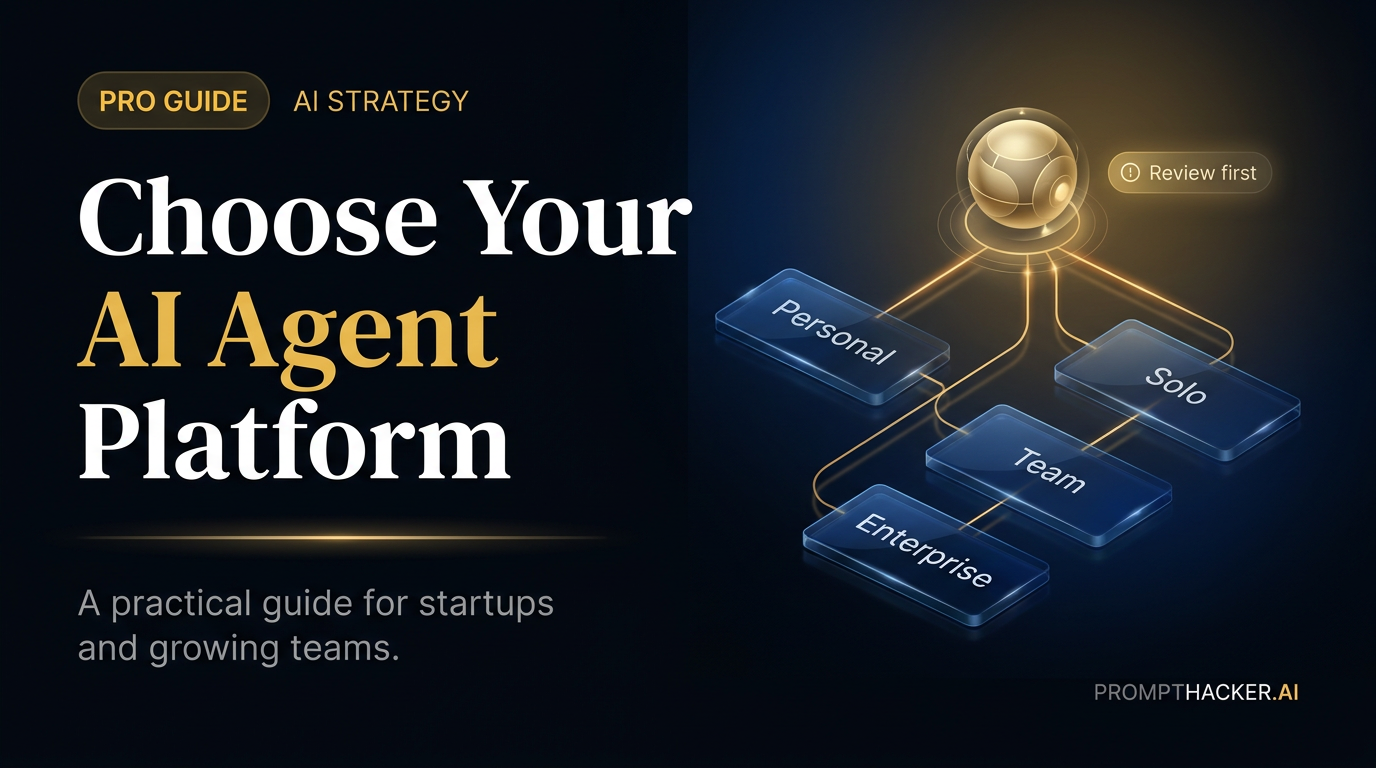
What matters today
A practical 2026 guide to choosing the right AI agent platform, model ecosystem, framework, or workflow builder for a growing team.
Key points
- What is an AI agent platform?
- Do not compare these layers as if they are competitors
- The 2026 changes worth putting on the calendar
- Start with the job, then choose the layer
- The enterprise platform layer
What you'll learn
- Why an agent platform, a model, a framework, and a workflow builder answer different buying questions
- What changed across Google, AWS, Microsoft, OpenAI, and Anthropic in 2026
- The smallest sensible starting path for a 20-person company, a solopreneur, and a corporate team
- A 30-day test plan that creates a real decision instead of another AI experiment
Most AI agent buying advice fails before it names a product. It puts a cloud platform, a language model, a coding framework, and a drag-and-drop automation tool in the same comparison chart. That makes a useful choice look like a popularity contest.
A 20-person company does not need the same thing as a bank building an internal agent program. A founder who wants a cleaner weekly client brief does not need the same thing as a developer who needs custom tools, long-running jobs, and a deployment environment. The right starting point is the smallest layer that can finish the work safely.
That sounds obvious, but it changes the shortlist. Start with the work, the data the agent needs, the human review point, and the person who will own a failure. Only then should you compare products.
What is an AI agent platform?
Direct answer: An AI agent platform is the layer that gives an AI model access to tools, data, permissions, memory, and a way to take or propose actions. The model is the reasoning engine. The platform is the vehicle, the controls, and the rules around it. A framework gives developers parts to build that vehicle. A workflow builder gives a team a visual way to assemble repeatable steps.
The engine-versus-car metaphor is useful because it explains a common mistake. GPT-5.6 Terra, Gemini 3.5, Claude Sonnet 5, and other models can power work. They do not, by themselves, decide which files they may read, which system they may update, or who needs to approve an outbound action. The product around the model determines much of that experience.
A platform can also be too much. If an executive wants a recurring meeting brief from a defined set of documents, a native AI surface plus a strong prompt and a review step may be enough. Building a custom agent for that job can add cost, security work, and maintenance without making the brief better.
Do not compare these layers as if they are competitors
Category map
The category map that prevents a bad shortlist
Compare each layer by the job it does, not by a generic best score.
| Layer | Decision it supports | Do not treat it as |
|---|---|---|
| Enterprise platform | How a company builds, governs, and runs agents | A personal productivity app |
| Work surface | Where people delegate work in the tools they already use | A custom agent runtime |
| Model ecosystem | Which reasoning and cost profile fits a task | A complete workflow |
| Framework or builder | How a technical or low-code team assembles a repeatable process | A direct replacement for an enterprise platform |
Important: This is a map, not a ranking. A workflow builder is not a weaker version of an enterprise platform. It solves a different problem. A model family is not a ready-made internal agent program. Treating all five layers as one market is how teams buy too much, too early.
The 2026 changes worth putting on the calendar
2026 watch dates
Three dates that change the shortlist
Track deadlines and launches that change an active buying or migration decision.
- June 16Copilot Cowork GA
Microsoft makes the work surface broadly available.
- July 9GPT-5.6 GA
OpenAI releases Sol, Terra, and Luna.
- July 30AWS cutoff
Bedrock Agents Classic stops accepting new customers.
- NowChoose the layer
Put the task and review boundary ahead of the vendor demo.
Several current changes alter the shortlist. The point is not to chase every launch. It is to know when an existing plan has a deadline or when a familiar product now belongs in a different category.
June 16, 2026
Microsoft Copilot Cowork reaches general availability
This matters most for teams already working inside Microsoft 365. It moves Cowork from a launch to a real procurement and training conversation.
July 9, 2026
OpenAI makes GPT-5.6 Sol, Terra, and Luna generally available
The useful distinction is simple: Terra is OpenAI's balanced tier for everyday work. OpenAI lists Terra at $2.50 per million input tokens and $15 per million output tokens.
July 30, 2026
AWS stops accepting new customers for Bedrock Agents Classic
AWS directs new advanced deployments toward AgentCore. If a team has an old Bedrock Agents plan in a slide deck, this is a migration decision, not a cosmetic name change.
Start with the job, then choose the layer
Decision ladder
Pick the smallest layer that can finish the job
More ownership and operating effort does not mean a better answer.
- 01Personal task
Use a native surface, a narrow source set, and draft-only output.
- 02Solo workflow
Configure a repeatable sequence only after the task proves useful.
- 03Team workflow
Keep permissions, files, and review where the team already works.
- 04Enterprise program
Build for formal ownership, many users, and important systems.
The path gets more involved from left to right. It does not get automatically better.
The practical decision ladder
One owner, narrow source set, draft output, human review.
Same trigger, same inputs, repeatable draft, simple exception path.
Shared files, shared permissions, named reviewers, and a clear place where work happens.
Many users, important systems, custom tools, formal ownership, and ongoing operational work.
The bars show increasing ownership and operating effort, not product quality. A longer bar does not mean a better choice.
The enterprise platform layer
Google: Gemini Enterprise Agent Platform
Google now calls the former Vertex AI surface the Gemini Enterprise Agent Platform. Its public product page groups Agent Platform, Agent Studio, Model Garden, the Agent Development Kit, Gemini 3.5, and third-party or open models under one larger enterprise AI environment. That matters when a team needs model choice, custom work, and governance in the same conversation.
A corporate strategist should look here when the organization already depends on Google Cloud and wants a standard place to build, evaluate, deploy, and govern custom agents. A non-engineer executive should not begin by learning every component. Begin with the business workflow. Bring in the advanced platform only when a native tool cannot provide the required control or integration.
AWS: AgentCore replaces the new-build path for Bedrock Agents
AWS has renamed its older offering Amazon Bedrock Agents Classic and says it will not accept new customers after July 30, 2026. AWS points customers who need the newer path toward AgentCore. Put that deadline in the migration plan before committing new build work to the older surface.
For an AWS-native company, the real question is less about a model bake-off and more about where the agent will run, which systems it can call, and how the team will own it after launch. AgentCore belongs in a platform conversation. It is not a casual substitute for a single executive workflow.
Microsoft: Copilot Cowork for work already living in Microsoft 365
Microsoft announced general availability for Copilot Cowork on June 16. The practical attraction is proximity: teams that already work in Microsoft 365 can evaluate delegation where files, meetings, and collaboration already happen. That reduces a familiar adoption failure, where an excellent agent lives in a separate tab no one remembers to open.
For a 20-person company, start with one internal task that ends in a reviewable draft. A project update, a decision memo, or a meeting follow-up works. Do not begin with permissions that can send, delete, publish, or change customer records. The first win should be useful and boring.
The model and builder layer
When a team needs a custom agent, the platform is only part of the choice. It still needs a model and a build path. Keep those decisions separate. The model determines how the work is reasoned through. The build path determines how a team creates tools, handles state, reviews outputs, and maintains the workflow.
OpenAI's current build story includes the Responses API and Agents SDK. The SDK works with the Responses API and can work with models from other providers. That is useful for a technical team that wants flexibility, but it still creates a product and ownership job. OpenAI has also published an Assistants API migration guide, with the old API scheduled to shut down on August 26, 2026. Do not start a new build on a path that already has a documented exit date.
Anthropic's model overview lists Claude Fable 5, Claude Opus 4.8, Claude Sonnet 5, and Claude Haiku 4.5. It also documents a spectrum of capability, speed, and context. Treat that list as a routing choice, not a trophy cabinet. Use a smaller or faster tier when the task has a clear review boundary. Bring more capability to work where the cost of a weak first draft is high.
For teams working in Slack, Anthropic's Claude Tag is another work-surface example. It is not a reason to rebuild every process around a new model. It is a reason to test whether a named, reviewable task inside an existing collaboration channel gets completed better than the old handoff.
Four paths that cover the people who will read this guide
Reader paths
Different readers should start in different places
The right starting path follows the work and the person who owns the result.
Decide identity, access, monitoring, approvals, and ownership before a platform choice.
Use an existing work surface before funding a custom build.
Automate a clear before-and-after workflow, not the whole business.
1. The corporate AI productivity strategist
Start with the operating model: identity, data boundary, tool access, human approvals, monitoring, and a named owner. Then evaluate an enterprise platform such as Gemini Enterprise Agent Platform, AgentCore, or the Microsoft environment your company already uses.
Avoid: a consumer-style "best agent platform" ranking. Success: one governed deployment path for a real business process.
2. The non-engineer executive at a 20-person company
Pick one task that ends in a draft: a weekly update, meeting brief, pipeline summary, or research memo. Use the work surface your team already pays for. Give the agent only the files it needs. Review the output yourself twice before inviting the team.
Avoid: frameworks, infrastructure, and autonomous actions on day one. Success: a repeatable draft that saves time without creating an IT project.
3. The solopreneur
Choose a recurring workflow with a visible before-and-after. Lead qualification, proposal preparation, client research, and content repurposing are better starts than a general "business agent." Use a workflow builder only when the sequence repeats enough to justify maintenance.
Avoid: multi-agent complexity before the simple process works. Success: one workflow that produces an accepted output with less cleanup.
4. The writer who has to explain this to everyone else
Use one vocabulary throughout. A model reasons. A platform governs and runs agents. A framework gives builders code-level control. A workflow builder helps people assemble repeatable steps. Readers can repeat those four lines in a meeting.
Avoid: treating agent, assistant, copilot, and workflow as interchangeable. Success: an executive can explain the decision without a glossary.
A 30-day rollout that creates evidence
The first month should not end with a strategy deck. It should end with one decision: keep, narrow, change, or stop. This plan works whether the team is testing a native work surface or a custom build.
Week one: choose one narrow job
Pick a task with defined inputs and a draft output. Record the manual time, the acceptable output, and the action the agent must never take.
Week two: run the same job twice
Use a fixed source set and the same review rule. The second run reveals whether the prompt and process are repeatable or merely impressive once.
Week three: measure accepted output
Count minutes saved, missing facts, human edits, and review confidence. A fast draft that needs a long repair session did not save time.
Week four: write one operating rule
State who uses the workflow, what data it may touch, which model or surface is approved, where it stops, and who reviews it. If the rule cannot fit on one page, the first workflow is too broad.
Design the review boundary before the integration
The cleanest early agent designs put a person at the precise moment where a mistake becomes expensive. That is not the same as making someone read every token the system produces. It means deciding what a person must approve before an agent sends a message, changes a record, spends money, grants access, or publishes something under the company name.
For a 20-person company, the boundary can be almost embarrassingly simple: the agent writes the weekly customer update, the account lead reads it, then the account lead sends it. The agent can propose calendar follow-ups, but it cannot create them. It can summarize the pipeline, but it cannot change the forecast. Those limits are useful product requirements, not signs that the team lacks ambition.
For a corporate program, write the same idea in more operational language. State the identity used by the agent, the data sources it can read, the tools it can call, the action classes that need approval, the audit record to retain, and the named business owner. The security team needs these details. So does the executive who will explain a bad result to a customer or the board. A vendor demo rarely forces this clarity, which is why teams should bring the questions with them.
For a solo business, the boundary protects attention. An agent that prepares a proposal draft from a client call and your standard service menu can be useful. An agent that invents a price, sends the proposal, and promises delivery dates while you are asleep is a different business decision. Keep the human review where judgment, relationship context, or cash is involved. Automate the repeatable preparation around that judgment first.
A useful test: Could a new teammate explain, in one minute, what the agent may read, what it may do, what it may only draft, and who gives the final approval? If not, the workflow needs a tighter boundary before it needs another integration.
This is also how to read product claims about autonomy. More autonomous usually means the system is allowed to take more steps without an immediate prompt from a person. It does not automatically mean it understands the business better, has earned more permission, or has a lower error rate. Ask the vendor to show the approval screen, exception path, and record of an action, not only the polished happy path. Those three details tell you whether the product is ready for a real workflow.
Measure the cost of the whole workflow
Accepted-output scorecard
Measure accepted output, not draft output
A model price is only one part of the workflow cost.
| Measure | Track it | Decision signal |
|---|---|---|
| Accepted output | Did the reviewer use the result? | Shows whether the agent finished a useful job |
| Review minutes | Time spent checking and repairing | Shows whether expert time actually fell |
| Exceptions | Runs that needed intervention | Shows whether the workflow can repeat |
| Maintenance | Prompt, connection, and model updates | Shows whether the team should keep owning it |
Token price is one part of an agent's cost. A cheap model can create expensive work when a senior person has to repair every output. A higher-priced model can be the practical choice when it produces a cleaner draft, cites the right sources, and cuts review time. The number that matters is the cost per accepted output.
This is where the original article's long model-price tables needed more context. Exact prices change, prompts vary, and agent runs can call tools or use several model turns. Use vendor pricing pages to estimate a specific workload. Then compare that estimate with the human time spent checking and cleaning the result.
A simple example makes the point. Say a founder spends 45 minutes assembling a weekly partner brief. An agent produces a first draft in minutes, but the founder then spends 35 minutes correcting missing context and reorganizing the structure. The agent helped a little, but it did not yet earn broader access. Narrow the source set, specify the format, and run it again before adding more tools.
Now take the same brief after the workflow has clear inputs, a fixed structure, and a stop rule. If review drops to ten minutes and the brief stays usable for several weeks, the team has evidence to keep it. That is a stronger business case than an impressive demo or a benchmark screenshot.
Make a clear go, narrow, or stop decision
Keep the workflow when two reviewed runs produce an accepted output, save meaningful human time, and stay inside the agreed data boundary.
Reduce the source set, output format, or permitted action when quality is close but review remains heavy. Most early agent wins come from narrowing a vague job.
Stop when the workflow cannot preserve the source boundary, creates hidden errors, or saves no review time. Stopping a bad pilot is good management, not a failed AI strategy.
The habit to build is decision discipline. Teams get better results when they promote a workflow because it has earned trust on real work, not because the vendor's newest feature sounds more autonomous.
The questions to ask before a demo
- What work should this finish? Name the input, output, and person who accepts the result.
- Where does the work already happen? Start in the environment where the files, collaboration, and approvals already live.
- What is the review point? The agent should create a draft or request approval before an action that affects customers, money, security, or records.
- Who owns the bad outcome? If no person owns an incorrect or unsafe result, the team is not ready to automate that task.
The answer can be a simple work surface, a model API, a workflow builder, a developer framework, or a full enterprise platform. The important part is that the answer follows the task. It should not follow the loudest launch of the month.
A quick reality check helps. If a team cannot name the first workflow, the source files, and the reviewer in one sentence, it is still shopping, not planning. Book another demo only after those three details are clear. The next product conversation will be shorter and much harder for a vendor to steer toward features the team will not use.
Frequently asked questions
What is the best AI agent platform for a startup?
There is no useful single winner. Start with the work environment your team already uses and a narrow workflow that ends in a draft. Move to a custom platform only when a native surface cannot supply the data access, controls, or repeatability the job needs.
What changed with AWS Bedrock Agents in 2026?
AWS now calls the earlier product Bedrock Agents Classic and says it will stop accepting new customers on July 30, 2026. New advanced deployments should evaluate AgentCore instead.
Is GPT-5.6 Terra a platform?
No. Terra is the balanced model tier in OpenAI's GPT-5.6 family. A team can use it inside an agent build, but the model alone does not provide the workflow, permissions, and review process that an agent platform requires.
Should a solopreneur use multi-agent workflows?
Only after a simple workflow has a proven bottleneck. Start with one job, one source set, one output, and one review step. Add another agent or more orchestration only when the simpler version fails for a specific reason.
Primary sources
This guide relies on current vendor documentation for product names, release dates, and stated capabilities. Product availability, pricing, and terms can change.
Action steps summary
- Name one job. Choose a recurring task with a clear input, draft output, and human reviewer.
- Choose the narrowest layer. Use a native surface for a personal task, a workflow builder for repetition, a framework for a custom build, and an enterprise platform for a governed program.
- Run two reviewed tests. Compare accepted output, cleanup time, source control, and risk behavior.
- Write a one-page rule. State the approved task, access boundary, stop point, reviewer, and owner before expanding use.
Three deep dives. Four useful moves. One email worth opening.
PromptHacker turns the AI firehose into practical next steps for work, health, family, and everything time keeps trying to steal.