PH PROMPTHACKER.AI

The Busy Investor's Guide to Investing With AI

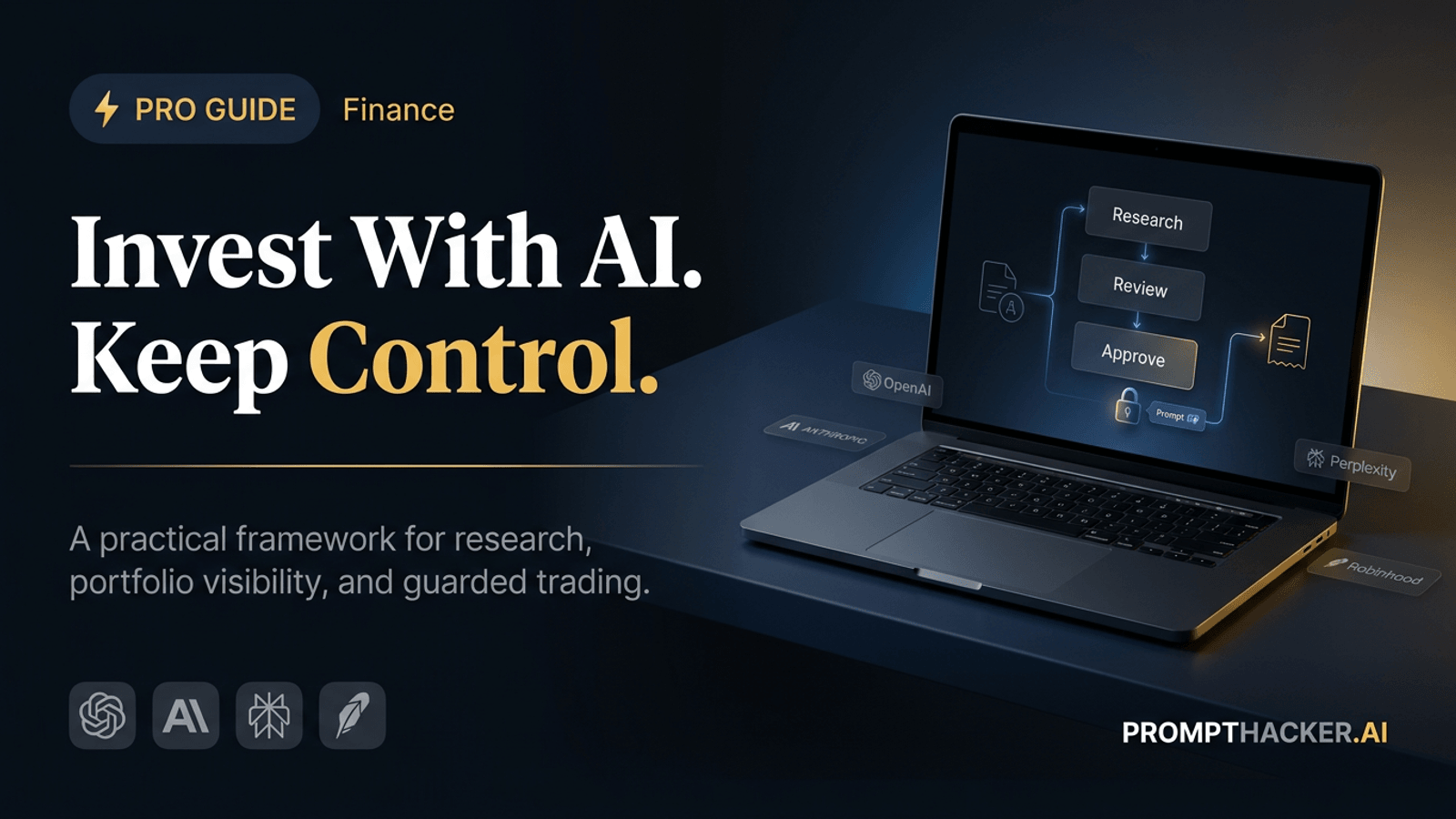
The practical, source-backed route to use AI for investment research, read-only portfolio context, and tightly controlled execution.
July 12, 2026 14 min read
The Busy Investor’s Guide to Investing With AI
Quick Scan

What matters today

A practical, source-backed guide to using Claude, ChatGPT, Codex, Perplexity, Robinhood, and AI agents for investing with less manual work and more control.

Format PRO GUIDE
Audience Executives using AI at work
Time 14 min read
Topic finance

Key points

  • What you'll learn
  • Rules of the road
  • Your permissions are part of the investment decision
  • The capability map: what each tool can do now
  • Do not set up every tool in one sitting

Article roadmap

What you will learn

  1. Which AI tools can research, which can see your portfolio, and which can place an order.

  2. A minimal first setup that removes research busywork without putting an agent in charge of your core account.

  3. How Robinhood's new agentic account works with Claude Desktop, ChatGPT, Codex, and other MCP-capable tools.

  4. A tighter route for active stock and options traders that keeps a review gate between AI analysis and real money.

Most investing admin is not investing. It is opening five tabs, scanning a headline you do not trust, trying to remember why you bought something, and then doing nothing because the information arrived too late or in the wrong shape.

AI can remove much of that friction. It can pull together a cited earnings brief, explain a portfolio's current shape, surface a catalyst you should inspect, and turn your own rules into a repeatable review. It cannot make the uncertainty disappear. It also cannot turn a good prompt into a fiduciary duty.

The useful question is not, "Which AI will pick my stocks?" The useful question is, "Which parts of my investing process should become faster, and where must I still slow down?" The answer is a three-rung ladder: research, read-only visibility, then tightly constrained execution.

Rules of the road

Use AI to organize evidence, surface questions, and enforce your written process. Do not use it as the sole basis for an investment decision. Every important answer needs a source, a date, and a reason it could be wrong.

An MCP is simply a standard connector that lets a compatible AI tool request approved information or actions from another service. It is not a magic permission slip. When you connect one to a brokerage, treat the AI as a third party with access to the data and authority you grant.

Your permissions are part of the investment decision

Connecting an account is not an ordinary software preference. It changes who can see balances, positions, transactions, and sometimes account identifiers. Use the official connection flow inside the product, not a pasted credential request in a chat. Review the specific access screen before you approve it, and do not assume that a familiar AI brand makes every connected service interchangeable.

Start with the smallest useful permission. For a research workflow, that may mean no account connection at all. For a read-only review, it may mean balances and portfolio context. For an execution-capable agent, it means one separate account, a written cash cap, a narrow asset list, and an explicit rule about whether the agent may only draft an order or can ever submit one. Those constraints are not technical decoration. They determine the downside when the model, the data, or your instruction is wrong.

Set a calendar reminder to revisit every financial connection after the first month, then quarterly. Remove a connector you no longer use. A forgotten finance integration is not passive. It is an account relationship that still deserves an owner.

Automation ladder

The executive automation ladder

Research first, read-only visibility second, and constrained execution only when you can supervise it.

01 | ResearchClaude and Perplexity

Use cited filings, earnings calls, and counterarguments to prepare questions. No brokerage connection needed.

02 | VisibilityChatGPT Finances

Review connected financial context and portfolio shape. It cannot move money or execute a trade.

03 | ExecutionRobinhood Agentic Trading

Use a dedicated, capped account with review gates. This adds authority and risk, not automatic wisdom.

The capability map: what each tool can do now

These products overlap less than their marketing makes it seem. ChatGPT Finances is a portfolio-and-household-money view. Claude and Perplexity are research surfaces. Robinhood Cortex is a plain-language market digest. Robinhood Agentic Trading is the one route in this guide that can execute an order, and it does so only in a dedicated Agentic account.

Current capability map

Consumer AI investing capabilities, July 2026

Availability changes by account, geography, and phased rollout. Confirm the feature visible in your account before you connect data or authority.

ToolUse it forCan it execute?Availability note
ChatGPT FinancesRead-only financial context, allocation, and holding changesNoPhased for eligible U.S. Plus and Pro users
Claude with web searchCited thesis checks, earnings, and market researchNot by itselfResearch surface until separately connected to a brokerage MCP
Perplexity FinanceSEC filings, transcripts, historical data, and researchNoCurrent finance features are available in its research surfaces
Robinhood CortexPlain-language market and portfolio digestsNoInformational only, not a research or trade recommendation
Robinhood Agentic TradingResearch, order review, and documented long equity or options ordersYes, in a dedicated accountRolling out. Eligibility and account access vary.

Do not set up every tool in one sitting

The lowest-effort route is one tool for one decision, not a four-product stack. Pick the friction you actually have. If you keep postponing earnings research, start with Perplexity. If you cannot explain your current allocation without opening several accounts, check whether ChatGPT Finances is available. If you already write investment theses, add Claude as the skeptical reader. Each of those can be useful without any trading connection.

Only consider an execution-capable agent after the research loop has proven that it saves you time and you can state your account boundary in writing. A good first setup is usually a 30-minute research experiment plus a later weekly review. It may take longer for a complex household, taxable account, or options workflow. That is appropriate. Due diligence should not be optimized into a timer.

The lowest-manual-work setup for a long-term investor

For most busy Executives, the right first move is not an agent that trades. It is a weekly review that turns portfolio sprawl and current research into one calm, source-backed decision memo. That saves time without creating a new failure mode.

1. Connect read-only context where it is available

ChatGPT Finances is the cleanest portfolio-visibility option in this set. Eligible U.S. Plus and Pro users can connect supported accounts through Plaid, then ask about spending, net worth, portfolio distribution, and daily changes in stock and ETF holdings. The useful distinction is simple: OpenAI says the product cannot move money, change an account setting, make a trade, alter retirement contributions, or open and close accounts.

That limitation is a feature for this job. Use it to see the shape of your finances and prepare better questions. Do not use it as a reason to hand over a portfolio decision to a chat window.

Using the connected portfolio distribution and holding data, create a structural summary of my portfolio. Show allocation by asset class and sector, concentration areas, and changes since the prior review. Do not give buy, sell, or hold recommendations. Flag only questions I should research before I make a decision.

2. Put Perplexity on filing and transcript duty

Perplexity is strongest when you need an evidence trail quickly. Its Finance surface now searches SEC filings directly, links into finance Spaces, and exposes historical U.S. equity price and volume data. The S&P 500 Transcripts Space covers more than 5,600 transcripts from the last two years. Its Research and Labs experiences can use real-time pricing, volume history, and financial-statement data.

That is not a reason to ask for a winner. It is a reason to stop reading a 10-Q as if it were a scavenger hunt. Ask the model to name the page, date, call, and source behind every claim. Then read the primary source for anything material.

For [TICKER], search the last two quarters of earnings-call transcripts and the latest SEC filings. Build a cited table with: management's three repeated priorities, changes in capital spending or margins, the clearest risk factors, and the original source for each point. Do not provide a rating or price target.

3. Use Claude to argue against you

Claude with web search is a good counterweight to a thesis you already like. Anthropic documents web search with citations and specifically identifies current market data, earnings reports, and industry trends as a financial-analysis use case. Claude alone is a research assistant. It does not become a brokerage just because its answer sounds confident.

Stress-test this thesis: [PASTE THESIS]. Search for recent filings, earnings commentary, regulatory changes, and industry data that would contradict it. Separate sourced facts from inference. Give me the three strongest disconfirming arguments, the date of each source, and what evidence would resolve the disagreement. Do not recommend a trade.

If you want one reusable prompt instead of a collection of templates, use this executive brief. It works in Claude or Perplexity and gives you one clean reading packet before you decide whether the topic deserves more time.

Create a five-minute executive brief on [COMPANY, ETF, OR THEME]. Use primary sources where possible. Separate verified facts, market commentary, and your inference. Include a bull case, bear case, open questions, source dates, and the one document I should read next. Do not make a buy, sell, or price-target recommendation.

Focused review

A focused weekly review

Keep the process bounded. The goal is a repeatable decision memo, not a superficial speed run.

  1. MondayReview the portfolio shape

    Use a read-only allocation summary to identify concentration and questions, not trade instructions.

  2. Earnings dayPrepare a source memo

    Use filings and transcripts to document what changed, the source date, and the missing evidence.

  3. Before a changeStress-test the thesis

    Ask for the strongest counterargument, then verify the cited sources yourself.

  4. After a decisionLog the reason and review date

    Record the decision, size, and invalidation condition in your own words.

When you move from research to execution, slow down one more time. Do not paste a research answer from Claude, Perplexity, ChatGPT, a newsletter, or social media directly into an execution-capable agent. Treat every AI-generated summary as untrusted input until you verify the cited source. Web pages can also contain malicious instructions designed to influence an AI agent, often called prompt injection. Keep research and trading authority separate, and review the exact order details yourself.

What “least manual work” should mean in practice

The goal is not to turn your portfolio into a high-frequency experiment. It is to remove the repeated clerical work that keeps an informed investor from reviewing the right evidence. A useful AI workflow should compress collection and comparison, not compress judgment. If an answer cannot show its source, date, and scope, it has not saved you work. It has created a verification task.

Start with recurring questions that have a stable shape: What changed in the last quarter? What did management repeat across two earnings calls? Where is my portfolio concentrated? What evidence weakens my thesis? These questions work because you can compare each answer to the previous review and see whether the process is improving. They also create a clean audit trail of what you considered before a decision.

Do not automate the things that require your personal circumstances or a regulated professional’s judgment: taxes, liquidity needs, an estate plan, your risk capacity, retirement timing, or whether a loss changes your overall plan. The best workflow leaves those decisions with you. It lets the software carry the documents, the timestamps, and the first draft of the questions.

Robinhood Cortex and Agentic Trading are not the same product

Robinhood Cortex Digests use AI to summarize factors that may affect an asset price or your portfolio. Robinhood is explicit that the digests are informational and should not be treated as research or a recommendation to buy, sell, or hold. This makes Cortex useful as a prompt to investigate, not as a signal to execute.

Robinhood Agentic Trading is different. It lets a third-party AI agent connect through Robinhood's Trading MCP to a separate self-directed Agentic account. Robinhood's current support pages list connection paths for Claude Code, Claude Desktop, ChatGPT, Codex, Codex CLI, Cursor, Grok, and other MCP-capable platforms. The product is rolling out, so not every eligible customer will see it.

Official product image

Robinhood Agentic Trading

Official product image from Robinhood’s May 27, 2026 announcement.

Official Robinhood Agentic Trading product image
Official Robinhood product image. Source: Robinhood’s May 27, 2026 Agentic Trading announcement.

What makes the design more responsible than an unofficial trading bot is account isolation. The agent can access account, position, balance, and transaction information, but it can only place trades in the dedicated Agentic account. Robinhood also describes activity tracking, P&L, notifications, and a disconnect control. Those guardrails reduce blast radius. They do not remove market, model, implementation, or monitoring risk.

The critical distinction

An AI agent can be instructed to act without asking you every time. That is not a convenience setting to enable casually. Robinhood warns that agentic trades can execute without direct input on each transaction, that agents can make errors or use incomplete information, and that you remain responsible for reviewing account activity. Treat the review gate as your default.

The controlled route for active stock and options traders

There is a real use case for an agentic account: a trader with a documented process who wants less manual checking, not less responsibility. Robinhood's current support documentation says agents can place long equity and options orders and can access real-time quotes, technical indicators, earnings, watchlists, scans, and order-review tools. The launch announcement first described an equities-only beta, so the current support page is the stronger source for present order types.

Options require a higher bar. They can lose value rapidly and involve contract mechanics, implied volatility, liquidity, expiry, and assignment risk that an AI summary cannot make simple. If you cannot independently read the contract, payoff, and maximum loss, restrict any agentic experiment to research or a pre-trade review for long equities. Do not let an agent choose an options structure, expiry, or position size for you.

For an options review, require the exact option symbol, strike, expiry, number of contracts, debit or credit, maximum loss, breakeven, and current bid-ask spread. If the agent cannot provide those fields from current data, stop at research. Do not accept a generic payoff description in place of the actual contract details.

Do not start by trying to automate a strategy. Start by asking an agent to prepare a pre-trade review that you must approve. That still eliminates a large portion of the repetitive work: gathering the price, checking the contract or share order, calculating the total exposure, and putting your own stated thesis beside the trade ticket.

Execution controls

Start with controls, not a strategy

Use a separate account, a fixed experimental balance, explicit confirmation, and a firm disconnect rule.

ControlStart settingReason
Account scopeSeparate Agentic account with a fixed experimental balanceLimits the effect of an error, misunderstood instruction, or bad data.
Order authorityPre-trade review and explicit confirmation for each specific orderLets you inspect the actual contract or share order before execution.
Asset scopeA named ticker or a short written watchlistStops an open-ended request from becoming a portfolio-wide change.
Stop ruleDisconnect after an unexplained order, data issue, or policy violationRemoving authority is the fastest response to a broken automation.

You are connected to my Robinhood Agentic account. Follow this policy exactly: 1. Analyze real-time quotes, indicators, and earnings data only for [TICKER OR WATCHLIST]. 2. Prepare a pre-trade review that states order type, quantity, total exposure, source timestamps, thesis, invalidation condition, and material risks. For an options order, include the symbol, strike, expiry, contract count, debit or credit, maximum loss, breakeven, and current bid-ask spread. 3. Do not place, modify, or cancel an order until I explicitly approve the specific reviewed order in this chat. 4. Do not broaden the watchlist, use another asset class, bypass a safeguard, or infer permission from an earlier approval. 5. If data are stale, a connection fails, or any instruction conflicts with this policy, halt and ask me what to do.

This is deliberately conservative. It is also where the time savings are. You no longer need to collect the same inputs by hand. You still own the moment of execution. If you cannot monitor the agentic account, do not use an execution-capable setup that day.

A simple decision tree for the next 30 days

Choose your route

  • 1 Need a cleaner research process? Start with Perplexity for filings and Claude for a counterargument memo. No account connection required.
  • 2 Need a clearer financial picture? If it appears in your account, use ChatGPT Finances for read-only context and a weekly allocation review.
  • 3 Need an active-trading assistant? Use Robinhood's Agentic route only after you can state the account cap, approval rule, allowed assets, and stop rule in one sentence each.

What AI should never decide for you

Do not ask a model to set your risk tolerance, emergency-fund target, retirement contribution, tax strategy, or whether you should take on leverage. Do not treat a cited answer as a verified answer. Citations can be stale, irrelevant, or selectively framed. Read the source, especially when the answer would cause you to sell, borrow, exercise an option, or materially change your allocation.

The SEC, NASAA, and FINRA jointly warn that AI-generated information can be inaccurate, incomplete, misleading, or fabricated. FINRA separately warns that even auto-trading offered through regulated entities requires active monitoring. Guaranteed returns and claims that an AI bot cannot lose are red flags, not product features.

Financial safety note

This guide is educational information, not individualized investment, legal, or tax advice. Investing involves risk, including possible loss of principal. Consider a qualified financial, tax, or legal professional before making a decision with material consequences.

Your one-page action checklist

  • Choose one job. Start with an allocation review, an earnings memo, or a thesis stress test. Do not connect an execution agent because a demo looks clever.
  • Require sources and dates. Make every research prompt ask for primary links and timestamps.
  • Make the read-only route useful. If ChatGPT Finances is available, use it to describe your portfolio before you ask any tool to discuss a security.
  • Keep Robinhood Cortex in the research bucket. A digest can create a question. It should not create an order.
  • If you use Agentic Trading, isolate it. Separate account, fixed funding cap, narrow watchlist, pre-trade review, immediate disconnect rule.
  • Review the review. Every week, compare what the AI said, what you did, and what actually happened. If the agent creates more noise than clarity, remove access.

Source register and availability note

Products and access rules move quickly. This guide reflects official documentation checked July 12, 2026. Confirm the features visible in your own account before you connect data, pay for a plan, or delegate any order authority.

Primary sources

Primary sources checked for this guide

Product access and rules move quickly. Confirm the features visible in your own account before you connect data, pay for a plan, or delegate any order authority.

Bottom line

Test one narrow workflow before you spend serious money. Keep the route only if it improves a decision, saves time, or gives your team clearer output.

About the author

Pierre Bradshaw Founder, PromptHacker.ai

Pierre has spent 25+ years building growth systems across fintech, real estate, lending, campaigns, and AI workflows, with machine-learning work dating back to 2012.

Email us
Free weekly briefing

Three deep dives. Four useful moves. One email worth opening.

PromptHacker turns the AI firehose into practical next steps for work, health, family, and everything time keeps trying to steal.