Claude Becomes a Persistent Slack Teammate With Claude Tag
Whether Claude Tag applies to your plan, and the exact 4-step admin setup from Anthropic's own page
What matters today
Whether Claude Tag applies to your plan, and the exact 4-step admin setup from Anthropic's own page
Key points
- Who Can Actually Use This, and the 4-Step Setup
- The Permission Model, Precisely: Agent Identity
- What "Memory" and "Ambient Behavior" Actually Mean
- The Karpathy Debate: Both Sides, Fairly
- 3 Workflows Worth Testing This Week
What You'll Learn
- Whether Claude Tag applies to your plan, and the exact 4-step admin setup from Anthropic's own page
- How the "agent identity" permission model actually works, channel by channel, tool by tool
- The August 3 migration deadline and what happens if your admin does nothing
- Both sides of the Karpathy debate, presented fairly, not cheerled
- 3 workflows worth testing this week, with the exact @Claude message to type
Picture Tuesday afternoon. A Claude chat tab holds the market research from Monday. A separate Slack thread holds the engineer's question about the same feature. A third tab holds a second AI session where someone pasted half the context for another opinion. None of the three know about each other, and re-explaining the project to each one eats 15 to 20 minutes before any real work starts.
That gap between where AI lives (a chat window) and where the team actually works (Slack) is why most AI adoption plateaus at "one person's productivity hack" instead of something the whole team relies on. If the assistant cannot see what the channel already knows, every request starts from zero.
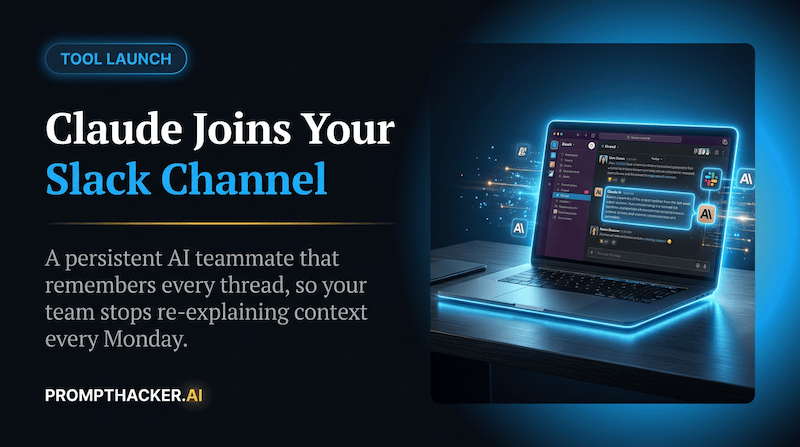
Anthropic's answer, launched June 23, 2026, is Claude Tag: a single Claude identity that lives inside a Slack channel, remembers what happened there, and takes on tasks anyone types after @Claude. It is not available on individual Pro or Max plans; it requires a Claude Team or Enterprise subscription, so Executives should know within the first minute whether this applies to their workspace at all. The setup, permission model, and honest tradeoffs are worth 10 minutes before deciding.
Who Can Actually Use This, and the 4-Step Setup
Claude Tag is in beta today for Claude Team and Enterprise customers only. If you pay for individual Pro or Max seats, this will not appear no matter how Slack is configured; it is built around admin-level controls for tool access, spend limits, and audit logs that only exist on the business tiers.
For Team and Enterprise admins, there is a real deadline. Anthropic is retiring the older Claude in Slack app entirely. Admins who do not migrate within 30 days of launch (roughly by July 23) still get auto-migrated to Claude Tag on August 3, 2026, with a default configuration instead of one chosen deliberately. Waiting does not avoid the change; it only removes the choice of how it happens.
Anthropic's launch page lists four setup steps, designed to take under an hour.
Pair Claude Tag with the workspace
Connect it to Slack so it can post messages, read permitted history, and appear in threads.
Give Claude access to tools
An admin defines a baseline "identity," a default set of tool connections and repositories at the workspace level, which every channel inherits, then overrides per channel: engineering gets GitHub and the data warehouse, a CRM connection stays confined to the sales team's private channel, legal documents stay away from everyone else. Public channels share one workspace identity; every private channel gets its own, with memory that never crosses over.
Set a monthly spend limit
Cap spend organization-wide and per channel, since tasks can run for hours unwatched.
Test in a private channel first
Bring in two or three teammates to surface a missing connection before the whole team hits the same wall somewhere that matters.
The Permission Model, Precisely: Agent Identity
The old Claude in Slack app acted on behalf of whoever tagged it, using that person's permissions, with no memory between conversations and no standing tool access. Claude Tag replaces that with what Anthropic calls "agent identity," an architectural change, not a marketing label. Claude does not borrow a human's login; it holds its own accounts in every connected system, posting in Slack as the Claude app, opening pull requests as the Claude GitHub App, and querying a data warehouse under a service account an admin provisioned in advance. Anthropic calls the security layer the Agent Proxy model: Claude never holds a person's credentials directly, infrastructure injects the right credential at request time from the service account tied to that channel's identity, each thread runs in its own sandboxed environment, and outbound network traffic defaults to blocked unless an admin explicitly allows a destination.
This matters because the old model breaks down once more than one person directs an agent. If three engineers and a product manager are debugging together, whose permissions apply when Claude reads a file on the team's behalf? There is no single right answer, so Anthropic moved the question from "what can this user do?" to "what can this agent do in this channel?", closer to how enterprises manage privileged service accounts than employee logins. One nuance: direct messages run on your individual account, using your own credentials, the right place for anything that should never live in a group channel, like a draft email.
What "Memory" and "Ambient Behavior" Actually Mean
"Memory" means Claude reads a channel's conversation history and retains facts, decisions, and context for future tasks in that channel: a roadmap explained across a dozen threads over three weeks carries into thread thirteen without anyone re-typing a summary. That memory is scoped strictly to the channel's identity, so information learned in a private legal channel cannot surface in a public engineering channel, even though the same underlying model runs both.
"Ambient behavior" is a separate, optional setting. Enabled, Claude does not wait to be tagged: it reads channel activity continuously and posts unprompted, flagging information or nudging a thread gone quiet without resolution. Off, Claude only acts when tagged, the safer starting point for a new channel. "Asynchronous task execution" means Claude does not require anyone to watch it work: assign a task and it breaks the work into stages, executes them with whatever tools the channel grants, and posts the finished result once done, sometimes minutes later, sometimes after hours in the background, and anyone in the channel can redirect it, since the work belongs to the channel, not whoever asked first.
@Claude pull last week's close rate and average deal size from the sales channel history, compare it against this week's numbers, and post a 3-bullet summary here by end of day.
The Karpathy Debate: Both Sides, Fairly
Claude Tag runs on Claude Opus 4.8, Anthropic's most capable public model, launched in late May 2026, since multi-stage asynchronous tasks only work if the model holds a coherent goal across many steps without losing the thread. Anthropic's launch post states that 65 percent of its product team's code is now created by its internal version of Claude Tag, including most of the code that built Claude Tag itself, a figure Anthropic self-reports and has not been independently audited.
65%
of Anthropic's own product team's code is now written by its internal version of Claude Tag, a self-reported figure not independently audited
That internal usage is part of why Andrej Karpathy, the former Tesla AI chief and early OpenAI researcher, posted on X the day Claude Tag launched, and it spread far past the AI industry's usual audience. His exact words: "This is a new paradigm for interacting with Claude that is significantly more 'inline' with all the other human activity org-wide." Once the engineering work across tools, integrations, memory, and security lands, he added, "Claude basically joins the team in a seamless way."
"Claude basically joins the team in a seamless way."
He called it the third major redesign of LLM interaction: first a website, second an app you download, third a persistent, asynchronous entity with org-wide tools and context, working alongside a team instead of waiting in a separate tab.
That framing is Karpathy's own read, not Anthropic's official language, and plenty pushed back hard. Skeptics called it overhyped marketing for what is, underneath the framing, a Slack bot with better memory that still only acts when tagged or when ambient mode is on, lacking the independent judgment that would make "teammate" more than a label:
- One quoted line: "It's a connector on steroids. Until the AI can go check a CRM record without me telling it to, it's just a bot."
- A critic going by Code Star put it sharper: "Why even use Slack at that point? Just have Claude talk to itself, tag itself, and build what it wants."
- On the r/ClaudeAI launch thread, some blamed the rollout for recent outages and called it a gimmick.
- A more structural critique came from Joanne Jang, who raised the "monotheistic" question: one shared Claude identity, or many specialized agents for different jobs? Claude Tag answers that one way, and not everyone agrees it is right.
On the enthusiastic side, the strongest defense did not come from Anthropic employees alone. Scott Stevenson, an external builder, argued that if Slack becomes where humans and AI agents collaborate by default, it could be one of the best acquisitions in tech history, since no generalized AI platform has solved multiplayer collaboration well. Both readings can be true. The mechanism is a real architectural departure from a stateless Slack bot; whether it earns "third paradigm of LLM UX" is a matter of taste.
3 Workflows Worth Testing This Week
The clearest way to evaluate Claude Tag is to drop it into work the team already does every week. Before trying anything below, tag it into a recurring Monday planning thread first and let memory build for a week or two: instead of someone spending 10 to 15 minutes copying last week's decisions into a fresh message, Claude answers from the channel's history, and any correction made in the thread becomes part of what it remembers next time.
1. Competitor monitoring in a dedicated channel. Create a private channel, grant Claude a web search connector and a competitive intelligence tool if the team already uses one, and ask it to run a standing check on a schedule instead of researching from scratch every time someone remembers to look.
@Claude check for any pricing page changes, new feature announcements, or press coverage from [Competitor Name] and [Competitor Name] since your last update in this channel. Post a 4-bullet summary and flag anything that affects our current positioning.
2. Meeting and board prep, built from what the channel already knows. Before a board call, tag Claude in the relevant channel and ask for an executive summary built from weeks of prior discussion, rather than pasting notes into a fresh chat and re-explaining who is who.
@Claude pull together an executive summary for tomorrow's board update: 3 wins from this quarter, 2 open risks discussed in this channel, and the specific numbers behind each. Keep it under 200 words.
3. Light, first-pass code review on a pull request diff. Grant the engineering channel's identity read access to the relevant repository, paste a diff or link a PR, and ask for a first pass before a human reviewer. This does not replace review; it catches obvious issues before a person spends time on them.
@Claude review this PR diff for obvious bugs, missing error handling, and anything that conflicts with patterns already used elsewhere in this repo. List findings by severity, most serious first.
Each takes under an hour to set up and test in a private channel before rolling out where the whole team can see it.
Is the Team or Enterprise Plan Worth It for This Alone
If you already run Team or Enterprise, Claude Tag costs nothing extra during the beta, and Anthropic is issuing launch credits so your whole team can test it first. The real cost is admin time: under an hour for setup, plus another hour or two scoping tool connections per channel before enabling ambient mode. For Executives on a lower plan, upgrading for this feature alone only pencils out if the workflows above map to real weekly work. On the time saved: a team spending even 15 minutes per person per day re-explaining context recovers well over an hour of collective time weekly for a five-person team, before counting tasks Claude completes on its own. For a team that lives in Slack all day, that makes this a low-risk test; for a team that barely uses Slack, the setup effort outweighs the benefit.
Action Steps Summary
1. Confirm your plan. Claude Tag only works on Team or Enterprise. Check your admin console before doing anything else.
2. Note the deadline. Migrate deliberately within 30 days of the June 23 launch, or Anthropic auto-migrates the workspace on August 3, 2026, with default settings you did not choose.
3. Run the 4-step setup. Pair with Slack, grant tool access at the workspace and channel level, set a monthly spend cap, and test in a private channel first.
4. Leave ambient mode off at first. Start with tag-only behavior until the team understands what Claude does with the access it has been given.
5. Test one recurring thread. Pick a weekly meeting or planning thread the team already runs and let Claude Tag build memory there for two weeks before judging it.
6. Try one workflow from this list. Competitor monitoring, meeting prep, or first-pass code review are the fastest paths to a real read on the time saved.
Three deep dives. Four useful moves. One email worth opening.
PromptHacker turns the AI firehose into practical next steps for work, health, family, and everything time keeps trying to steal.