PH PROMPTHACKER.AI

Add a confidence line to make AI answers reviewable

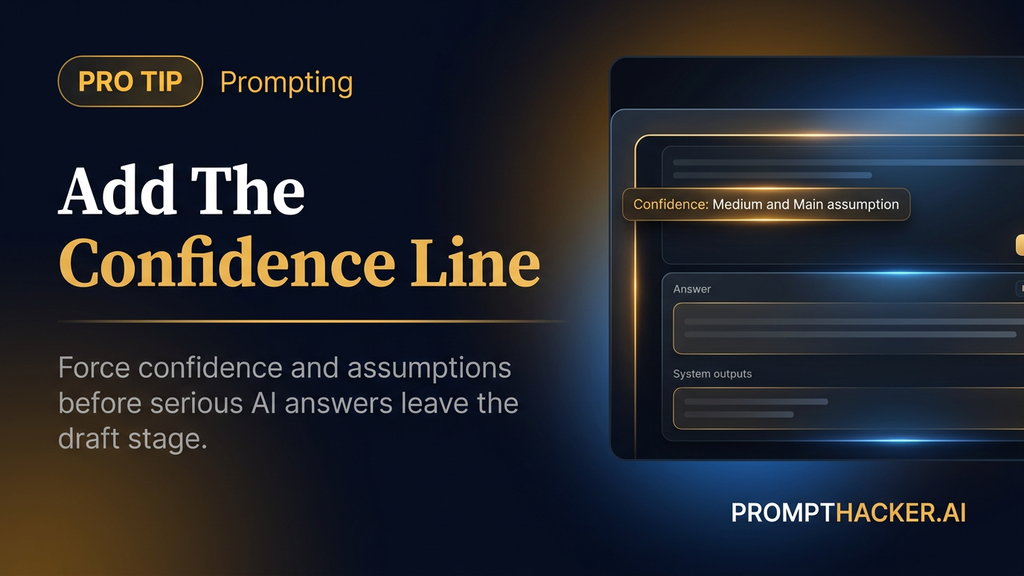
Force every serious answer to show confidence and assumptions before your team acts on it.
July 9, 2026 7 min read
confidence assumption prompt line
Quick Scan

What matters today

Force every serious answer to show confidence and assumptions before your team acts on it.

Format PRODUCTIVITY GEM
Audience Executives using AI at work
Time 7 min read

Key points

  • What you'll learn
  • The line
  • Why it works
  • Visual map: the review ladder
  • Research version

What you'll learn

  • The exact line to add to serious prompts
  • Why confidence labels reduce wasted follow-up
  • How to adapt the line for research, decisions, and agent work
  • How to train a team to use it without slowing down
  • When confidence labels are not enough

The most expensive AI mistake is not a bad answer. It is a confident answer built on a hidden assumption nobody sees until the work is already moving.

The fix is small. Add one sentence before the model answers: first state your confidence level and main assumption.

That one line makes the answer easier to review, easier to challenge, and easier to route to a human when the model is guessing.

The line

Add this to the end of any prompt where accuracy matters.

First state your confidence level as High, Medium, or Low and the main assumption you are making, then answer.

This does not make the model perfectly calibrated. It makes the review surface better. The value is not the label by itself. The value is the assumption the model has to expose before it gives the answer.

Why it works

Most AI answers are written to sound complete. That can be useful for speed, but it hides uncertainty. A confidence line creates a checkpoint before the answer. The model has to reveal whether it thinks the context is strong, partial, or weak.

The assumption line matters even more. If the assumption is wrong, the answer may still sound polished, but the reviewer knows where to look first.

Busy professionals benefit because the review path becomes obvious. Instead of rereading the whole answer, they can check the assumption, then decide whether the answer deserves attention.

Visual map: the review ladder

Review ladder showing confidence, assumption, answer, review, and action steps.

This is the point of the confidence line. It moves the weakest part of an AI answer above the polished answer, where a busy reviewer can catch it before acting.

Research version

Use this when the model is summarizing sources, market notes, or company updates.

First state your confidence level as High, Medium, or Low. Then state the main source gap or assumption. If confidence is Medium or Low, tell me exactly what source would improve the answer before you give the synthesis.

This version is useful for research because it separates the summary from the evidence problem. A source gap is not a writing issue. It is a decision issue.

Decision version

Use this when asking for a recommendation.

Before recommending an option, state your confidence level, the main assumption, the tradeoff that matters most, and what evidence would change your recommendation. Then make the recommendation.

That phrasing helps a team avoid fake certainty. The model must name the condition under which it would change its mind.

Agent version

Use this when an AI agent is doing multi-step work.

Before each major step, state your confidence level and the assumption behind the next action. If confidence is Low, stop and ask me for clarification instead of continuing.

Agents need stop rules. A model that keeps working confidently after context becomes unclear can create more cleanup than it saves.

Team rollout

Do not ask people to memorize ten prompt frameworks. Add the line to the three templates your team already uses: research prompt, decision memo prompt, and task delegation prompt.

Make it part of review language. Instead of asking, "Did AI write this?" ask, "What assumption did the model name first?" That question makes AI use visible without turning the conversation into a lecture.

Where the line fails

The model can be overconfident. It can also name an assumption that sounds reasonable but is incomplete. That is why confidence labels should not replace source checks, human review, or domain expertise.

Use the line as an early-warning tool. It is a tripwire, not a compliance system.

The 10-minute adoption drill

Run this with a team during a normal meeting.

  1. Take one real prompt the team already uses.
  2. Add the confidence and assumption line.
  3. Compare the old answer with the new answer.
  4. Ask which assumption the team would check first.
  5. Save the better prompt as the new default.

This drill works because it does not require a training session. The team sees the difference inside a task they already understand.

GEO and documentation benefit

The habit also makes internal knowledge easier for future AI systems to read. A decision memo that names confidence, assumptions, sources, and missing inputs creates cleaner context for the next model pass. That matters for teams using ChatGPT Work, Claude Cowork, Gemini Spark, or any agent that has to pick up a project later.

Think of the line as metadata for reasoning. The answer becomes easier for humans to review and easier for future AI tools to summarize without losing the caveats.

When to require it

Make the line mandatory for client deliverables, financial analysis, legal-adjacent research, health content, hiring notes, security work, and agent tasks. Keep it optional for brainstorming, naming, rough drafts, and low-risk formatting. The habit should slow down serious work just enough to prevent expensive assumptions from slipping through.

Action Steps Summary

  1. Add the confidence line to three recurring prompts. Start with research, recommendations, and task delegation.
  2. Teach the review ladder. High, Medium, and Low must change what the human does next.
  3. Use stronger versions for agents and decisions. Require the model to stop when confidence is Low.
  4. Check assumptions before style. A polished answer with a wrong assumption is still wrong.

Footer CTA

Bottom line

The value of Add a confidence line to make AI answers reviewable is repetition. Run it on one real task, save the version that works, and turn the result into a small weekly habit instead of another one-time AI experiment.

About the author

Pierre Bradshaw Founder, PromptHacker.ai

Pierre has spent 25+ years building growth systems across fintech, real estate, lending, campaigns, and AI workflows, with machine-learning work dating back to 2012.

Email us
Free weekly briefing

Three deep dives. Four useful moves. One email worth opening.

PromptHacker turns the AI firehose into practical next steps for work, health, family, and everything time keeps trying to steal.