PH PROMPTHACKER.AI

Google AI Boost Bootcamp 201 Marketing Workflow

Google published AI Boost Bootcamp 201 for marketing teams on June 22, 2026. The course is built around role-specific Gemini workflows instead of abstract AI literacy. That is the right direction. Most teams do not need another "what is AI?" session. They need one repeatable workflow that changes the work next Monday.
June 25, 2026 4 min read
google ai boost bootcamp 201 marketing workflow
Quick Scan

What matters today

Google published AI Boost Bootcamp 201 for marketing teams on June 22, 2026. The course is built around role-specific Gemini workflows instead of abstract AI literacy. That is the right direction.

Format TOP UPDATE
Audience Executives using AI at work
Time 4 min read

Key points

  • Use the course as a workflow factory
  • Four workflows worth testing
  • 1. Customer feedback synthesis
  • 2. Competitive research
  • 3. Sentiment analysis in Sheets

Google published AI Boost Bootcamp 201 for marketing teams on June 22, 2026. The course is built around role-specific Gemini workflows instead of abstract AI literacy. That is the right direction. Most teams do not need another "what is AI?" session. They need one repeatable workflow that changes the work next Monday.

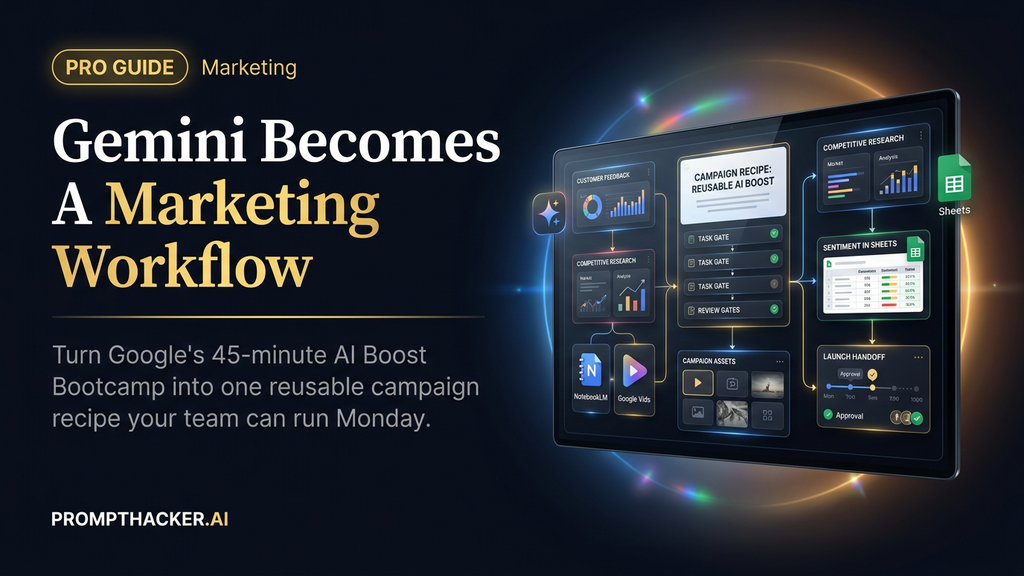
The course points marketers toward practical surfaces across Google Workspace: NotebookLM for customer feedback synthesis, Gemini Deep Research for competitive analysis, Canvas and Google Vids for campaign assets, =AI() in Sheets for sentiment analysis, Workspace Studio for campaign workflows, and Gemini Enterprise agents for marketing tasks.

The lesson for Executives is bigger than marketing. AI adoption works better when it is tied to a job, an input, an output, a review step, and a success metric.

Use the course as a workflow factory

Do not assign the course and ask for a summary. That produces polite compliance and no operational change.

Instead, assign one person to bring back one tested recipe. The deliverable should fit on one page:

  • Workflow name.
  • Business problem.
  • Inputs required.
  • Tool used.
  • Prompt or instruction.
  • Human review step.
  • Output format.
  • Owner.
  • Success metric.
  • When to stop using it.

That last line matters. AI workflows need an off-ramp. If the result is slower, riskier, or harder to review than the old process, it should not become a habit.

Four workflows worth testing

Start with one of these.

1. Customer feedback synthesis

Use NotebookLM to organize customer interviews, survey comments, support snippets, and sales notes into themes. The output should not be "what customers said." It should be "what changed in our understanding of the buyer."

Prompt:

Synthesize this customer feedback into five themes. For each theme, include supporting evidence, one quote or paraphrased example, the likely buyer concern, and one marketing action we could take in the next two weeks. Flag anything that needs more evidence.

2. Competitive research

Use Gemini Deep Research for a competitor scan tied to a decision. The weak version is a generic competitor profile. The useful version answers a specific question, such as whether a campaign should emphasize speed, integration, price, trust, or support.

Prompt:

Research the last 30 days of public moves by [COMPETITORS]. Focus on messaging changes, product announcements, pricing signals, customer concerns, and partnership activity. End with three implications for our next campaign and cite the sources used.

3. Sentiment analysis in Sheets

Use =AI() in Sheets to classify a small batch of comments. This is not a substitute for research judgment. It is a way to speed up the first pass.

Prompt inside the sheet:

Classify this comment as positive, neutral, negative, or mixed. Then name the main theme in five words or fewer.

4. Campaign handoff

Use Canvas, Google Vids, or Workspace Studio to turn a campaign brief into a first draft of assets and tasks. The review step should be built in from the beginning.

Prompt:

Turn this campaign brief into a launch handoff. Include target audience, message hierarchy, asset list, owner for each asset, review milestone, launch risks, and the first five tasks.

What Executives should ask for

The win is not "the team took an AI course." The win is one documented workflow that saves time or improves quality.

Ask for:

  • Before and after time estimate.
  • A sample output.
  • The review checklist.
  • The human owner.
  • The metric that proves the workflow helped.

If the person cannot show those five things, the workflow is not ready.

Run it as a two-week pilot

The fastest way to make the training useful is to run it as a small pilot instead of a team-wide mandate.

Week one is discovery. One marketer completes the course, chooses a workflow, tests it on real material, and writes the recipe. The recipe should include exact inputs, the tool used, the prompt, the review step, and the final output format.

Week two is adoption. A second marketer uses the recipe without coaching. If the second person cannot reproduce the result, the recipe is not clear enough. If the output is useful but risky, add a review gate. If the output saves no time, kill the workflow and choose another.

That sequence keeps the team honest. A good AI workflow should survive a handoff. It should not depend on one enthusiastic early adopter knowing exactly how to talk to the model.

The meeting agenda

When the pilot comes back, use a short review meeting:

  • What job did this workflow replace or improve?
  • What input did it require?
  • What output did it create?
  • What human review was required?
  • What was the time saved or quality gain?
  • What could go wrong if the team used this weekly?

The last question is the one that turns training into operations. Marketing workflows touch claims, customer quotes, competitive positioning, brand voice, and launch timing. That means the review step is not optional. It is part of the workflow.

The best outcome is not "we trained everyone." The best outcome is one small workflow that a busy team will actually reuse.

Action steps

  • Assign one marketer to complete Bootcamp 201 and return with one tested recipe, not a recap.
  • Pick one workflow from feedback, competitive research, sentiment analysis, or campaign handoff.
  • Save the final recipe in the team wiki with owner, inputs, review step, and success metric.

Source: https://workspace.google.com/blog/ai-and-machine-learning/scale-ai-adoption-by-role-introducing-ai-boost-bootcamp-201-for-marketing

Bottom line

The useful move with Google AI Boost Bootcamp 201 Marketing Workflow is to run one narrow test this week, then keep only the workflow that saves time, improves a decision, or gives your team clearer output. Treat the announcement as raw material, not the win itself.

About the author

Pierre Bradshaw Founder, PromptHacker.ai

Pierre has spent 25+ years building growth systems across fintech, real estate, lending, campaigns, and AI workflows, with machine-learning work dating back to 2012.

Email us
Free weekly briefing

Three deep dives. Four useful moves. One email worth opening.

PromptHacker turns the AI firehose into practical next steps for work, health, family, and everything time keeps trying to steal.