Use an AI model scorecard before you switch defaults
Compare frontier models by task quality, cost, reliability, context handling, and review effort.
What matters today
Compare frontier models by task quality, cost, reliability, context handling, and review effort.
Key points
- What you'll learn
- The scorecard prompt
- Visual scorecard
- Founder money angle
- Run the evaluation in one hour
What you'll learn
- The six scores that matter for model choice
- How to run a fast model evaluation without a lab
- When to rotate a primary model
- How to turn results into a routing rule
- How to keep model hype from hijacking team focus
Time to value: 25 minutes.
A new model launch can make a smart team behave like a distracted shopper. Someone posts a benchmark, someone tries one prompt, and the default changes before anyone measures what improved.
Executives need a lighter process. The goal is not to build a research lab. The goal is to decide which model handles which business task with the least cost and review burden.
A six-category scorecard is enough for most teams.
The scorecard prompt
Use this prompt whenever the team wants to compare two models. Replace the brackets with the actual models and use case.
You are an expert AI workflow auditor for a business team. I am evaluating [Model A] vs [Model B] for [primary use case: research synthesis, client deliverables, multi-step agent workflows, code generation and review, or spreadsheet analysis].
Create a 6-category scorecard with scores out of 10 and one-sentence justification for each category: output quality, speed and token efficiency, reliability on multi-step tasks, context handling, estimated cost per accepted output, and review effort.
Then give a routing recommendation: primary model, secondary model, no-use situations, and the single highest-ROI workflow change to make this week.
The prompt forces the model decision into a business frame. A model can be excellent and still be the wrong default if it adds review anxiety, costs too much for routine work, or lives outside the tools the team uses.
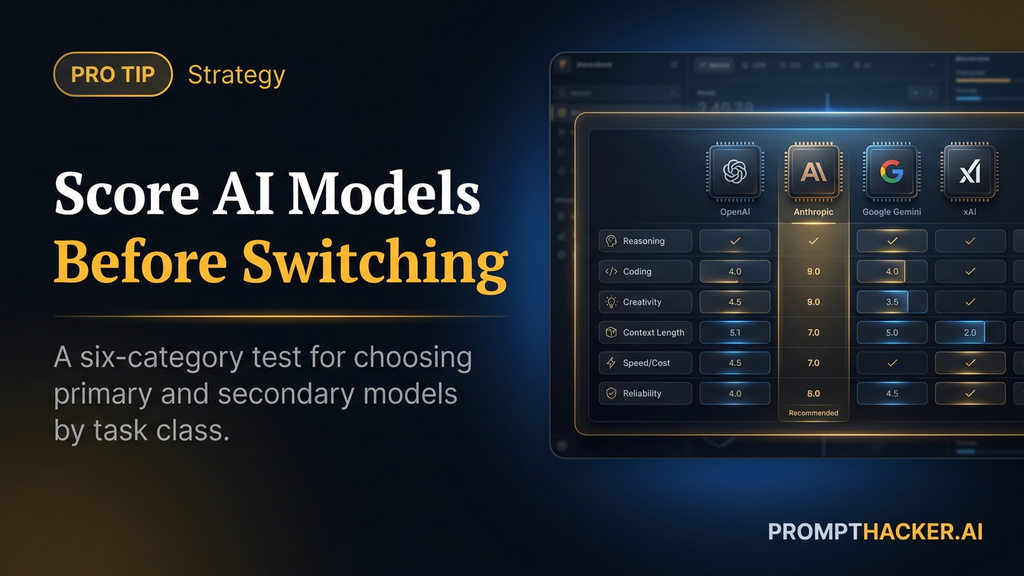
Visual scorecard
Use this scorecard before changing defaults. The winner is not the newest model. The winner is the model that creates a better accepted output for the workflow that matters this week.
Founder money angle
The founder question is not "Which model is smartest?" It is "Which model lets the team ship the same quality with fewer senior-review minutes?"
If a model saves 30 minutes per week for a senior seller, engineer, analyst, or founder, it is worth attention. If it produces impressive demos but requires the same cleanup, it belongs in the experiment pile.
Use accepted output as the unit of measurement. First drafts do not matter. The accepted output is the artifact the team actually uses after review.
Run the evaluation in one hour
Pick one recurring task class. Do not evaluate models across everything at once.
Good task classes:
- Research synthesis from three sources.
- Client-facing memo draft.
- Code change with tests.
- Spreadsheet analysis.
- Meeting summary with decisions and owners.
- Agent workflow with a source list and stop point.
Run the same input through two or three models. Do not improve one prompt and leave the others weak. If a model needs special formatting, note that in the result because prompt maintenance is part of the cost.
Decision map
Use this routing logic after the scorecard:
- Wins quality and review effort: test as primary for that task class.
- Wins cost but loses quality: use for drafts, extraction, or low-risk work only.
- Wins quality but loses speed or integration: keep as a specialist model.
- Loses context handling: keep away from file-heavy workflows.
- Creates hidden assumptions: require confidence and assumption lines or do not use.
The answer does not need one winner. The team needs a routing rule.
Example
Imagine the use case is client research synthesis. Model A writes a smoother summary but misses two source caveats. Model B writes a rougher summary but preserves source limits and costs less. The right route may be Model B for research gathering and Model A for final language polish.
That is the point of the scorecard. It prevents a team from treating model choice as one winner across all work. A model can be primary for research, secondary for writing, and off-limits for spreadsheet reasoning.
Team policy after the score
The scorecard should always end with a rule people can follow. For example:
- Use Sonnet 5 for nuanced writing and agent planning.
- Use ChatGPT Work for desktop workflows that need connected apps and review.
- Use Gemini Spark for narrow Mac and Google Workspace pilots.
- Use a lower-cost model only for extraction or first drafts.
- Escalate to human review before legal, finance, health, security, hiring, or customer-impacting actions.
Without a rule, the scorecard becomes trivia. With a rule, it becomes an operating advantage.
Common mistakes
Do not compare models on one weird prompt. Do not use public benchmark screenshots as your only evidence. Do not change the company default because one employee had a good result. Do not ignore integration. A model that requires people to leave the place work happens may lose even when its raw answer is better.
The most useful test is boring: same input, same success criteria, same reviewer, same accepted-output standard.
Action Steps Summary
- Choose one use case. Pick a recurring task where model choice can save at least 30 minutes per week.
- Run the scorecard prompt. Compare two or three models on the same input and judge the accepted output.
- Write one routing rule. Assign primary, secondary, and no-use situations for that task class.
- Recheck monthly during heavy launch periods. Model markets move quickly, but the team does not need a new default every Friday.
Footer CTA
Three deep dives. Four useful moves. One email worth opening.
PromptHacker turns the AI firehose into practical next steps for work, health, family, and everything time keeps trying to steal.