PH PROMPTHACKER.AI

The Multi-Model Council Prompt That Actually Works (and What It Costs)

Why copy-pasting one task into three chatbot tabs is not a real multi-model check, and what actually is
July 1, 2026 9 min read
openrouter multi model council prompt
Quick Scan

What matters today

Why copy-pasting one task into three chatbot tabs is not a real multi-model check, and what actually is

Format PRO TIP
Audience Executives using AI at work
Time 9 min read
Topic Pro Tip

Key points

  • Why a Single Access Point, Not Three Logins
  • Setting Up OpenRouter (5 Minutes)
  • The Council Prompt (Copy This)
  • Fusion: One Call Instead of Four
  • The Real Dollar Cost of One Council Run

What You'll Learn

  • Why copy-pasting one task into three chatbot tabs is not a real multi-model check, and what actually is
  • How to set up OpenRouter as a single access point to Claude, GPT, Gemini, and Grok with one API key
  • The exact copy-pasteable council prompt, plus how to run it manually or through OpenRouter's Fusion feature in one call
  • A real worked cost example for a 3-model panel run, in actual dollars and cents
  • What to do when one model in the panel returns a weak or wrong answer

Three browser tabs open. Claude in one, ChatGPT in another, Grok in a third. The same paragraph gets pasted into each, three answers come back, and now someone has to decide which parts to keep and how to stitch the survivors into one usable answer. That is not a multi-model council. That is data entry with extra steps, and it takes 15 to 20 minutes for a task that should take two.

The stakes are not just wasted time. Every model has blind spots: one might miss a recent regulatory change, another might reason confidently through a math error, a third might hedge on the one question that needed a firm answer. Running a task through only one model means betting the whole decision on that model's blind spots. Executives who cross-check high-stakes output (a pricing memo, a legal summary, a go-to-market plan) already know this. The problem has been the manual labor of doing it well.

There is a way to run the same task across 3 to 4 models from a single place, get every answer back in parallel, and have a separate model point out exactly where they agreed, disagreed, or each caught something the others missed. It costs real money, and the amount is knowable in advance. Here is the setup, the prompt, and the actual math.

Why a Single Access Point, Not Three Logins

The three-tab approach does not fail because it is slow. It fails because Claude, ChatGPT, and Grok each live behind a separate login, a separate bill, and a separate interface with no shared memory of the task. A human has to be the router, payment processor, and synthesis engine at once, for every query. That does not scale past one or two uses before Executives quietly stop doing it.

An API is the plain-language version of the fix: a way for one piece of software to ask another piece of software to do something, without a human clicking through a website. A token is the small chunk of text (roughly three-quarters of a word) a model reads or writes, and every model bills by counting tokens in and out. An aggregator sits in front of many providers and gives access to all of them through one login and one bill, the same way a universal remote replaces five separate remotes.

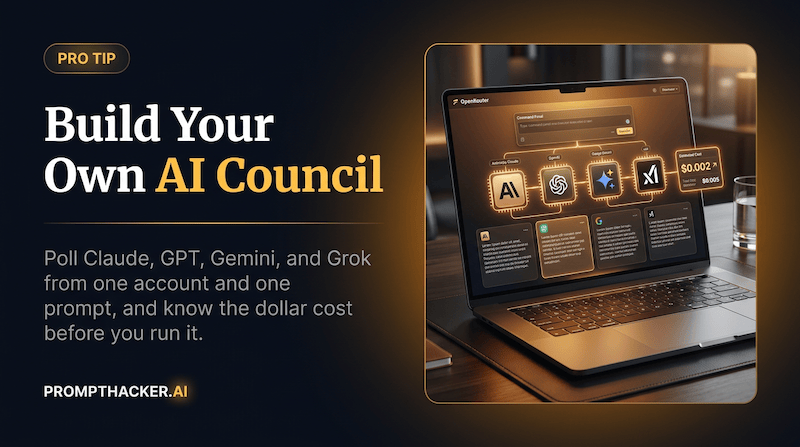
OpenRouter (openrouter.ai) is an aggregator built for exactly this. One account and one API key reaches Claude, GPT, Gemini, Grok, and more than 400 other models, billed to the same balance. That single access point is what makes a real multi-model council possible: one request goes to one place, which fans it out to however many models are named, waits for all of them, and returns every answer together.

Setting Up OpenRouter (5 Minutes)

Create a free account at openrouter.ai, then add a starting credit balance of $5 to $10 on the Credits page. Credit purchases carry a 5.5 percent platform fee with an 80 cent minimum, so a $10 top-up nets roughly $9.45 in usable credit, enough for dozens of single-model chats or a handful of full council runs.

OpenRouter also lists free-tier models with no token cost, capped at 50 requests per day total (rising to 1,000 per day once at least $10 in credits has been purchased). Use it to confirm the prompt format below works before spending anything; it will not run a real paid panel, since paid models are billed per token regardless of the free allowance, but it confirms the workflow end to end. Executives who would rather bring their own OpenAI, Anthropic, or Google keys can do that too (BYOK, bring your own key): the first 1 million BYOK requests per month are free, then a 5 percent fee applies on top of the provider's normal rate.

Create a free account

Sign up at openrouter.ai. No cost to start.

Add $5 to $10 in credit

On the Credits page. A 5.5 percent fee (80 cent minimum) applies, netting roughly $9.45 usable from a $10 top-up.

Test on the free tier

Confirm the prompt format works using free-tier models (50 requests per day cap) before spending on a paid panel.

Pick models and run the prompt

Choose 3 to 4 models for the panel, then run the council prompt below manually in the chat playground or with one call to Fusion.

The Council Prompt (Copy This)

Paste this into the OpenRouter chat playground (openrouter.ai/chat), where a single conversation can call several models and show every response side by side:

Task: [paste your actual task] Panel: assign this task's sub-parts to 3 to 4 models available on your OpenRouter account (for example Claude Sonnet 5 or Fable 5, GPT-5.5, Gemini 3.1 Pro, Grok), based on which model actually fits each part. Output format: Subtask Assignments: which model handled what, and why Key Output From Each: short bullets Synthesized Final Answer: clear and actionable Assumptions and Gaps: what still needs a human to check Estimated Cost: rough token cost for this run

Run each sub-part manually across three or four chosen model tabs, then paste the collected outputs into a synthesis model with the same prompt to fill in Subtask Assignments through Estimated Cost. Or skip the manual routing entirely by calling Fusion, OpenRouter's built-in feature that automates this whole workflow in one request.

Fusion: One Call Instead of Four

Fusion sends one prompt to a chosen panel of models in parallel, then hands every response to a judge model that returns a structured breakdown: where the panel agreed (higher-confidence), where they contradicted each other, what only one model covered, and what none addressed. A final model writes the user-facing answer grounded in that breakdown. It runs as a preset chatroom at openrouter.ai/fusion, no code required, the fastest way to run the council prompt without touching an API directly.

OpenRouter's own benchmark data backs the approach, using the DRACO benchmark (100 deep-research tasks, built by Perplexity to grade reasoning, tool use, and citation quality):

  • A fused pair of Fable 5 and GPT-5.5 scored 69.0 percent, beating Fable 5 running alone at 65.3 percent
  • A budget-model panel (Gemini 3 Flash, Kimi K2.6, and DeepSeek V4 Pro) scored 64.7 percent, close to Fable 5's solo score at roughly half the cost
  • Fusing Claude Opus 4.8 with a second copy of itself still gained 6.7 points over Opus 4.8 solo, so a real chunk of the benefit comes from the synthesis step itself, not just from mixing brands

The trade-off is speed. Fusion typically takes 2 to 3 times longer than a single model call, since it waits for every panel member before the judge can compare them. Reserve it for judgment calls (a competitive analysis, a contract check, a strategy memo), not a quick fact lookup.

The Real Dollar Cost of One Council Run

Every model in the panel gets billed, not just the one that "wins," so a 3 to 4 model council run costs several times a single chat message. Here is one realistic run in actual numbers, using OpenRouter's posted rates. Assume a task with roughly 800 words of input context (about 1,100 tokens) sent to each panel model, and each returns roughly 500 words of output (about 700 tokens).

A 3-model panel of Claude Sonnet 5 ($2 per million input tokens, $10 per million output tokens), GPT-5.5 ($5 per million input, $30 per million output), and Gemini 3.1 Pro ($2 per million input, $12 per million output) breaks down as: Claude Sonnet 5 costs about $0.009, GPT-5.5 costs about $0.027, and Gemini 3.1 Pro costs about $0.011. Panel subtotal: about $0.047.

Add a synthesis pass where a judge model (Claude Sonnet 5) reads all three combined responses and writes a final answer: another $0.009. Total for the full 3-model council plus synthesis: roughly $0.06 for that one run, versus about $0.009 for a single Claude Sonnet 5 message covering the same input and output. The council run costs 6 to 7 times more than the single-model version, matching the general rule: pay for every model in the panel, not just one.

Add a 4th model such as Grok, or a longer task with 3,000 to 5,000 words of context instead of 800, and the run moves from a few cents to 20 to 60 cents. Still cheap for a decision worth checking twice, but not free, and now a known number instead of a guess. That is what the Estimated Cost line in the prompt is for: ask the synthesis model to state the rough token cost for that specific run, using the actual context length, not a generic rate table.

When One Panel Member Returns a Bad Answer

A council of models is not immune to a weak answer, it is just harder for one to go unnoticed. If one panel model hallucinates a statistic, misreads the task, or returns a generic non-answer, the synthesis step is built to catch it: consensus across the other models gets treated as higher-confidence, and a lone claim that contradicts the rest gets flagged rather than silently blended in. That is the value of the Assumptions and Gaps line in the prompt: it forces the synthesis model to name what still needs a human to verify, instead of presenting one smoothed-over answer as settled fact.

The failure mode to actually worry about is the opposite one: every panel model sharing the same blind spot, most often a fact newer than its training data. Web search and web fetch tools enabled on the panel models (on by default inside Fusion) cut this risk by letting each model check a live source, but they do not eliminate it. Treat the Synthesized Final Answer as a strong first draft, not a verified final one, particularly for numbers, dates, and named claims.

If Managing API Credits Is Not for You

Not every Executive wants to track per-token costs, even at a few cents per run. Two subscription-based alternatives, both covered elsewhere in this issue, do a version of the same multi-model check inside a flat monthly fee: Sakana Fugu ships a ready-to-use council-of-experts system, and Perplexity Max includes a Model Council feature built into its existing subscription. Both trade the granular cost control here for a simpler, fixed-price experience. OpenRouter is the right tool when the goal is choosing the exact models on the panel and knowing the exact cost before it runs.

Action Steps Summary

1. Create an OpenRouter account. Sign up free at openrouter.ai, no credit card required to start.

2. Add $5 to $10 in credit. Expect a 5.5 percent fee (80 cent minimum) on the purchase, netting roughly $9.45 usable from a $10 top-up.

3. Test on the free tier first. Confirm the prompt format works using free models (50 requests per day cap) before spending on a paid panel.

4. Run the council prompt. Use it manually across 3 to 4 chosen models in the chat playground, or call Fusion at openrouter.ai/fusion for one-step automation.

5. Check the Estimated Cost line before committing. A 3-model panel plus synthesis runs roughly 6 to 7 times the cost of a single-model chat on the same task, typically a few cents to under a dollar.

6. Treat Assumptions and Gaps as required reading. A synthesized answer is a strong draft. Verify numbers, dates, and named claims before acting on them.

Time to value: 12 minutes from account creation to a completed council run with a synthesized answer.

Bottom line

The value of The Multi-Model Council Prompt That Actually Works (and What It Costs) is repetition. Run it on one real task, save the version that works, and turn the result into a small weekly habit instead of another one-time AI experiment.

About the author

Pierre Bradshaw Founder, PromptHacker.ai

Pierre has spent 25+ years building growth systems across fintech, real estate, lending, campaigns, and AI workflows, with machine-learning work dating back to 2012.

Email us
Free weekly briefing

Three deep dives. Four useful moves. One email worth opening.

PromptHacker turns the AI firehose into practical next steps for work, health, family, and everything time keeps trying to steal.