Streamline Executive Workflows: Implement AI Automation for Strategic Focus
How to identify high-volume, repetitive executive tasks suitable for AI automation.
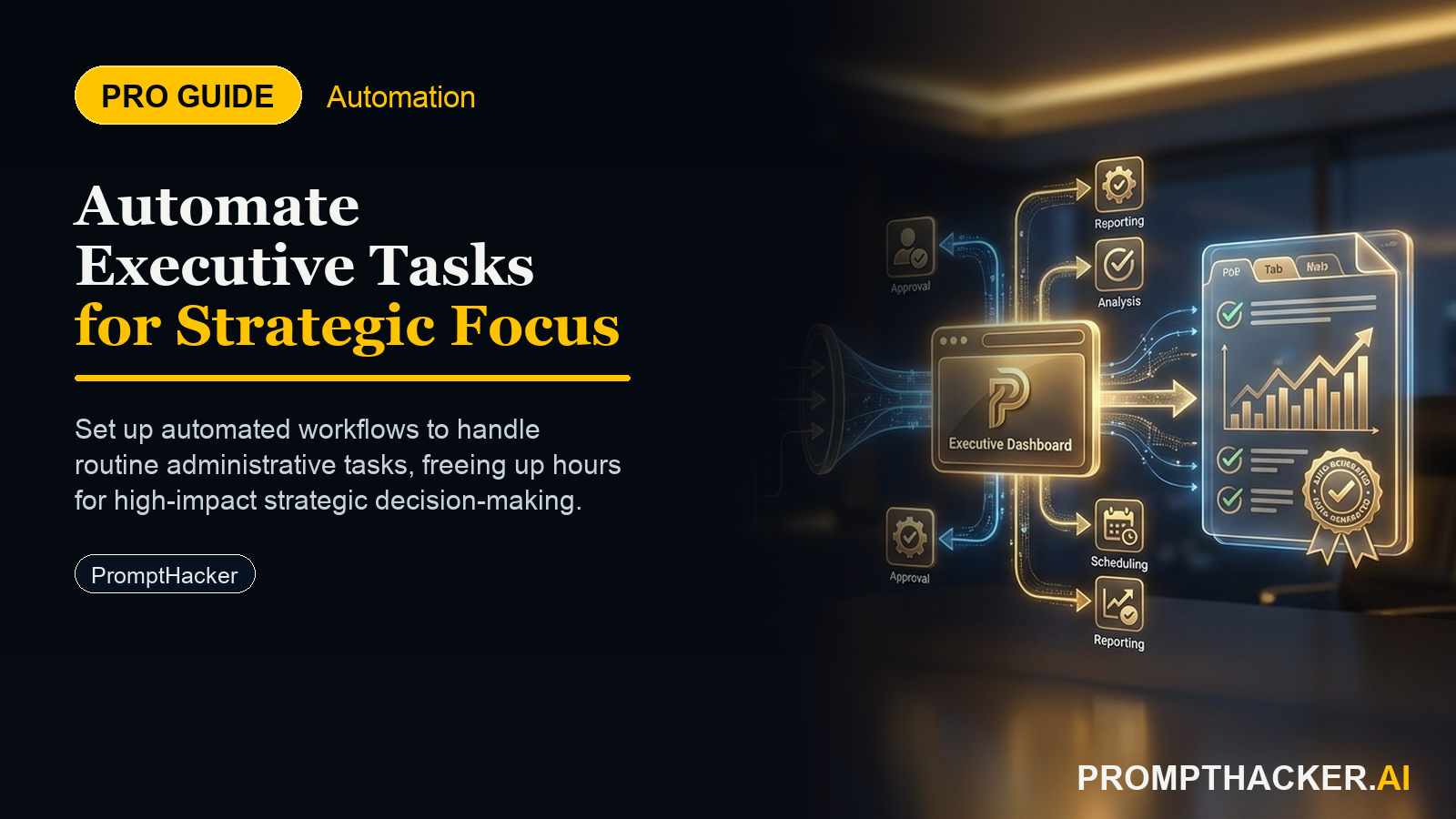
What matters today
How to identify high-volume, repetitive executive tasks suitable for AI automation.
Article roadmap
What you will learn
-
How to identify high-volume, repetitive executive tasks suitable for AI automation.
-
How to construct a multi-step AI automation sequence for efficient data processing.
-
How to deploy AI to synthesize complex information into actionable executive summaries.
-
How to integrate AI-powered drafting into your workflow.
-
How to maintain oversight and quality control in AI-automated processes.
A Chief Operating Officer at a rapidly scaling manufacturing firm faces a constant deluge of weekly operational reports. Each Monday morning, the COO spends 90 minutes manually reviewing production metrics, supply chain updates, and quality control summaries from five different departments. The goal is to distill these reports into a concise, actionable summary for the executive leadership team, highlighting key risks and opportunities.
Failing to streamline such repetitive, data-intensive tasks can trap executives in reactive work, diverting attention from proactive growth initiatives. The cumulative effect of these small, time-consuming duties is a significant reduction in capacity for innovation, market analysis, and long-term strategic development.
This article outlines a practical, multi-step AI automation sequence designed to alleviate the burden of repetitive data synthesis and communication drafting.
Executives constantly seek ways to optimize their time and focus on strategic growth. Integrating AI automation into daily operations offers a direct path to streamlining repetitive tasks and eliminating manual workflows.
Time to value: 20 minutes for initial setup and 5 minutes per subsequent use.
Step 1: Define the Automation Scope and Data Inputs
Before applying AI, clearly define the specific, repetitive task you aim to automate. For executives, this often involves synthesizing information from multiple sources and generating a summary or communication.
Real-world scenario: A Vice President of Product Development receives a weekly digest of customer feedback, competitor product launches, and internal sprint reviews. The VP needs to consolidate these into a "Product Health Report" for the CEO.
Step 2: Construct the AI Prompt Chain for Information Synthesis
The core of this automation lies in a sequential prompt chain that guides the AI through the synthesis process, ensuring that the final output remains aligned with your strategic objectives.
Ready to scale your productivity?
Get full access to our library of executive automation templates.
Three deep dives. Four useful moves. One email worth opening.
PromptHacker turns the AI firehose into practical next steps for work, health, family, and everything time keeps trying to steal.