PH PROMPTHACKER.AI

AI Builds 10-Minute Mobility for Your Specific Pain Points

Executives gain a personalized 10-minute daily mobility protocol, precisely targeting their tension areas to enhance physical comfort and readiness.

July 23, 2025 8 min read
ai health tip executive wellbeing stress reduction
Quick Scan

What matters today

Executives gain a personalized 10-minute daily mobility protocol, precisely targeting their tension areas to enhance physical comfort and readiness.

Format HEALTH GUIDE
Audience Executives using AI at work
Time 8 min read
Topic Health

Key points

  • Required Tool: ChatGPT-4o (Text-to-Plan)
  • Step-by-Step Setup: Preparing Your Input Data
  • The Verbatim Prompt to Use
  • What the AI Produces: Your Custom Mobility Sequence
  • Interpreting and Acting on the Output

What you will learn in this article:

  • How to precisely articulate your specific physical tension areas and lifestyle factors to an AI.
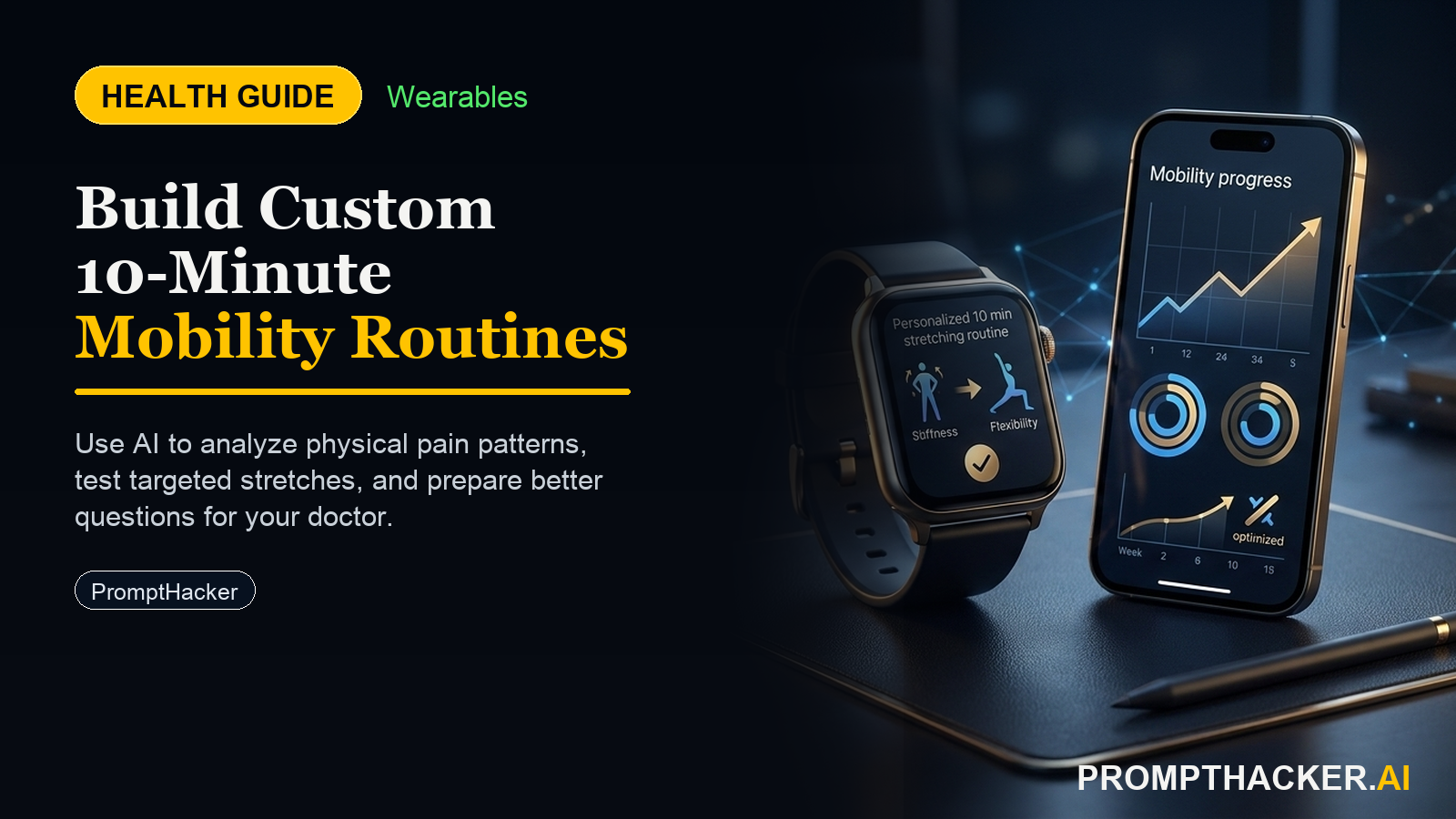
  • How to generate a custom 10-minute daily mobility routine using ChatGPT-4o, tailored to your unique needs.
  • How to receive a screenshot-ready exercise card for quick reference on your mobile device.
  • How to identify and avoid movements that could exacerbate sharp pain, ensuring a safe routine.
  • How to integrate an effective, personalized mobility practice into a demanding executive schedule.

The demands of executive life often place significant strain on the body. Prolonged hours spent at a desk, frequent travel, and the mental intensity of decision-making can manifest as persistent physical tension. Hip flexors tighten from sitting, the thoracic spine stiffens from a slumped posture, and the neck and shoulders accumulate stress, leading to discomfort that impacts focus, energy, and overall wellbeing. Many executives acknowledge these issues but struggle to find the time or expertise for a targeted solution, often resorting to generic stretches that miss their specific pain points.

Ignoring these early signals of physical imbalance is not a sustainable strategy. Over time, chronic tension can escalate into more significant issues: reduced range of motion, increased risk of injury, persistent aches, and even impaired cognitive function due to discomfort. The cumulative effect can diminish an executive's capacity for peak performance, making long days feel even longer and impacting both professional output and personal quality of life. The challenge lies in creating a highly personalized, efficient routine that fits into an already packed schedule.

This article delivers a precise method for leveraging AI to overcome this challenge. You will learn how to articulate your unique physical pain points and lifestyle factors to ChatGPT-4o. The AI will then generate a custom 10-minute daily mobility sequence, complete with exact exercises, reps, and hold times, formatted as a convenient, screenshot-ready card for your phone. This approach removes guesswork, providing an immediately actionable plan to address your specific tension areas and reclaim physical comfort.

Integrating effective mobility work into a busy executive schedule requires precision and personalization. Generic stretching routines often fail to address the specific patterns of tension accumulated from prolonged sitting, frequent travel, and high-stress environments. This is where AI, specifically ChatGPT-4o, becomes an invaluable tool, acting as your personal mobility coach to design a routine tailored to your exact needs.

Required Tool: ChatGPT-4o (Text-to-Plan)

This process relies on ChatGPT-4o, accessible via a web browser on any computer or through the official ChatGPT app on your iPhone or iPad. No specialized fitness apps or wearable devices are required for this specific tip, though you will need an active ChatGPT Plus subscription to access the `4o` model. The `4o` model is chosen for its superior ability to understand nuanced instructions and format outputs clearly, making it ideal for generating an actionable plan.

Step-by-Step Setup: Preparing Your Input Data

Before interacting with ChatGPT-4o, gather a few key pieces of information about your daily life and physical state. Accuracy here directly translates to the relevance of the AI's output.

  • Identify Specific Tension Areas : Be as precise as possible. Instead of saying "my back hurts," specify "lower back tightness, especially after sitting," "stiff thoracic spine between shoulder blades," or "tight hip flexors and glutes." The example areas provided (hip flexors, thoracic spine, neck) are common, but you should list your actual areas of discomfort. Consider where you feel stiffness, aching, or restricted movement.
  • Estimate Daily Sitting Hours : Reflect on an average workday. Include time at your desk, in meetings, commuting, and any other sedentary periods. Provide a realistic number, for example, "10 hours per day."
  • Estimate Monthly Travel Frequency : Consider how many days per month you typically spend traveling, which often involves prolonged sitting in planes, trains, or cars. For example, "7 days per month."

Having these details ready ensures your prompt is comprehensive and provides the AI with the necessary context to generate a highly relevant routine.

The Verbatim Prompt to Use

Once you have your specific data, open ChatGPT-4o and input the following prompt. Remember to replace the bracketed placeholders `[X]`, `[Y]`, and `[list]` with your actual numbers and tension areas.

VERBATIM PROMPT

"I sit roughly [X] hours per day and travel [Y] days per month. My specific problem areas are [list]. Build me a 10-minute daily mobility routine targeting those areas. Give me exact exercises with reps or hold times. Format it as a short card I can screenshot and keep on my phone. Flag any movements I should skip if pain is sharp rather than tight."

What the AI Produces: Your Custom Mobility Sequence

ChatGPT-4o will process your input and generate a personalized 10-minute daily mobility sequence. The output will be formatted as a concise, screenshot-ready card. This card will list specific exercises, along with clear instructions for reps or hold times, all designed to target the tension areas you specified. Crucially, it will also include warnings for any movements that should be skipped if you experience sharp pain, differentiating it from general tightness.

For example, if you specified "tight hip flexors, stiff thoracic spine, and neck tension," the AI might suggest exercises like:

• Couch Stretch (Hip Flexors) : 60 seconds per side. Hold gently, focusing on the front of the hip. Skip if sharp knee pain occurs.

• Cat-Cow (Thoracic Spine) : 10 reps. Focus on articulating each segment of the spine. Skip if sharp lower back pain.

• Thread the Needle (Thoracic Rotation) : 30 seconds per side. Reach through, gently twisting. Skip if sharp shoulder pain.

• Neck Rotations (Neck Tension) : 5 slow reps each direction. Gently move head side to side. Skip if sharp neck pain or dizziness.

• Chin Tucks (Neck Posture) : 10 reps, holding for 3 seconds. Gently draw chin back. Skip if any sharp pain.

The "screenshot-ready card" format means the output will be compact, easy to read, and designed for quick access on your mobile device, eliminating the need to search for complex instructions.

Interpreting and Acting on the Output

Review the generated routine carefully. Each exercise should directly correlate with one of your identified problem areas.

  • Understand the "Why" : While the AI does not explicitly state the anatomical reason for each exercise in the output card, you can infer its purpose. For example, a "Couch Stretch" is a classic hip flexor opener, while "Thread the Needle" targets thoracic spine rotation. If you are unsure about an exercise, a quick search can provide visual demonstrations.
  • Prioritize Safety : Pay close attention to the "skip if pain is sharp" flags. Sharp pain indicates potential injury or aggravation, while general tightness or a dull ache during a stretch is usually acceptable. Always listen to your body.
  • Consistency is Key : The routine is designed to be 10 minutes daily. Consistency is far more important than intensity. Even 5-7 minutes daily is more beneficial than one long session per week.

Edge Cases: What to Do If the Result Seems Off

AI is powerful, but it relies on clear input. Here are common edge cases and how to address them:

  • Incomplete Data : If you provided vague tension areas or omitted lifestyle factors, the AI might generate a less specific routine. Solution : Refine your initial input. For example, instead of "back pain," try "tightness in the lumbar spine, especially on the right side, after prolonged sitting." Re-prompt with the clearer information.
  • AI Misreads Something : Occasionally, the AI might misinterpret an instruction or suggest an exercise that seems unrelated to your problem areas. Solution : Provide feedback to the AI in a follow-up prompt. For example, "The routine you provided includes [Exercise X], but I don't see how it addresses my [Problem Area Y]. Can you suggest an alternative or explain its relevance?" You can also specify "only include exercises that directly target [Problem Area]."
  • Result Seems Off or Too Simple/Complex : If the routine feels too basic or overly complicated for a 10-minute slot. Solution : Adjust your prompt. You can add "Keep exercises simple and bodyweight only" or "Include slightly more advanced mobility drills." You can also specify the type of stretch, such as "dynamic stretches" or "static holds."
  • Pain vs. Tightness Clarification : If the AI does not adequately flag movements for sharp pain. Solution : Explicitly ask for this. "Please ensure each exercise includes a clear flag for when to skip if sharp pain is present, distinguishing it from general tightness."

How Often to Repeat This

This custom mobility routine is designed for daily implementation. Consistent, short bursts of mobility work are highly effective for counteracting the effects of prolonged static postures and stress.

You should re-evaluate and potentially re-prompt ChatGPT-4o:

  • Every 1-3 Months : As your body adapts, or if your lifestyle factors (sitting hours, travel) change significantly.
  • If Pain Points Shift : If old tension areas resolve and new ones emerge, or if the nature of your discomfort changes.
  • Before/After Significant Travel or Stress Periods : Proactively adjust your routine to prepare for or recover from demanding periods.

Worked Example: A VP of Operations' Personalized Routine

Consider Alex, a 43-year-old Vice President of Operations. Alex sits roughly 10 hours per day, managing a demanding team and frequently traveling for client meetings, averaging 7 days per month. His primary complaints are tight hip flexors from prolonged sitting, a stiff thoracic spine that restricts his upper body movement, and chronic neck tension that sometimes leads to tension headaches.

Alex opens ChatGPT-4o and inputs:

VERBATIM PROMPT

Bottom line

Use AI Builds 10-Minute Mobility for Your Specific Pain Points as an input to better questions, not as a substitute for medical judgment. The win is a clearer pattern, a safer conversation with a professional, and one small change you can evaluate honestly.

About the author

Pierre Bradshaw Founder, PromptHacker.ai

Pierre has spent 25+ years turning noisy data into practical decision systems, with machine-learning work dating back to 2012. PromptHacker health guides stay educational, source-checked, and low-risk.

If you have any questions or comments about AI Builds 10-Minute Mobility for Your Specific Pain Points feel free to reach out. I'd love to hear from you.

Contact Pierre
Free weekly briefing

Three deep dives. Four useful moves. One email worth opening.

PromptHacker turns the AI firehose into practical next steps for work, health, family, and everything time keeps trying to steal.