PH PROMPTHACKER.AI

The AI Imagination Machine: Invent a New Animal

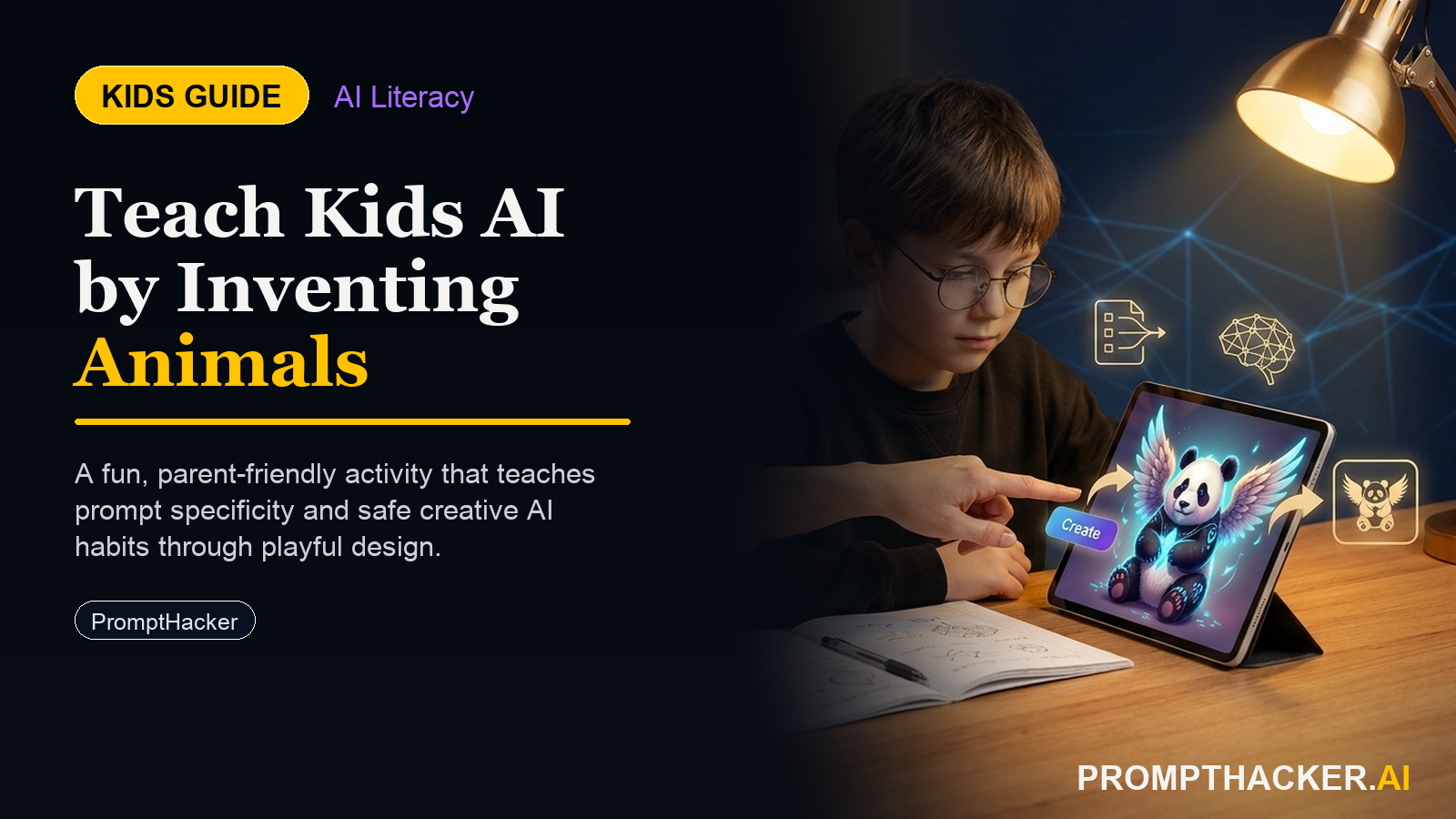
Encourage creativity and digital literacy by having children invent a new animal with AI-generated text and images.

February 5, 2025 8 min read
ai kids imagination machine invent animal
Quick Scan

What matters today

Encourage creativity and digital literacy by having children invent a new animal with AI-generated text and images.

Format KIDS GUIDE
Audience Executives using AI at work
Time 8 min read
Topic Kids and AI

Key points

  • Bring Fantastical Creatures to Life with AI
  • Activity for Age 8: The Illustrator's Challenge
  • Activity for Age 11: The Junior Biologist's Report
  • Activity for Age 14: The Evolutionary Storyteller

What you will learn in this article:

  • Children develop creative writing skills by designing imaginative animal characteristics.
  • Children learn foundational prompt engineering principles through guided AI interaction.
  • Children practice critical evaluation by comparing AI-generated text and images to their original concepts.
  • Children explore scientific concepts like habitats, diets, superpowers, and evolutionary history.
  • Children gain practical experience using generative AI tools, fostering digital literacy.

For many parents and educators, the rapid evolution of artificial intelligence presents both excitement and questions about how to best prepare the next generation. Consider the curious 11-year-old who uses AI for homework but has never explored its creative potential, or the imaginative 8-year-old whose fantastical ideas often outpace their ability to put them on paper. This activity offers a structured yet open-ended opportunity for children to move beyond passive consumption of technology and become active creators.

Children who do not engage with AI creatively early on may miss out on developing crucial skills for a future increasingly shaped by intelligent systems. Understanding how to prompt AI effectively, evaluate its outputs, and integrate it into creative processes are not just technical skills; they are foundational literacies for innovation and problem-solving in any field. This early exposure helps demystify AI, transforming it from a black box into a collaborative tool.

This AI Imagination Machine activity guides children through inventing a new animal, complete with a habitat, diet, and unique abilities, using AI tools. Depending on their age, children will then either draw their creation, develop a realistic biology textbook entry, or craft its evolutionary history and generate a visual. The activity combines imaginative writing with visual AI prompting, fostering critical thinking and digital literacy in a fun, engaging way.

Bring Fantastical Creatures to Life with AI

This activity uses ChatGPT and DALL-E 3, both available through free tiers, to help children invent and describe new animals. Children will need access to a standard household device such as a phone, tablet, or laptop. The setup takes about five minutes, and once initiated, children can work independently. The focus is on active creation, where the child builds a tangible output, not just consumes information.

Tools You Will Use:

  • ChatGPT (free tier, accessible via web browser)
  • DALL-E 3 (free tier, integrated into ChatGPT or via Copilot)

Device Needed:

  • Any standard device with internet access (laptop, tablet, or smartphone).

Getting Started: Accessing the AI Tools

  • Open ChatGPT: Go to chat.openai.com. If an account is not set up, follow the simple instructions to create a free account. This usually involves an email address and a phone number for verification.
  • Access DALL-E 3: DALL-E 3 is integrated into the free version of ChatGPT. When using ChatGPT, simply ask it to "create an image" or "generate a picture," and it will automatically use DALL-E 3. Alternatively, DALL-E 3 is also freely accessible through Microsoft Copilot (copilot.microsoft.com).

Activity for Age 8: The Illustrator's Challenge

For children aged 8, this activity sparks creativity and helps them articulate their imaginative ideas. The goal is to invent a creature with AI's help and then draw it.

  • Start the Conversation: Open ChatGPT and tell it, "Let's invent a new animal! I need its name, habitat, what it eats, and one special superpower. Make it friendly and surprising."
  • Define the World: ChatGPT will respond with ideas. If the child wants to guide it, they can add details like, "I want an animal that lives in the desert," or "It should eat only plants."
  • Refine the Creature: Review ChatGPT's suggestions. The child can ask, "Can its superpower be flying, but only at night?" or "What if it has sparkly fur?"
  • Confirm the Concept: Once the child is happy with the name, habitat, food, and superpower, ask ChatGPT to summarize the creature's description in one short paragraph.
  • Draw Your Animal: Using paper and drawing tools (crayons, markers, colored pencils), the child draws their newly invented animal based on the AI-generated description. This is the tangible output.

Parental Support for Age 8:

Encourage the child to be specific with their requests to ChatGPT. Ask questions like, "What color do you imagine it is?" or "What sounds does it make?" While they draw, ask them to describe their creature and why they chose certain features. This helps them articulate their creative process.

Common Mistake (Age 8):

Children might try to make the creature overly complex with too many superpowers or features. Guide them to focus on one main superpower and a few key characteristics to keep the drawing manageable and the concept clear. Suggest simplifying if the description becomes unwieldy.

Worked Example (Age 8): The Glimmerwing Dragonfly

An 8-year-old named Maya wanted to invent a creature that lived in a magical forest.

  • Maya's Initial Prompt:

PROMPT

"Invent a new animal for me! It lives in a magical forest. What does it eat? What is its superpower?"

  • ChatGPT's Response (Simplified):

AI RESPONSE

"Okay, how about the 'Whisperbloom'? It lives in the enchanted Whispering Woods, eats glowing moonberries, and its superpower is making plants grow super fast!"

  • Maya's Refinement:

PROMPT

"I like Whisperbloom, but I want it to fly and have sparkly wings. And maybe it makes music?"

  • ChatGPT's Refinement:

AI RESPONSE

"Great idea! Let's call it the 'Glimmerwing Dragonfly.' It lives in the Whispering Woods, eats glowing moonberries, and its superpower is that its wings sparkle with musical notes when it flies, calming other forest creatures."

  • Maya's Drawing: Maya then drew a beautiful dragonfly with iridescent wings, tiny musical notes floating around it, perched on a glowing moonberry bush. She was surprised by how much ChatGPT helped her imagine the details, especially the musical notes.

Activity for Age 11: The Junior Biologist's Report

This activity builds on the previous one by introducing a layer of scientific realism and critical evaluation. Children invent a creature with AI, then ask AI to write a biology textbook entry for it, checking if it sounds realistic.

  • Invent Your Creature: Follow steps 1-3 from the Age 8 activity to invent a new animal, including its name, habitat, food, and a specific adaptation or unique feature (instead of a pure "superpower" for realism). For example, "Its special ability is camouflage that changes with its mood."
  • Request a Textbook Entry: Once the creature is well-defined, ask ChatGPT, "Now, write a short biology textbook entry for my [Creature's Name]. Include details about its physical description, behavior, diet, habitat, and how its special adaptation helps it survive. Make it sound like a real scientific entry."
  • Evaluate for Realism: Read the AI-generated textbook entry. The child's task is to identify if the information sounds believable for a real animal. Ask questions like: "Does its diet make sense for its habitat?"
  • "Is its adaptation helpful for survival?"
  • "Are there any parts that sound too fantastical or not scientific enough?"
  • Refine with AI: If the entry needs adjustment, tell ChatGPT, "That's good, but can you make its [specific detail, e.g., diet] more realistic for a [creature type] living in a [habitat type]?" or "Can you explain how its [adaptation] evolved over time?" The child repeats steps 3 and 4 until satisfied.
  • Finalize the Entry: The refined biology textbook entry is the tangible output.

Parental Support for Age 11:

Discuss what makes a scientific explanation "realistic." You can ask, "If this animal were real, what challenges would it face in its habitat? How does its unique feature help overcome those challenges?" Encourage them to think about cause and effect in biology.

Common Mistake (Age 11):

Children might accept the AI's first draft without critical review. Prompt them to actively look for inconsistencies or areas that could be more scientifically plausible. Remind them that AI sometimes "guesses" based on patterns and needs human guidance for accuracy.

Activity for Age 14: The Evolutionary Storyteller

This activity challenges older children to design a creature, write its evolutionary history, generate a visual using DALL-E 3, and then critically evaluate if the AI image matches their detailed description. This connects to real-world scientific modeling and visual communication.

  • Detailed Creature Design: Begin by designing a creature with ChatGPT. This time, be much more specific. Ask ChatGPT for: A unique name.
  • A specific habitat (e.g., "the deep-sea hydrothermal vents of the Pacific").
  • A detailed physical description (size, color, number of limbs, unique anatomical features).
  • Its diet and place in the food web.
  • A unique survival adaptation.
  • Ask ChatGPT to summarize this detailed description.
  • Craft Evolutionary History: Once the creature is fully designed, ask ChatGPT, "Based on this creature, write a brief evolutionary history. Describe its likely ancestor, what environmental pressures led to its current form, and how its unique adaptation developed over millions of years."
  • Generate a Visual with DALL-E 3: Now, use the detailed physical description from step 1 to prompt DALL-E 3. Tell ChatGPT, "Now, create a highly detailed, realistic image of the [Creature's Name] based on the description we just created. Show it in its natural habitat, [specific habitat]. Make sure to include [3-5 key physical features from your description]." Example Prompt for DALL-E 3:

PROMPT

"Generate a photorealistic image of a 'Chrono-Serpent' in a bioluminescent deep-sea cave. It is 15 feet long, has iridescent scales that shimmer between deep blue and violet, six fin-like appendages, and two glowing antennae that emit soft amber light. Show it coiling around a hydrothermal vent."

  • Evaluate the AI Image: Compare the DALL-E 3 generated image to the detailed description and evolutionary history you crafted. This is the critical evaluation step. "Does the image accurately represent all the physical features described?"
  • "Does its environment look like the habitat described?"
  • "Are there any discrepancies or parts the AI missed or misinterpreted?"
  • "If this creature evolved as described, does the image look like a plausible outcome?"
  • Refine and Repeat (Optional): If the image does not match, identify what is missing or incorrect. Then, refine your DALL-E 3 prompt, being even more specific about those features, and generate a new image. The detailed creature design, evolutionary history, and the DALL-E 3 image (and analysis) are the tangible outputs.

Parental Support for Age 14:

Discuss the concept of "prompt engineering" and how precise language impacts AI output. Explore how scientists use models and visual representations to understand complex evolutionary processes. Talk about the limitations of current AI image generation and how human oversight remains crucial. This activity connects directly to fields like zoology, paleontology, and scientific illustration.

Bottom line

The point of The AI Imagination Machine: Invent a New Animal is not a perfect final project. It is helping kids see how examples, labels, and feedback shape an AI system, then asking better questions about the tools around them.

About the author

Pierre Bradshaw Founder, PromptHacker.ai

Pierre has spent 25+ years building practical learning and growth systems, with machine-learning work dating back to 2012. PromptHacker kids projects focus on real creation, safety, and AI literacy.

If you have any questions or comments about The AI Imagination Machine: Invent a New Animal feel free to reach out. I'd love to hear from you.

Contact Pierre
Free weekly briefing

Three deep dives. Four useful moves. One email worth opening.

PromptHacker turns the AI firehose into practical next steps for work, health, family, and everything time keeps trying to steal.