Your Child's AI Space Tour Guide: Explore the Cosmos with ChatGPT
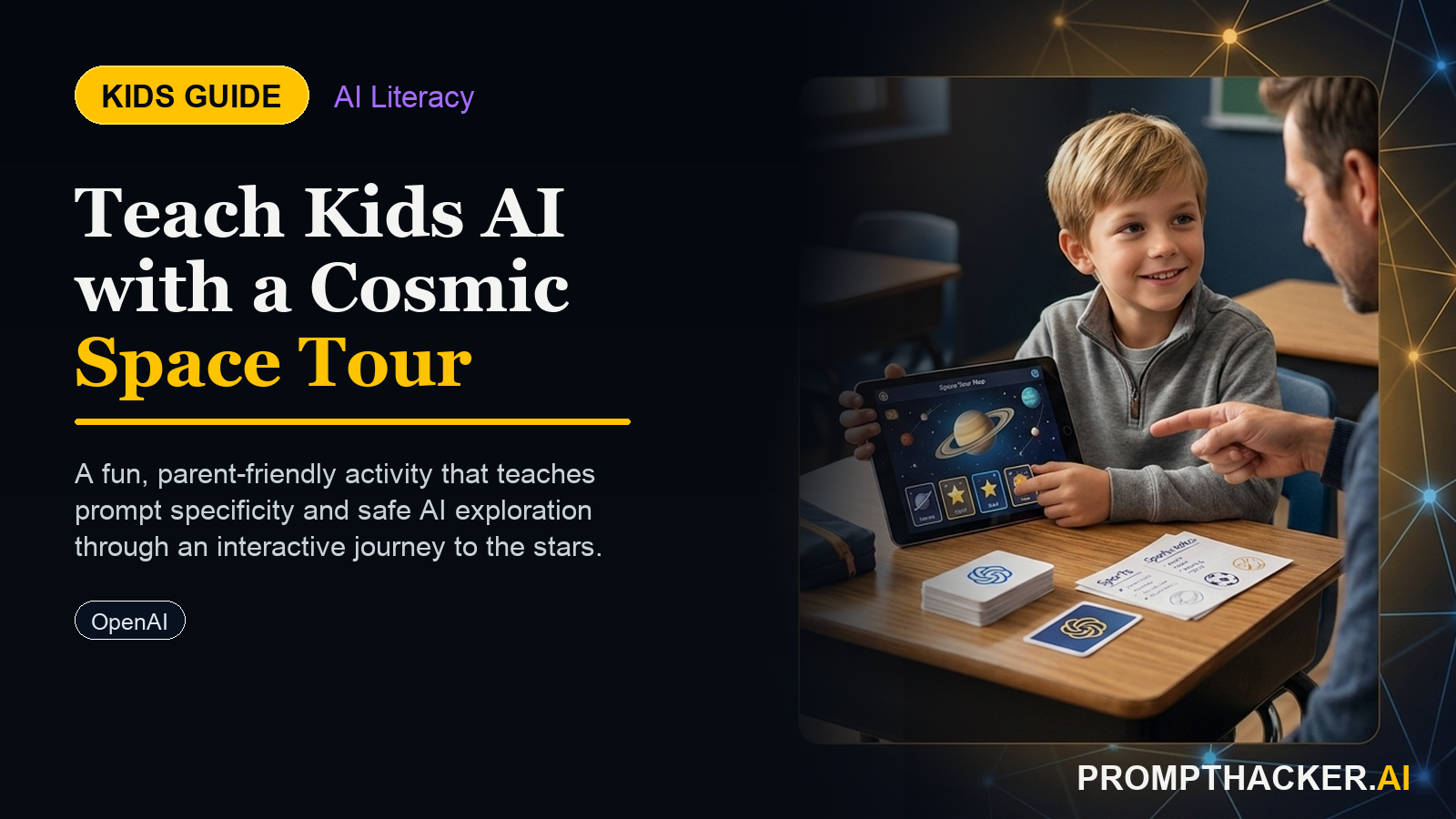
Kids create a hands-on AI project: Your Child's AI Space Tour Guide: Explore the Cosmos with ChatGPT. A parent or educator helps them build, test, and explain what the AI tool gets right and wrong.
What matters today
Kids create a hands-on AI project: Your Child's AI Space Tour Guide: Explore the Cosmos with ChatGPT. A parent or educator helps them build, test, and explain what the AI tool gets right and wrong.
Article roadmap
What you will learn
-
How to use AI as an interactive learning tool for complex subjects.
-
Develop critical thinking skills by evaluating and verifying AI-generated information.
-
Understand fundamental concepts of space exploration, from planetary features to mission planning.
-
Practice effective prompt engineering to guide AI conversations and achieve specific learning outcomes.
-
Cultivate scientific curiosity and a deeper appreciation for factual accuracy.
The digital landscape offers unprecedented opportunities for children to engage with knowledge. For a child who might be curious about the vastness of space, but finds traditional textbooks daunting, AI can act as a dynamic, personalized tutor. Imagine an 11-year-old, perhaps one who uses AI simply for quick homework answers, suddenly discovering AI can lead them on an epic journey through the solar system, making learning an adventure rather than a chore. This activity transforms passive consumption of information into an active, guided exploration, tailored to their individual pace and interests.
Without early exposure to AI as a creative and critical thinking partner, children risk seeing it merely as a shortcut or a data retriever. They might miss the opportunity to develop crucial skills in prompt engineering, information verification, and the ability to direct advanced tools for personalized learning. These are not just tech skills; they are foundational for navigating a future where AI will be integrated into nearly every professional and personal domain. Guiding them now helps them become creators and critical users, not just consumers, of technology.
This week's Kids Tip empowers children to turn ChatGPT into their personal space tour guide. From an imaginary field trip to the moon for an 8-year-old, to designing a realistic Mars mission for a 14-year-old, this activity encourages active participation. Children will formulate questions, direct their AI guide, and critically assess the information received, all while exploring the wonders and challenges of space exploration. It is a hands-on way to connect scientific curiosity with practical AI interaction, requiring minimal setup and no specialized equipment.
Child AI Space executive action plan
This activity harnesses the power of ChatGPT to transform abstract concepts of space exploration into an interactive, personalized learning experience. Children will use a standard household device - a phone, tablet, or laptop - to engage with the AI. The setup time for a parent or educator is minimal, typically under five minutes, after which the child can largely proceed without direct supervision.
Tools and Setup:
- Platform: ChatGPT (free version is sufficient).
- Device: Any internet-connected device (laptop, tablet, smartphone).
- Preparation: Ensure the child has access to ChatGPT and understands basic interaction. A parent can briefly explain that ChatGPT is like a very knowledgeable friend who can tell stories and answer questions.
Activity for Age 8: Your Solar System Field Trip
This activity is designed to spark imagination and introduce the solar system in a fun, conversational way. The child will direct AI to create a narrative adventure.
What the child produces: A personalized, imaginative story of their solar system field trip.
Step-by-Step Instructions:
- Open ChatGPT: Help your child navigate to ChatGPT.
- Start the Adventure: Prompt ChatGPT with a simple request.
- Choose Your Destination: ChatGPT will likely suggest a planet. Encourage your child to respond with their preference, or ask for more options.
- Explore and Imagine: Encourage your child to ask follow-up questions about what they would see, do, or feel on each planet.
- Continue the Tour: After exploring a stop, prompt ChatGPT to move to the next destination.
- Reflect: Once the tour is complete, ask the child to summarize their favorite part.
Unlock Full Access
Get weekly AI tutorials and prompt templates for your family.
Three deep dives. Four useful moves. One email worth opening.
PromptHacker turns the AI firehose into practical next steps for work, health, family, and everything time keeps trying to steal.