PH PROMPTHACKER.AI

Bring Your Favorite Book Characters to Life with AI Roleplay

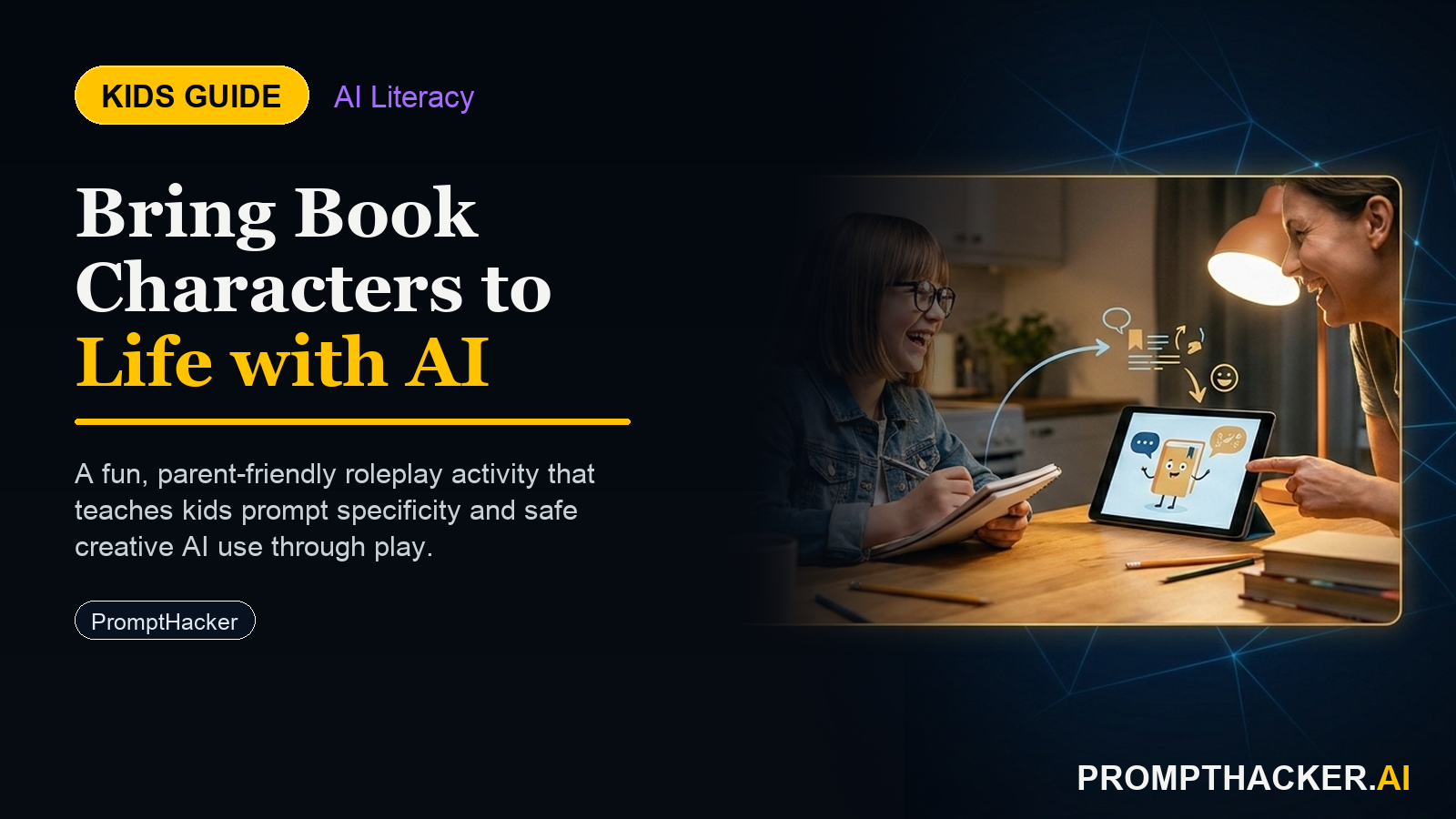
Children will create interactive character conversations, developing critical thinking, reading comprehension, and an understanding of AI reliability.

August 20, 2025 8 min read
ai kids tip character roleplay reading
Quick Scan

What matters today

Children will create interactive character conversations, developing critical thinking, reading comprehension, and an understanding of AI reliability.

Format KIDS GUIDE
Audience Executives using AI at work
Time 8 min read
Topic Kids and AI

Key points

  • Bring Favorite Book executive action plan
  • Getting Started: Setting the Stage for AI Roleplay
  • Initial Setup Steps (for all ages):
  • Activity for Age 8: Meet Your Favorite Character!
  • Step-by-Step Instructions:

What you will learn in this article:

  • How to prompt an AI to adopt a specific persona from literature.
  • Methods for evaluating AI responses for character consistency and accuracy.
  • Techniques to identify when an AI "hallucinates" or fabricates information.
  • The foundational principles of AI reliability testing and fact-checking.
  • How to articulate observations and findings in a structured, analytical way.

Children today grow up surrounded by AI, from smart speakers to personalized recommendations. While many interact with AI passively, a different kind of engagement can transform their understanding and critical thinking. Consider a curious 11-year-old who loves fantasy novels, or a 14-year-old who uses AI for quick homework answers but has never critically examined its output. This activity transforms passive consumption into active, investigative learning, using the familiar world of books as its playground.

Without opportunities to actively engage with and test AI, children may miss out on crucial skills for the future. They might accept AI outputs uncritically, failing to develop the discernment needed to distinguish between accurate information and AI-generated fabrications. This gap can hinder their reading comprehension, analytical abilities, and their capacity to understand the limitations and potential of intelligent systems. Developing a critical eye for AI's performance is as vital as reading itself.

This PromptHacker Kids Tip offers a hands-on method for children to interact with AI, not just as a tool, but as a subject of inquiry. They will prompt an AI to roleplay as a beloved book character, then engage in structured questioning and critical evaluation. This journey will deepen their appreciation for literature, sharpen their analytical skills, and introduce them to the fundamental concepts of AI reliability and consistency, all while creating tangible outputs at each age level.

Bring Favorite Book executive action plan

This activity guides children through an engaging process of interacting with AI, using their favorite books as the foundation. They will prompt AI to become a character, ask questions, and then critically evaluate the AI's performance. This process enhances reading comprehension, hones analytical skills, and provides a practical introduction to AI reliability. The activity can be completed using either ChatGPT or Claude, and requires only a standard household device such as a phone, tablet, or laptop. No specialized hardware or paid subscriptions are necessary.

Getting Started: Setting the Stage for AI Roleplay

Before diving into the age-specific activities, all children will begin by setting up the AI to adopt a character persona. This initial step is straightforward and consistent across age groups.

Tools: ChatGPT (available at chat.openai.com) or Claude (available at claude.ai). Both offer free access tiers suitable for this activity. Device: Any internet-connected device with a web browser.

Initial Setup Steps (for all ages):

  • Open your AI tool: Go to chat.openai.com or claude.ai in your web browser.
  • Start a new chat: Look for a "New Chat" or "New Conversation" button.
  • Choose your character and book: Think of a favorite character from a book you know well. For example, Hermione Granger from the *Harry Potter* series, Percy Jackson from *Percy Jackson & The Olympians*, or Gandalf from *The Lord of the Rings*.
  • Give the AI its persona prompt: Type a prompt like this: "Please pretend to be [Character Name] from the book [Book Title] by [Author's Name]. You should respond exactly like this character would, using their personality, vocabulary, and knowledge from the book."

Example Prompt

"Please pretend to be Hermione Granger from the book *Harry Potter and the Sorcerer's Stone* by J.K. Rowling. You should respond exactly like Hermione would, using her personality, vocabulary, and knowledge from the book."

  • Confirm the persona: The AI should respond, acknowledging its new role. It might say something like, "Alright, I shall endeavor to embody the diligent and logical mind of Hermione Granger. What knowledge do you seek?" This confirms the AI is ready to roleplay.

Once the AI has adopted its character persona, the specific activities diverge based on the child's age, introducing increasing layers of complexity and critical analysis.

Activity for Age 8: Meet Your Favorite Character!

At this age, the focus is on direct interaction and initial character recognition. Children will engage with the AI character and form a basic judgment about its consistency.

What the child produces: A simple, written assessment of whether the AI sounded like the character, noting one or two specific reasons.

Step-by-Step Instructions:

  • Complete the Initial Setup: Follow steps 1-5 above to get the AI roleplaying as your chosen character.
  • Ask Five Questions: Think of five questions you would ask your character if you met them. These questions should be about things that happen in their book or their personality.

Example questions for Hermione Granger

1. "What is your favorite class at Hogwarts?" 2. "Do you like Ron and Harry?" 3. "What was the scariest thing you faced in your first year?" 4. "What spell do you use most often?" 5. "Is reading your favorite thing to do?"

  • Observe the Responses: Read the AI's answers carefully. Pay attention to the words it uses and the way it "talks."
  • Decide: Does it sound like the real character? Think about how the character acts and speaks in the book. Does the AI's response match that?
  • Write Your Assessment: On a piece of paper or in a simple document, write "Yes" or "No" to the question "Did the AI sound like [Character Name]?" Then, write one or two sentences explaining why. For example, "Yes, because Hermione used smart words and talked about books a lot," or "No, because Gandalf didn't sound wise enough."

Worked Example (Age 8 - Hermione Granger):

A child named Lily (8) chose Hermione Granger. She asked her five questions. Hermione's answers were full of facts about Hogwarts, mentioning "logic" and "rules," and expressing her dedication to studying.

*Lily's Assessment:* "Yes, the AI sounded like Hermione. She talked about how important studying is and used big words, just like Hermione does in the books. She also seemed very serious about getting good grades."

Parent or Educator Support (Age 8):

Encourage your child to pick a character they know very well. Help them brainstorm questions that relate directly to the character's known traits or events in the book. If they struggle to articulate *why* the AI sounds or doesn't sound like the character, prompt them with, "What specific words did the AI use?" or "How did Hermione act in the book when something similar happened?"

Common Mistakes (Age 8):

* Asking questions unrelated to the book: The AI might struggle to stay in character. Guide them to focus on book-specific queries. * Too few details in their assessment: Help them connect their "yes" or "no" to concrete examples from the AI's answers.

Activity for Age 11: Character Investigator!

This activity introduces a layer of critical thinking about AI's limitations. Children will test if the AI stays in character when asked about events it shouldn't know about.

What the child produces: A comparison list or short paragraph detailing instances where the AI stayed in character versus when it made things up or broke character.

Step-by-Step Instructions:

  • Complete the Initial Setup: Follow steps 1-5 from the "Getting Started" section to get the AI roleplaying as your chosen character.
  • Ask About Unfamiliar Events: Think of events that happen *outside* of the character's main story or a sequel they weren't in, or even real-world events. The goal is to see if the AI can admit it doesn't know, or if it tries to invent an answer while staying in character.

Example questions for Percy Jackson (from *The Lightning Thief*)

1. "What did you think of the new Avengers movie?" 2. "Did you ever meet Harry Potter?" 3. "What happened to Camp Half-Blood after the events of *The Last Olympian*?" (This is a trick question if the child has only read the first book, but if they know about later books, they can ask about something outside the entire series or a different series). 4. "How do you feel about climate change?" 5. "What's your favorite type of pizza?" (This might be a simple, character-consistent guess, or it might be fabricated.)

  • Observe and Analyze: Read the AI's responses carefully. Did the AI character admit it didn't know?
  • Did it try to answer while still sounding like the character, even if the information was made up?
  • Did it break character and respond as a generic AI?
  • Create Your Comparison: On a piece of paper or in a document, create two columns: "AI Stayed in Character / Admitted Not Knowing" and "AI Made Things Up / Broke Character." List the questions and the AI's behavior under the correct column.

Example Entry

* Question: "Did you ever meet Harry Potter?" * AI Stayed in Character / Admitted Not Knowing: "A wizard, you say? I'm afraid my adventures are usually focused on gods and monsters, not quite the same sort of magical folk. Never heard of him, actually." (Stays in character, admits not knowing.) * AI Made Things Up / Broke Character: "Harry Potter? Oh yes, he's a famous wizard! I helped him fight Voldemort once." (Made things up, likely broke character by knowing too much.)

Worked Example (Age 11 - Percy Jackson):

An 11-year-old named Sam chose Percy Jackson. He asked Percy about a new video game. Percy responded, "A video game, you say? I'm more accustomed to fighting mythical beasts with a sword, not pressing buttons. Sounds like a lot less danger, though!" He stayed in character, admitting unfamiliarity. Sam then asked about a character from a different book series. Percy responded, "I'm not familiar with that hero, but I wish them luck on their quest. Sounds like they could use a demigod's help!" Again, staying in character while admitting ignorance.

Bottom line

The point of Bring Your Favorite Book Characters to Life with AI Roleplay is not a perfect final project. It is helping kids see how examples, labels, and feedback shape an AI system, then asking better questions about the tools around them.

About the author

Pierre Bradshaw Founder, PromptHacker.ai

Pierre has spent 25+ years building practical learning and growth systems, with machine-learning work dating back to 2012. PromptHacker kids projects focus on real creation, safety, and AI literacy.

If you have any questions or comments about Bring Your Favorite Book Characters to Life with AI Roleplay feel free to reach out. I'd love to hear from you.

Contact Pierre
Free weekly briefing

Three deep dives. Four useful moves. One email worth opening.

PromptHacker turns the AI firehose into practical next steps for work, health, family, and everything time keeps trying to steal.