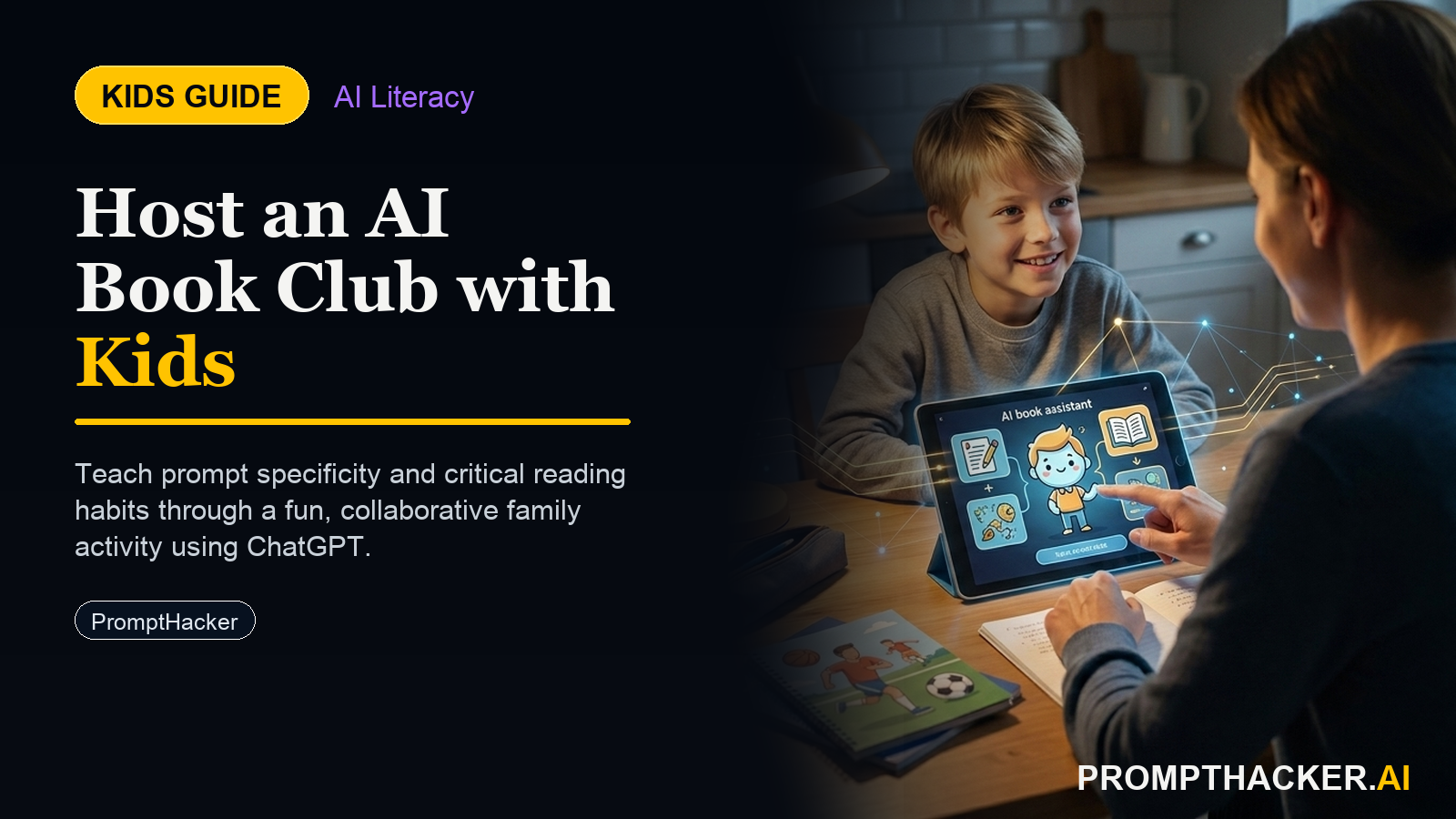
Boost Reading Skills: AI as Your Child's Book Club Co-Host
Children will create personalized book discussions, deepening their comprehension and critical thinking through interactive AI engagement.
What matters today
Children will create personalized book discussions, deepening their comprehension and critical thinking through interactive AI engagement.
Key points
- Main Content: AI as a Book Club Co-Host
What you will learn in this article:
- Children develop stronger reading comprehension by analyzing book themes and lessons.
- Critical thinking skills improve as children evaluate and challenge AI-generated responses.
- Children learn to formulate effective questions and arguments, a foundational skill for academic success.
- Children gain an understanding of AI's capabilities as a learning tool, moving beyond passive consumption.
Imagine a curious 11-year-old, perhaps one who has never truly considered the deeper messages within a story, now actively debating a book's central theme with an artificial intelligence. Or picture a 14-year-old, accustomed to using AI for quick answers, discovering the satisfaction of constructing a reasoned counter-argument against an AI's interpretation, defending their own thoughtful reading. This activity introduces children to AI not as a shortcut, but as a dynamic partner in intellectual exploration. It transforms reading from a solitary pursuit into an engaging, interactive experience that fosters genuine understanding and analytical rigor.
Children who do not develop these critical engagement skills early may miss out on more than just deeper reading comprehension. They risk viewing AI as an infallible source of truth rather than a tool for dialogue and discovery. Without learning to question, compare, and challenge AI's output, they may struggle to develop independent thought and the ability to formulate their own informed opinions in an increasingly AI-driven world. This foundational skill set prepares them for future academic and professional environments where critical evaluation of information, regardless of its source, remains paramount.
This activity delivers a powerful method for children to engage with literature on a new level. It uses AI to spark curiosity, encourage deeper analysis, and build confidence in expressing personal interpretations. From identifying core lessons to challenging complex themes, children will actively construct their understanding of a story, developing valuable skills that extend far beyond the pages of a book.
Main Content: AI as a Book Club Co-Host
This activity transforms any book into an opportunity for rich discussion and critical thinking, using ChatGPT as an interactive co-host. It requires only a standard household device capable of running ChatGPT, such as a phone, tablet, or laptop. No specialized hardware or paid subscriptions are needed. The process is designed to be completed in short bursts, making it easy to fit into any schedule.
Activity for Age 8: Discovering Core Lessons
At this age, the focus is on identifying the main message or moral of a story and forming a personal opinion about it. This builds foundational comprehension and encourages early critical thinking.
What to do: After reading a book, big or small, children will ask ChatGPT what it believes was the most important lesson. They then consider if they agree with the AI's answer and explain why.
Step-by-step instructions:
- Read a book: Encourage your child to read a book they enjoy or one assigned for school.
- Open ChatGPT: Help your child open ChatGPT on your chosen device.
- Introduce the book: Prompt ChatGPT with the book's title and author. For example: "I just read 'The Giving Tree' by Shel Silverstein. Can you tell me what you think was the most important lesson in this story?"
Example Prompt
"I just read 'The Giving Tree' by Shel Silverstein. Can you tell me what you think was the most important lesson in this story?"
- Read AI's response: Have your child read ChatGPT's answer.
- Formulate an opinion: Ask your child, "Do you agree or disagree with what the AI said? Why?" Encourage them to think about their own experience with the story.
- Respond to AI (optional but recommended): Your child can type their agreement or disagreement back to ChatGPT. For example: "I agree, I think the lesson is about selfless love because the tree always gave. What do you think about that?" Or, "I disagree, I think the lesson is about taking too much, because the boy only thought of himself. Can you see that too?"
Example Child Response
"I agree, I think the lesson is about selfless love because the tree always gave. What do you think about that?"
Alternative Child Response
"I disagree, I think the lesson is about taking too much, because the boy only thought of himself. Can you see that too?"
What the child produces:
A verbal or typed response articulating their understanding of a book's central message and their agreement or disagreement with an AI's interpretation. This is a direct expression of their comprehension and initial critical thought.
Parent/educator support: Guide your child in formulating clear questions for ChatGPT. Help them articulate their reasons for agreeing or disagreeing, even if it is a simple "I think the boy was mean to the tree." Focus on the "why" behind their answer.
Common mistakes and how to help: Children might simply say "yes" or "no" without explanation. Prompt them with follow-up questions like, "What part of the story made you think that?" or "Did anything surprise you about the AI's answer?"
Activity for Age 11: Crafting Discussion Questions and Comparing Insights
This level introduces the skill of question formulation and the comparison of different perspectives, enhancing analytical reading.
What to do: After reading a book, children will ask ChatGPT to suggest three discussion questions. They then answer these questions themselves, and finally, ask ChatGPT to answer the same questions, comparing their responses.
Step-by-step instructions:
- Read a book: Your child reads a book.
- Open ChatGPT: Open ChatGPT on your device.
- Request discussion questions: Prompt ChatGPT: "I just finished reading 'Charlotte's Web' by E.B. White. Can you give me three good discussion questions about the book?"
Example Prompt
"I just finished reading 'Charlotte's Web' by E.B. White. Can you give me three good discussion questions about the book?"
- Answer the questions: Have your child write down or verbally articulate their answers to each of the three questions. Encourage them to think deeply about characters, plot, and themes.
- Ask AI to answer: Prompt ChatGPT with each question individually, asking it to provide its own answer. For example: "What is the most important theme in 'Charlotte's Web'?"
Example Prompt
"What is the most important theme in 'Charlotte's Web'?"
- Compare and contrast: Discuss with your child: "How were your answers similar to the AI's? How were they different? Did the AI's answers make you think of anything new?"
What the child produces:
Their own written or verbal answers to specific discussion questions, followed by a comparison of their insights with AI-generated responses. This tangible output demonstrates their ability to analyze and articulate their understanding.
Parent/educator support: Help your child understand the difference between factual recall and analytical questions. For example, "What happened next?" is factual, while "Why did the character make that choice?" is analytical. Encourage detailed answers from your child before they see the AI's response.
Common mistakes and how to help: Children might give very short answers. Encourage them to elaborate by asking, "Can you tell me more about that?" or "What in the book made you feel that way?" If the AI's questions are too simple or too complex, guide your child to refine their initial prompt. For example: "Can you give me three *challenging* discussion questions for a middle schooler?"
Refined Prompt Example
"Can you give me three *challenging* discussion questions for a middle schooler?"
Activity for Age 14: Challenging AI Interpretations and Defending Arguments
This advanced level fosters sophisticated critical thinking, argumentative writing, and an understanding of subjective interpretation in literature. It connects directly to skills used in academic essays and debates.
What to do: After reading a book, children will ask ChatGPT for its interpretation of a key theme. They will then identify an aspect of that interpretation they disagree with, write a one-paragraph counter-argument, and defend their reading.
Step-by-step instructions:
- Read a book: Your child reads a more complex novel, perhaps one with multiple layers of meaning, such as 'The Giver' by Lois Lowry.
- Open ChatGPT: Open ChatGPT on your device.
- Request theme interpretation: Prompt ChatGPT: "I just finished 'The Giver' by Lois Lowry. What do you think is a central theme of the book, and how does the story support that theme?"
Example Prompt
"I just finished 'The Giver' by Lois Lowry. What do you think is a central theme of the book, and how does the story support that theme?"
- Analyze AI's interpretation: Have your child read ChatGPT's response carefully. Ask them to identify a point they could argue against or offer an alternative perspective on. For example, if AI says the theme is "the importance of memory," your child might consider "the danger of conformity."
Three deep dives. Four useful moves. One email worth opening.
PromptHacker turns the AI firehose into practical next steps for work, health, family, and everything time keeps trying to steal.