PH PROMPTHACKER.AI

Rapid Strategic Digest: Extract Executive Insights from Multiple Documents

Learn to use AI to synthesize complex documents into concise strategic digests, enabling faster, more informed executive decisions.

February 12, 2025 8 min read
ai pro tip executive insights
Quick Scan

What matters today

Learn to use AI to synthesize complex documents into concise strategic digests, enabling faster, more informed executive decisions.

Format PRO TIP
Audience Executives using AI at work
Time 8 min read
Topic Pro Tip

Key points

  • Step 1: Consolidate and Prepare Your Documents
  • Step 2: Craft Your "Strategic Digest" Prompt
  • Step 3: Execute and Review the Initial Digest
  • Step 4: Refine for Depth and Nuance
  • Action Steps Summary

What you will learn in this article:

  • How to prepare diverse documents for AI-driven strategic analysis to gain comprehensive overviews.
  • How to craft a precise prompt to direct AI in synthesizing complex information for executive review.
  • How to identify overarching trends and strategic implications from multiple data sources to inform decision-making.
  • How to generate actionable insights and flag conflicting information to ensure robust strategic planning.
  • How to refine AI-generated digests to meet specific executive reporting standards and accelerate strategic discussions.

A Chief Executive Officer at a rapidly expanding manufacturing firm faces a familiar challenge. A critical quarterly board meeting is approaching, and the CEO needs to present a clear, actionable overview of the company's performance, market position, and future strategic direction. The problem is not a lack of information. Instead, it is an overwhelming abundance: a 70-page internal quarterly report, three lengthy market research studies, a competitor analysis brief, and a collection of recent customer feedback summaries. Each document contains vital data points, but manually sifting through hundreds of pages to connect the dots and extract the core strategic narrative is a multi-day task.

Relying on traditional methods means hours spent in isolation, poring over dense text, cross-referencing figures, and attempting to synthesize disparate information into a cohesive narrative. This manual process is not only time-consuming but also prone to human bias and the accidental omission of critical details. The CEO risks walking into the board meeting with a less-than-optimal strategic presentation, potentially missing key insights that could influence major investment decisions or market pivots. The firm's agility and competitive edge depend on rapid, accurate strategic synthesis.

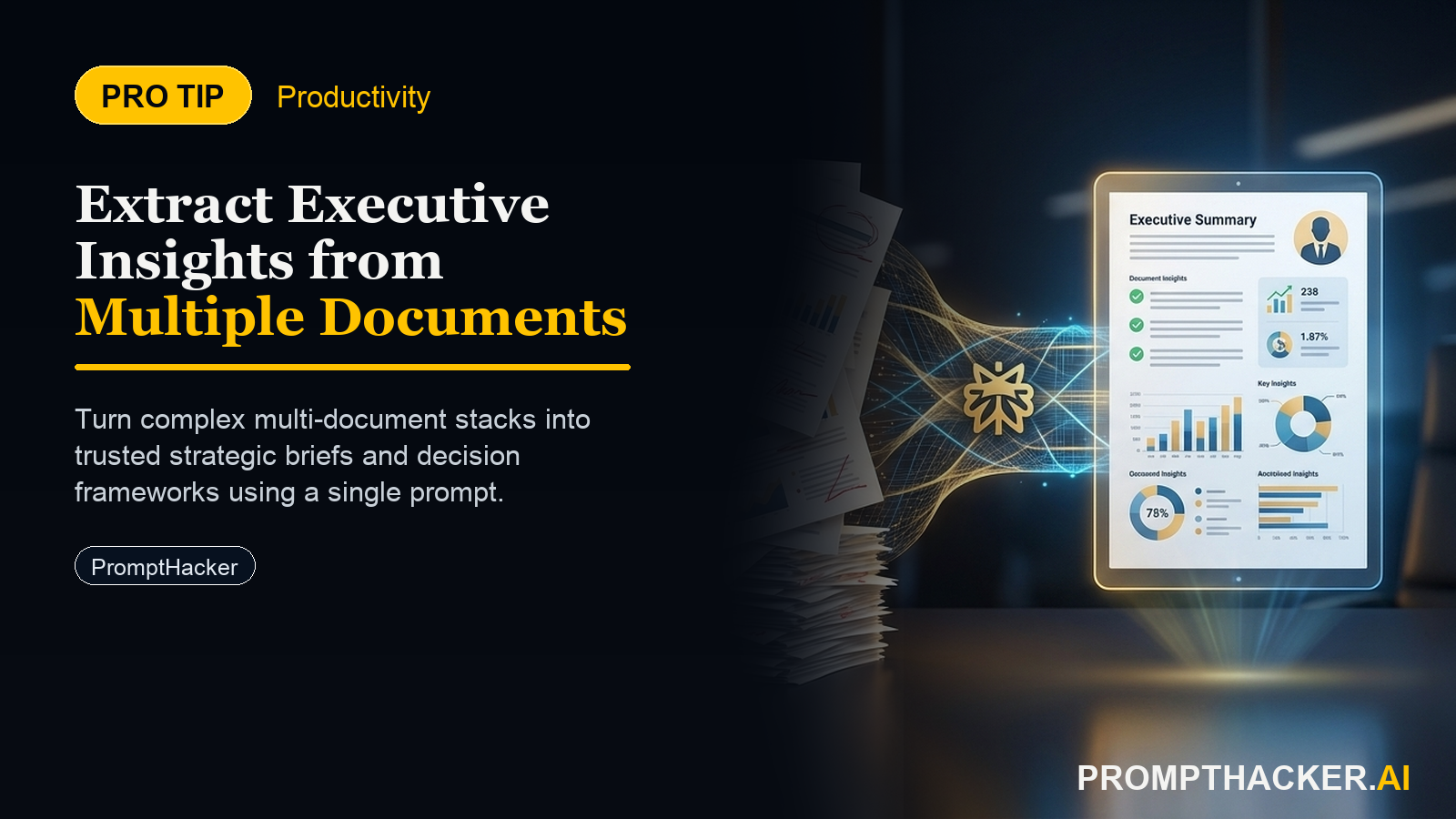
This Pro Tip introduces the "Strategic Digest" pattern, a powerful AI-driven method to transform mountains of data into concise, actionable executive insights. Discover how to leverage advanced large language models to act as your personal strategic analyst, distilling complex documents into the essential information needed for informed, high-stakes decision-making. This approach significantly reduces preparation time, sharpens strategic focus, and ensures no critical information is overlooked.

Executives are constantly inundated with information, yet the most valuable commodity remains time. The "Strategic Digest" pattern is engineered to give back that time by automating the initial, labor-intensive phase of strategic analysis. This method allows an executive to upload multiple, diverse documents to an advanced large language model (LLM), such as Claude 3 Opus, and receive a synthesized, executive-ready report in minutes. The core value lies in the AI's ability to process vast contexts, identify patterns across documents, and present information with a strategic lens.

Tool: Claude 3 Opus (or similar advanced LLM with document upload capabilities) Pattern: The "Strategic Digest" Pattern Time to value: 7 minutes for initial digest generation, 20-30 minutes for refinement.

Step 1: Consolidate and Prepare Your Documents

Before engaging the AI, gather all relevant documents. These can include internal reports (e.g., quarterly performance, sales forecasts, project updates), external market research, competitor analyses, industry trend reports, analyst briefings, and customer feedback summaries. The strength of this pattern lies in its ability to cross-reference information from varied sources.

Why this step matters

The quality of the AI's output is directly proportional to the quality and relevance of the input. Consolidating documents ensures the AI has all necessary information to draw comprehensive conclusions. It also prevents the need for multiple, fragmented AI interactions.

Potential pitfalls and solutions

Too many documents or overly large files: While Claude 3 Opus boasts a large context window, extremely voluminous inputs (e.g., hundreds of pages across dozens of documents) can still strain its processing. Solution: Prioritize the most critical documents. If facing an exceptionally large input, consider breaking it into thematic chunks and running separate digests, then summarizing the summaries.

Inconsistent formatting: Documents in vastly different formats (e.g., PDFs, Word, Excel, text files) are generally handled well by advanced LLMs. However, poorly scanned PDFs or image-only documents may not be fully readable. Solution: Convert image-only PDFs to text-searchable PDFs where possible. For critical data in spreadsheets, consider extracting key tables into a text-based format or describing the data within the prompt.

Step 2: Craft Your "Strategic Digest" Prompt

The prompt is the instruction set for your AI strategic analyst. It must be explicit, defining the AI's role, the task, the focus areas, and the desired output format.

FULL EXAMPLE PROMPT

"You are a highly skilled strategic analyst. I am uploading several documents (e.g., quarterly reports, market research, competitor analyses). Your task is to synthesize these documents to provide a concise strategic digest for an executive leadership team. Focus on: 1. Key Takeaways: Summarize the most critical information from all documents combined. 2. Emerging Trends: Identify any overarching trends, opportunities, or threats. 3. Strategic Implications: What does this mean for our company's current strategy? 4. Actionable Insights: Suggest 3-5 concrete actions or areas for further investigation. 5. Conflicting Information: Highlight any areas where documents present contradictory data or perspectives. Present this information in a structured, executive-ready format, using clear headings and bullet points. Do not exceed 800 words for the entire digest."

Why this prompt works

Explicit Role Setting ("You are a highly skilled strategic analyst"): This primes the AI to adopt a specific persona, influencing its tone, focus, and analytical depth. It encourages a professional, results-oriented output.

Clear Task Definition ("Your task is to synthesize these documents..."): No ambiguity about the objective. The AI knows it needs to integrate information, not just summarize individual documents.

Target Audience ("for an executive leadership team"): This guides the AI to prioritize high-level, strategic information over granular details, ensuring the language and focus are appropriate for executive consumption.

Structured Focus Areas (1-5): This is the core of the pattern. By explicitly asking for "Key Takeaways," "Emerging Trends," "Strategic Implications," "Actionable Insights," and "Conflicting Information," the prompt forces the AI to perform specific analytical operations. This prevents generic summaries and ensures the output directly addresses executive needs. Key Takeaways: Ensures the most vital information is not missed. Emerging Trends: Critical for foresight and proactive strategy. Strategic Implications: Connects the data directly to the company's current and future direction. Actionable Insights: Translates analysis into potential next steps, moving beyond mere observation. Conflicting Information: Acknowledges the complexity of real-world data, providing a more nuanced and trustworthy analysis by flagging discrepancies.

Desired Format ("structured, executive-ready format... headings and bullet points"): Ensures readability and immediate utility for busy executives.

Word Limit ("Do not exceed 800 words"): Enforces conciseness, a hallmark of effective executive communication.

Step 3: Execute and Review the Initial Digest

Upload your prepared documents to Claude 3 Opus (or your chosen LLM) and then paste the prompt. The AI will process the information and generate the strategic digest.

Why this step matters

This is where the AI's processing power converts raw data into structured insights. The initial review is crucial for verifying accuracy and alignment with your specific needs.

Potential pitfalls and solutions

AI "Hallucinations" or misinterpretations: While advanced LLMs are less prone to factual errors, they can still misinterpret nuanced data or draw incorrect inferences, especially with complex or ambiguous inputs. Solution: Cross-reference critical claims in the AI's digest with the original documents. If a specific data point or conclusion seems off, quickly locate it in the source. This is why having the original documents readily accessible is key.

Generic or vague output: Sometimes, despite a specific prompt, the AI might produce a digest that is too high-level or lacks sufficient detail. Solution: Use follow-up prompts. For example, "Expand on the strategic implications for our R&D department, referencing specific projects mentioned in the 'Q4 Performance Report'." Or, "Provide specific data points to support the claim about 'emerging market opportunity' from the 'Market Research Study X'."

Step 4: Refine for Depth and Nuance

The initial digest is a powerful first draft, but it often benefits from executive-level refinement. This involves adding your unique business context, deeper strategic thinking, and any specific nuances the AI might have missed.

Why this step matters

The AI provides the synthesis, but human executives provide the wisdom. This step ensures the digest is not just informative but also strategically sound and aligned with the company's specific objectives and unspoken context.

Real-world scenario for refinement: Consider a Head of Product at a software company. They used the "Strategic Digest" pattern to analyze several beta test reports, customer support tickets, and competitor feature releases. The AI identified a strong trend towards "user-friendly onboarding" and suggested investing in new tutorials. The Head of Product reviews this. While accurate, they know that the company's current engineering roadmap is already stretched thin with a major platform migration. They might refine the "Actionable Insights" to prioritize "investigate third-party onboarding solutions" or "allocate dedicated UX resources for a phased onboarding improvement plan," reflecting the internal constraints and strategic priorities that the AI cannot know. This refinement transforms a good AI output into an excellent, actionable executive document.

Potential pitfalls and solutions

Over-reliance on AI: Treating the AI's output as a final, uneditable document can lead to missed opportunities for deeper human insight and strategic alignment. Solution: Always approach the AI's digest as a highly advanced first draft. Dedicate time for critical review, questioning, and adding your unique executive perspective.

Losing the AI's initial value: Over-editing can dilute the efficiency gains. Solution: Focus refinement on strategic implications, actionability, and alignment with internal context. Avoid re-writing sections that are already clear and accurate.

By integrating this "Strategic Digest" pattern into your workflow, you dramatically reduce the time spent on information synthesis, allowing more bandwidth for critical thinking, strategic planning, and leadership.

Action Steps Summary

Bottom line

The value of Rapid Strategic Digest: Extract Executive Insights from Multiple Documents is repetition. Run it on one real task, save the version that works, and turn the result into a small weekly habit instead of another one-time AI experiment.

About the author

Pierre Bradshaw Founder, PromptHacker.ai

Pierre has spent 25+ years building growth systems across fintech, real estate, lending, campaigns, and AI workflows, with machine-learning work dating back to 2012.

If you have any questions or comments about Rapid Strategic Digest: Extract Executive Insights from Multiple Documents feel free to reach out. I'd love to hear from you.

Contact Pierre
Free weekly briefing

Three deep dives. Four useful moves. One email worth opening.

PromptHacker turns the AI firehose into practical next steps for work, health, family, and everything time keeps trying to steal.