Automate Weekly Executive Meeting Prep with AI-Driven Agenda and Action Tracking
How to integrate AI for pre-meeting data synthesis, streamlining information review.
What matters today
How to integrate AI for pre-meeting data synthesis, streamlining information review.
Article roadmap
What you will learn
-
How to define a clear meeting profile to ensure AI generates relevant agendas.
-
How to craft a master prompt for consistent, AI-generated meeting agendas.
-
How to integrate AI for pre-meeting data synthesis, streamlining information review.
-
How to design a post-meeting prompt for automated summaries and action item extraction.
-
How to implement a reusable AI template to reclaim 75 minutes of executive time per recurring meeting.
A VP of Operations at a rapidly expanding tech firm faces a familiar challenge every Monday morning. The weekly leadership sync, vital for strategic alignment, often begins with a fragmented agenda. Key updates are scattered across emails, project management tools, and impromptu discussions. Post-meeting, compiling notes, extracting action items, and ensuring accountability consumes another hour, often delaying critical follow-ups. This executive finds themselves spending precious weekend hours just preparing for the week's first major internal commitment.
Without a structured, efficient approach, these recurring executive meetings become a drain on resources rather than a driver of progress. Inconsistent agendas lead to off-topic discussions. Poorly documented action items result in missed deadlines and a lack of accountability. The cumulative effect is delayed decision-making, reduced operational velocity, and executives spending valuable time on administrative overhead instead of strategic initiatives. The cost is not just in wasted hours, but in lost opportunities and slowed growth.
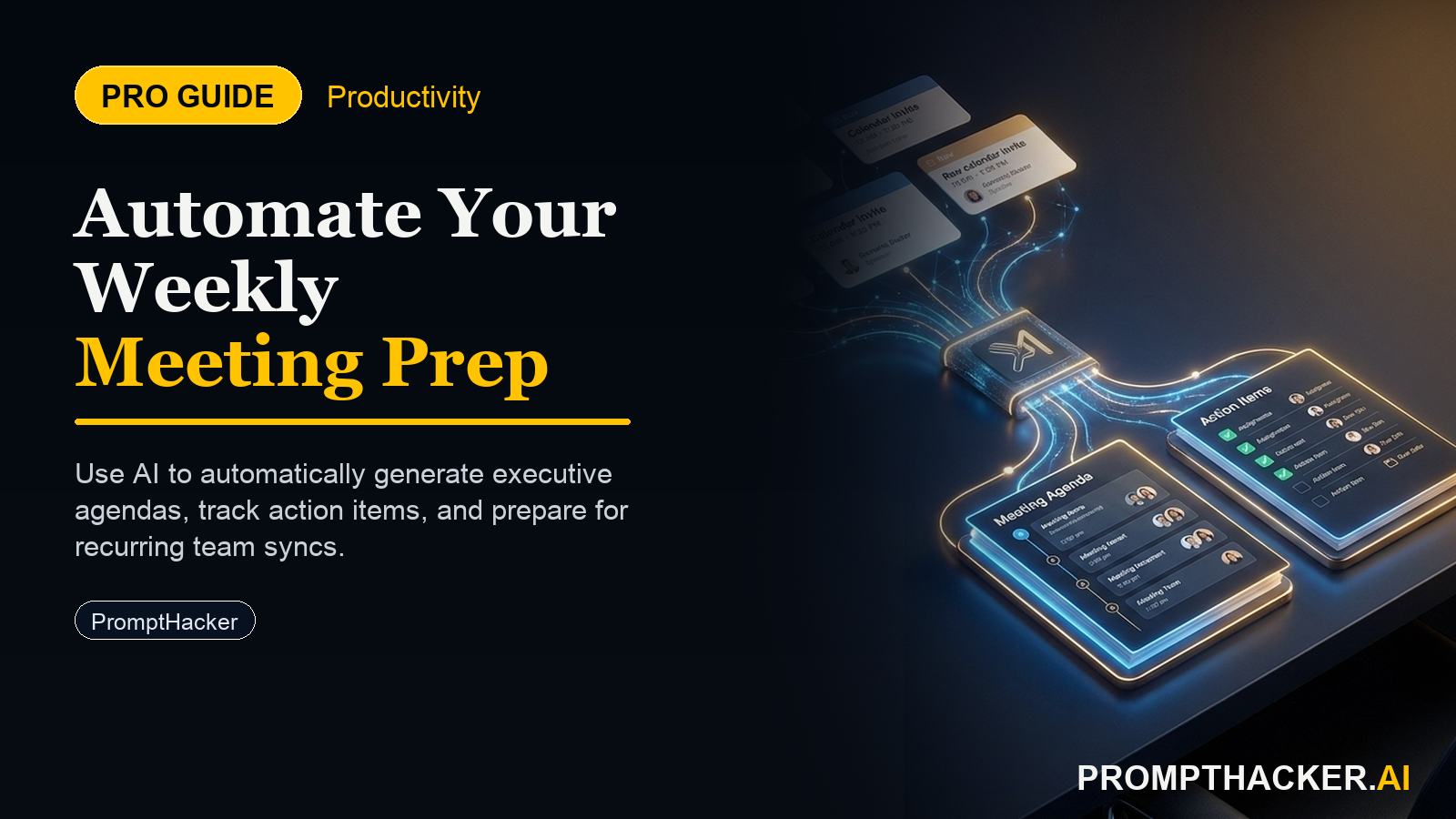
This article details a straightforward, AI-driven system designed to automate the most time-consuming aspects of executive meeting preparation and follow-up. Executives can implement a reusable template and prompt chain to generate structured agendas, synthesize pre-meeting data, and automate post-meeting summaries with clear action items. This approach reclaims an average of 75 minutes per recurring meeting, allowing leaders to focus on high-impact strategic work.
The consistent demands of executive leadership often include a heavy calendar of recurring meetings. These meetings, while crucial for alignment and decision-making, can become significant time sinks due to manual preparation, scattered information, and inefficient follow-up processes. An AI-driven approach offers a powerful solution, standardizing these processes and ensuring every meeting is productive and actionable. This Productivity Gem outlines a system to automate recurring executive meeting preparation and follow-up, leveraging a prompt chain to generate agendas, synthesize data, and extract action items efficiently.
The benefit of this system extends beyond simple time savings. It ensures consistency in meeting structure, improves the quality of pre-meeting insights, and enhances accountability through automated action item tracking. Executives gain predictability and reliability in their meeting cadence, allowing them to allocate mental energy to the strategic content of discussions rather than the administrative burden.
Time to value: 20 minutes (initial setup).
Setup Steps for Automated Executive Meeting Prep and Follow-up
Implementing this Productivity Gem involves a one-time setup of a prompt chain within your chosen AI tool (e.g., ChatGPT-4o or equivalent). This sequence creates a reusable template that streamlines your recurring meeting workflow.
1. Define Your Meeting Profile
Before crafting prompts, clearly define the type of recurring meeting you intend to automate. This foundational step ensures the AI generates relevant and focused content. Consider the meeting's primary objective, typical attendees, standard duration, and key discussion areas. For example, a "Weekly Leadership Sync" might focus on operational updates, strategic initiatives, and team performance, while a "Monthly Board Report Prep" would center on financial performance, market conditions, and governance items.
Why it works: Providing a detailed profile gives the AI the necessary context to tailor its output precisely. Without this, prompts can yield generic or irrelevant information, requiring extensive manual correction. A well-defined profile acts as the guardrails for the AI, ensuring its output is immediately useful.
2. Craft the Master Agenda Generation Prompt
This prompt will be the core of your pre-meeting automation. It instructs the AI to create a structured agenda based on your defined meeting profile and any new inputs. The prompt should be comprehensive enough to cover standard sections while remaining flexible for weekly adjustments.
"You are an expert executive assistant. Create a structured agenda for our [Meeting Name]. The objective is [Objective]. Use the following inputs: [Insert raw notes/updates]. Ensure the agenda includes time allocations for each section and highlights critical decision points."
Ready to scale your productivity?
Get full access to our library of executive-grade AI templates and workflows.
Three deep dives. Four useful moves. One email worth opening.
PromptHacker turns the AI firehose into practical next steps for work, health, family, and everything time keeps trying to steal.