PH PROMPTHACKER.AI

Claude 3.5 Opus Elevates Strategic Planning for C-Suite Decisions

Claude 3.5 Opus enhances strategic planning, enabling executives to explore business strategies and forecast outcomes accurately.

June 18, 2025 9 min read
anthropic claude opus strategic planning boost
Quick Scan

What matters today

Claude 3.5 Opus enhances strategic planning, enabling executives to explore business strategies and forecast outcomes accurately.

Format TOP UPDATE
Audience Executives using AI at work
Time 9 min read
Topic Anthropic

Key points

  • Step 1: Access Claude 3.5 Opus
  • Step 2: Input Your Strategic Challenge and Relevant Data
  • Step 3: Prompt Claude for Strategic Options and Analysis
  • Step 4: Analyze Claude's Detailed Scenarios and Recommendations
  • Step 5: Inform Board Discussions and Refine Strategies

What you will learn in this article:

  • How to leverage Claude 3.5 Opus to generate multiple strategic options for market expansion.
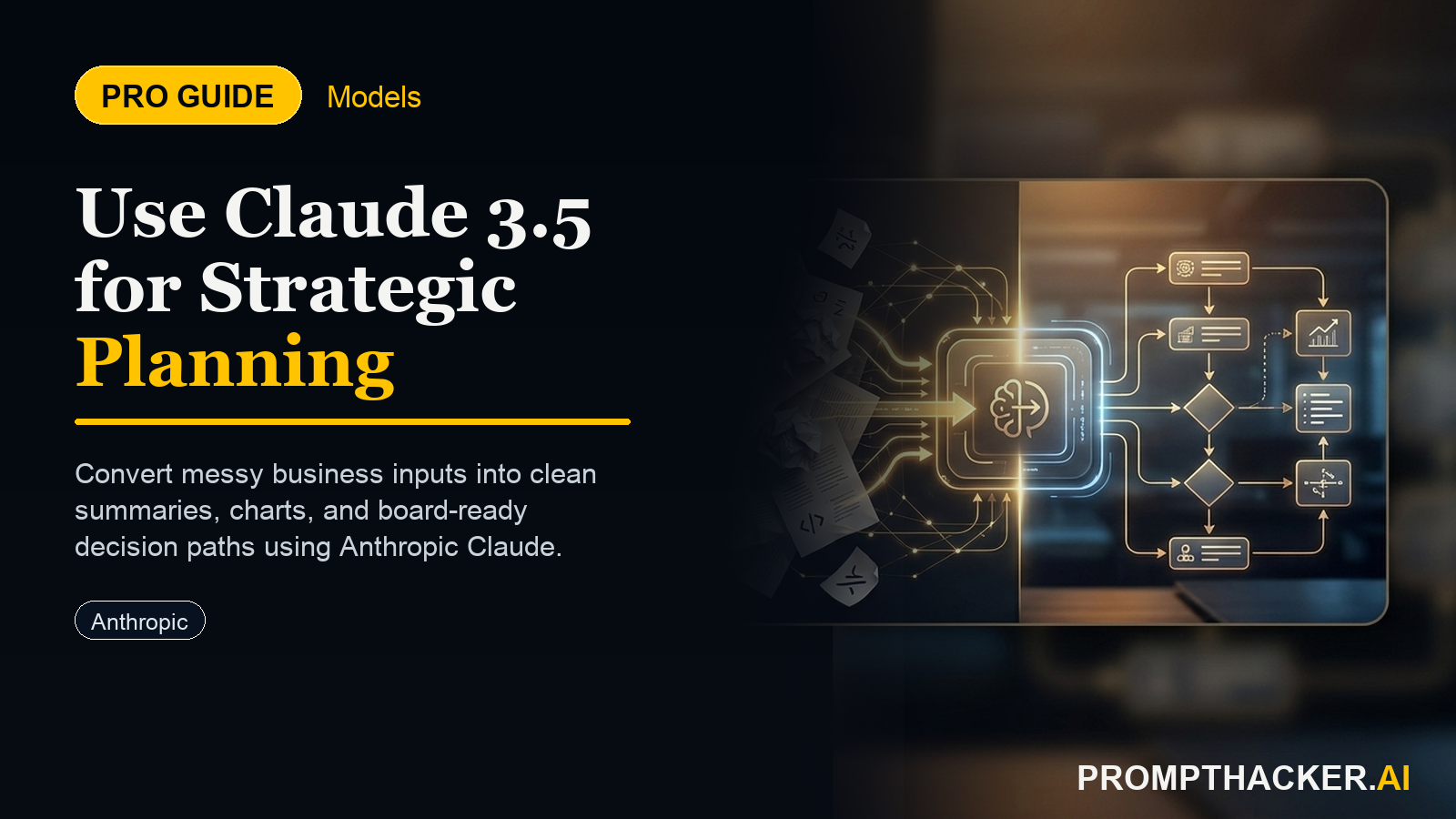
  • How to use AI to forecast business outcomes with greater accuracy, reducing manual modeling efforts.
  • How to integrate advanced scenario analysis into board discussions for informed decision-making.
  • How to accelerate strategic planning processes, saving 110 minutes weekly on research and analysis.

A CEO of a mid-sized manufacturing firm is facing unprecedented market shifts. New competitors are emerging, supply chains are volatile, and customer demands are rapidly evolving. The executive team needs a robust strategy for growth and resilience, but traditional manual research and hypothetical modeling consume weeks, often leaving critical decisions to intuition rather than data-driven scenarios. The pressure is on to identify viable strategic options, assess their risks, and forecast potential outcomes with speed and precision.

Without a systematic approach to strategic planning, the firm risks losing market share, making suboptimal investments, and failing to adapt to a dynamic business landscape. Competitors who move faster with data-backed strategies will gain a significant advantage, potentially jeopardizing the company's long-term viability. The cost of slow, inefficient strategic analysis is not just lost time, but lost opportunity and increased operational risk.

This article details how Anthropic's Claude 3.5 Opus provides a powerful AI co-pilot for these high-stakes strategic planning challenges. Executives can now explore multiple business strategies and forecast outcomes with greater accuracy, accelerating critical decision-making processes. Learn the precise steps to integrate this advanced AI into your strategic workflow and regain 110 minutes weekly in focused, data-driven planning.

Anthropic has released a significant update to Claude 3.5 Opus, enhancing its ability to assist with complex strategic planning and scenario analysis. This update improves the model's reasoning over large, unstructured datasets, enabling executives to explore diverse business strategies and forecast outcomes with greater accuracy. The result is a more efficient and informed strategic planning cycle, eliminating extensive manual research and hypothetical modeling for key initiatives. Executives using this update gain an estimated 110 minutes per week, making it an essential tool for C-suite executives and business development leads.

Step 1: Access Claude 3.5 Opus

The first step in leveraging these enhanced capabilities is to access Anthropic's flagship model, Claude 3.5 Opus. This model is designed for complex reasoning tasks, making it suitable for high-level strategic discussions. Ensuring access to the most advanced version of Claude ensures that the AI can handle the depth and breadth of data required for robust strategic analysis.

Accessing Claude 3.5 Opus involves logging into the Anthropic platform. The interface is designed for executive use, providing a clean workspace to input prompts and review outputs. Familiarity with the platform's basic features, such as chat history and file upload options, helps streamline the strategic planning process. This initial step ensures that the executive is operating with the most capable AI tool for the task at hand.

Step 2: Input Your Strategic Challenge and Relevant Data

Once Claude 3.5 Opus is open, the next critical step involves clearly articulating your strategic challenge and providing all relevant supporting data. This includes both market data and internal resources. A clear, concise problem statement guides the AI, while comprehensive data ensures its analysis is grounded in reality.

For a strategic challenge, consider questions like: "How can our retail chain expand into a new geographic region?", "What is the optimal strategy to counter a new competitor's market entry?", or "How should we diversify our product portfolio in a changing economic climate?" The more specific the challenge, the more targeted Claude's output will be.

Relevant market data can include competitor reports, industry trend analyses, demographic shifts, economic forecasts, regulatory changes, and consumer behavior studies. Internal resources might encompass financial reports, talent pool assessments, R&D capabilities, existing infrastructure, operational capacities, and current sales performance. Claude 3.5 Opus excels at reasoning over large, unstructured datasets, meaning you can upload lengthy documents, reports, and internal memos directly. This reduces the time spent manually extracting key information.

When dealing with sensitive internal data, consider anonymizing specific figures or using a secure, internal deployment of Claude if available. This protects proprietary information while still allowing the AI to process the necessary context. The quality and completeness of the input data directly influence the quality and relevance of Claude's strategic recommendations.

Step 3: Prompt Claude for Strategic Options and Analysis

With the strategic challenge and data in place, you are ready to prompt Claude for generating strategic options. The prompt should be clear, specific, and guide the AI toward the desired output format and content. This is where the core value of Claude 3.5 Opus's enhanced reasoning capabilities becomes apparent.

For example, if the challenge is market expansion, use the following verbatim prompt:

VERBATIM PROMPT

"Generate three distinct strategic options for market expansion, including potential risks and benefits."

This prompt is effective because it asks for "distinct" options, pushing Claude to explore varied approaches rather than slight variations of a single idea. Requesting "potential risks and benefits" ensures a balanced analysis for each option, preparing executives for a comprehensive evaluation.

Claude processes this input by analyzing the provided market data and internal resources, identifying patterns, trends, and potential opportunities or constraints. Its improved reasoning engine allows it to synthesize this information into coherent, actionable strategies. For the retail chain example, Claude might generate options such as:

  • Aggressive Acquisition of Local Competitors: This option involves identifying and acquiring existing smaller retail chains in the target region to quickly gain market share and infrastructure. Risks include high upfront capital investment, integration challenges, and potential cultural clashes. Benefits include rapid market entry, immediate customer base, and reduced time to profitability.
  • Phased Organic Growth with Targeted Marketing: This strategy focuses on opening a few flagship stores in key urban centers, supported by localized digital marketing campaigns and community engagement. Risks include slower market penetration and intense competition from established players. Benefits include lower initial capital outlay, greater control over brand image, and flexibility to adapt based on early market feedback.
  • Partnership with a Local Logistics Provider for Rapid Entry: This approach leverages a local partner's distribution network and supply chain expertise to establish an online presence with minimal physical footprint initially, followed by selective store openings. Risks include dependence on partner performance and potential loss of direct customer interaction. Benefits include reduced operational overhead, faster supply chain setup, and access to local market knowledge.

If the initial options are not sufficiently distinct, refine the prompt. For instance, you might add: "Ensure one option focuses on sustainability, another on rapid market disruption, and a third on incremental, low-risk growth." This guides Claude to diversify its output further. The goal is to generate a range of viable pathways to thoroughly explore.

Step 4: Analyze Claude's Detailed Scenarios and Recommendations

The output from Claude 3.5 Opus provides a detailed foundation, but it is not the final decision. The next step involves critically analyzing the generated scenarios and recommendations. This requires human judgment, internal expertise, and a deep understanding of the organization's unique context.

Evaluate each option for logical consistency, ensuring that the proposed benefits align with the strategy and that the identified risks are comprehensive. Cross-reference Claude's insights with your own market intelligence and internal data. For example, if Claude suggests an aggressive acquisition strategy, assess its feasibility against your company's current M&A capabilities and financial liquidity. If it proposes organic growth, consider your marketing team's bandwidth and historical success with similar campaigns.

This analytical phase is where executives add value by identifying gaps in the AI's reasoning, challenging assumptions, and integrating qualitative factors that AI might miss. For the retail chain's expansion, the executive team would assess each option against strategic priorities like brand reputation, long-term growth targets, and risk tolerance. They might realize that while "Aggressive Acquisition" offers rapid entry, it conflicts with a corporate culture focused on organic, sustainable growth.

The estimated 110 minutes saved weekly comes from Claude handling the initial heavy lifting of research synthesis and option generation. Instead of spending days brainstorming and compiling preliminary reports, executives can dedicate that time to the higher-value task of critical evaluation, refinement, and strategic decision-making.

Step 5: Inform Board Discussions and Refine Strategies

The final step is to translate these AI-generated insights into actionable intelligence for board discussions and the refinement of long-term business strategies. Claude 3.5 Opus serves as a powerful co-pilot, not a replacement for executive leadership.

Use Claude's detailed scenarios and risk/benefit analyses to structure presentations for board meetings or executive strategy sessions. Present the distinct options, highlighting the pros and cons of each as identified by the AI and refined by your team. This approach facilitates a more informed and efficient debate, as board members can immediately engage with well-defined strategic pathways rather than starting from scratch.

For a tech startup considering a pivot, Claude could analyze various new market opportunities, competitive landscapes, and potential product-market fit for different pivot options. The executive team could then present these options to investors, demonstrating a thorough, data-driven approach to adapting their business model. This process accelerates decision-making, allowing the startup to respond quickly to market demands.

The ability to present pre-vetted, data-backed strategic options accelerates the entire decision-making process. It moves discussions from "what are our options?" to "which option should we pursue, and how?" This efficiency is crucial for maintaining agility in competitive markets and ensuring that strategic initiatives are grounded in comprehensive analysis. The strategic insights derived from Claude 3.5 Opus empower executives to make faster, more confident decisions that drive long-term success.

Action Steps Summary

  • Access Claude 3.5 Opus: Log into the Anthropic platform to ensure you are using the most advanced version of Claude for complex reasoning tasks. This provides access to its enhanced strategic planning capabilities.
  • Input Strategic Challenge and Data: Clearly define your strategic problem and upload all relevant market data and internal resources. This comprehensive input guides Claude's analysis and ensures its recommendations are grounded in current business realities.
  • Prompt for Strategic Options: Use a specific prompt, such as "Generate three distinct strategic options for market expansion, including potential risks and benefits," to direct Claude toward generating varied and balanced strategic pathways. This leverages Claude's ability to synthesize complex information into actionable plans.
  • Analyze Detailed Scenarios: Critically evaluate Claude's generated scenarios and recommendations, cross-referencing them with internal expertise and qualitative factors. This step ensures that AI-driven insights are refined with human judgment before being presented to stakeholders.
  • Inform Board Discussions and Refine Strategies: Translate Claude's insights into structured presentations for board meetings, facilitating informed debate and accelerating critical decision-making. This positions the executive team to make faster, data-backed strategic choices.

Bottom line

The useful move with Claude 3.5 Opus Elevates Strategic Planning for C-Suite Decisions is to run one narrow test this week, then keep only the workflow that saves time, improves a decision, or gives your team clearer output. Treat the announcement as raw material, not the win itself.

About the author

Pierre Bradshaw Founder, PromptHacker.ai

Pierre has spent 25+ years building growth systems across fintech, real estate, lending, campaigns, and AI workflows, with machine-learning work dating back to 2012.

If you have any questions or comments about Claude 3.5 Opus Elevates Strategic Planning for C-Suite Decisions feel free to reach out. I'd love to hear from you.

Contact Pierre
Free weekly briefing

Three deep dives. Four useful moves. One email worth opening.

PromptHacker turns the AI firehose into practical next steps for work, health, family, and everything time keeps trying to steal.