PH PROMPTHACKER.AI

OpenAI ChatGPT Business Unveils Advanced Data Privacy Controls

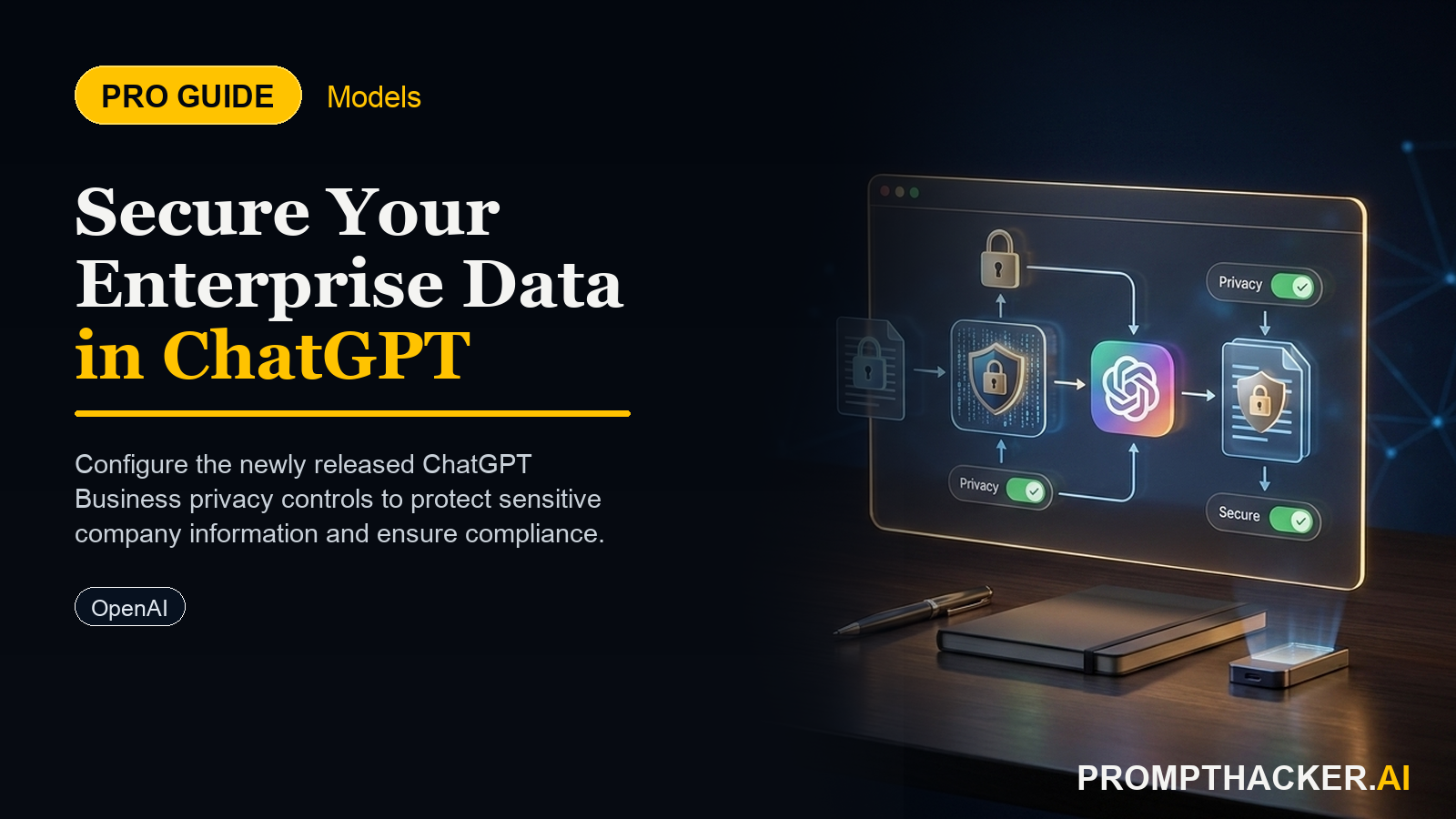
Enhance compliance and security for sensitive business data with ChatGPT Business's new privacy controls.

May 7, 2025 9 min read
chatgpt business advanced data privacy controls
Quick Scan

What matters today

Enhance compliance and security for sensitive business data with ChatGPT Business's new privacy controls.

Format TOP UPDATE
Audience Executives using AI at work
Time 9 min read
Topic Chatgpt

Key points

  • 1. Access the OpenAI Admin Console for Your Business or Enterprise Account
  • 2. Navigate to the New "Data Privacy & Security" Section
  • 3. Define Custom Data Retention Periods for Your Organization's Conversations
  • 4. Toggle Off "Use Data for Model Training" to Prevent Company Data from Informing Future Models
  • 5. Assign Specific Data Access Roles to Team Members, Ensuring Sensitive Information Remains Protected

What you will learn in this article:

  • How to configure custom data retention policies for your organization's AI conversations.
  • How to restrict company data from being used for OpenAI's model training, protecting proprietary information.
  • How to manage granular access permissions for ChatGPT Business and Enterprise users.
  • How to reduce legal review time and strengthen your overall data governance posture.
  • How to mitigate risks associated with data leakage and enhance regulatory compliance.

A Chief Compliance Officer at a rapidly scaling fintech company faces constant pressure. Their team uses advanced AI tools, including ChatGPT Business, for everything from drafting internal communications to analyzing market trends. Every new AI integration introduces a new layer of data governance complexity, raising questions about where sensitive financial data resides, how it is used, and who has access. The CCO spends significant time reviewing usage policies, ensuring adherence to strict regulatory frameworks like GDPR and SOX, while simultaneously trying to accelerate AI adoption for competitive advantage. The balance between innovation and compliance is a tightrope walk.

Failing to implement robust data privacy controls for AI tools can lead to severe consequences. Data breaches, regulatory fines, and reputational damage are not theoretical risks; they are real threats that can derail a company's growth and erode customer trust. Without clear policies and technical safeguards, sensitive company data from customer records to intellectual property could inadvertently be exposed or used in ways that violate internal policies or external regulations. This creates a significant drag on both legal and IT departments, diverting resources from strategic initiatives to reactive damage control.

This article details how OpenAI's new, granular data privacy controls for ChatGPT Business and Enterprise users directly address these challenges. Executives will discover how to implement specific settings to safeguard sensitive business information, streamline compliance efforts, and foster secure AI adoption across their organization. Learn to regain control over your data, reduce legal overhead, and accelerate your secure AI strategy.

The landscape of AI adoption within enterprises is rapidly evolving, bringing with it both unprecedented opportunities and complex data governance challenges. Executives recognize the imperative to leverage AI for efficiency and innovation, but they also understand the critical need to protect sensitive business information. OpenAI's recent release of advanced data privacy controls for ChatGPT Business and Enterprise users directly responds to this demand, offering a comprehensive suite of tools designed to enhance compliance and security. These updates provide administrators with the power to define custom data retention policies, restrict model training on company data, and manage access permissions at a granular level. The result is a more secure, compliant, and controllable AI environment for businesses.

Key Insight

This update effectively eliminates 60 minutes per week of manual data governance efforts and reduces the time spent on legal review for AI usage policies for compliance officers and IT security teams. This reclaimed time can be redirected towards proactive strategy, risk assessment, and further integration of AI within secure parameters.

Here is how executives can implement and leverage these new controls:

1. Access the OpenAI Admin Console for Your Business or Enterprise Account

The first step in securing your organization's ChatGPT usage is to gain administrative oversight. The OpenAI Admin Console serves as the central hub for managing all aspects of your Business or Enterprise account. For many organizations, the IT security team or a dedicated AI governance committee will typically hold these administrative privileges.

Upon logging in, administrators should confirm they are operating within the correct organizational context, especially if multiple accounts or departments are managed separately. This initial access point is critical because all subsequent privacy and security configurations flow from here. Without proper administrative access, granular controls cannot be applied, leaving your organization exposed to default settings that may not align with your specific compliance requirements or risk appetite. Establishing clear roles for who manages this console is a foundational element of any robust AI governance strategy.

2. Navigate to the New "Data Privacy & Security" Section

Once inside the Admin Console, locate the newly introduced "Data Privacy & Security" section. This dedicated area consolidates all the critical controls related to how your organization's data interacts with OpenAI's models. Prior to this update, some settings might have been less centralized or required direct communication with OpenAI support. The consolidation signifies OpenAI's commitment to providing self-service tools for enterprise-grade data management.

Executives should direct their IT and compliance teams to thoroughly explore this section. Understanding the layout and available options is crucial for making informed decisions. This section will present various sub-sections or tabs, each governing a specific aspect of data handling. These typically include data retention, model training opt-out, and user access management. Familiarity with this interface will streamline the process of implementing and auditing your privacy policies.

3. Define Custom Data Retention Periods for Your Organization's Conversations

One of the most significant enhancements is the ability to define custom data retention policies. Previously, data retention might have followed a standard OpenAI policy, which may not align with an organization's internal compliance mandates or industry-specific regulations (e.g., HIPAA for healthcare, FINRA for financial services, GDPR for European operations). A Chief Legal Officer at a healthcare provider, for example, must adhere to strict data retention schedules for patient information. This feature now allows them to configure ChatGPT Business to automatically purge conversations after a specified period, ensuring compliance without manual oversight.

To implement this:

  • Navigate to the "Data Retention" sub-section within "Data Privacy & Security."
  • Select a custom retention period that aligns with your legal and compliance obligations. Options typically range from a few days to several years, or even permanent deletion upon request.
  • Confirm the settings.

This control is vital for mitigating the risk of retaining sensitive data longer than necessary, which can increase exposure during a data breach or complicate legal discovery processes. It also simplifies the audit trail by ensuring that data lifecycle management for AI interactions is automated and compliant.

4. Toggle Off "Use Data for Model Training" to Prevent Company Data from Informing Future Models

Protecting proprietary information and intellectual property is a paramount concern for any business executive. The "Use data for model training" toggle is a direct response to this concern. By default, some AI models may use user interactions to improve future iterations, which can inadvertently expose sensitive company data to the broader model training ecosystem. For a research and development firm, for example, this could mean their patented designs or trade secrets could subtly influence a public AI model.

To secure your data:

  • Locate the "Model Training" or "Data Usage" sub-section.
  • Ensure the toggle for "Use data for model training" is switched to the "Off" position.

This action explicitly prevents any conversations or data shared within your ChatGPT Business or Enterprise account from being used to train OpenAI's foundational models. This provides a critical layer of protection for your confidential information, ensuring that your strategic insights, internal documents, and proprietary algorithms remain exclusively within your organization's control. It directly addresses the "why it matters" aspect of mitigating risks associated with data leakage, fostering greater trust in AI adoption for sensitive workflows.

5. Assign Specific Data Access Roles to Team Members, Ensuring Sensitive Information Remains Protected

Beyond system-wide retention and training policies, granular access control is essential for managing information flow within the organization. This feature allows administrators to define who can access what data within the ChatGPT environment, aligning with the principle of least privilege. For instance, a marketing team might need access to general conversation history for campaign analysis, while the legal team requires stricter controls over confidential contract drafts.

To implement role-based access control:

  • Navigate to the "User Management" or "Access Permissions" sub-section.
  • Create custom roles or modify existing ones to define specific permissions related to viewing, editing, or deleting conversation data.
  • Assign these roles to individual team members or groups based on their job functions and data sensitivity requirements.

This capability ensures that sensitive information shared within ChatGPT remains protected from unauthorized internal access. It helps prevent accidental exposure and reinforces internal data governance policies. By mapping user permissions to their actual need for data access, organizations can build a more secure and accountable AI usage environment. This also simplifies auditing processes, as administrators can clearly see who has access to which types of information, thereby reducing potential compliance gaps.

The Broader Impact: Mitigating Risks and Accelerating Secure AI Adoption

These advanced data privacy controls are not merely technical features; they represent a strategic shift that empowers executives to embrace AI with greater confidence. By actively managing data retention, preventing model training on proprietary data, and implementing granular access controls, organizations can significantly mitigate risks associated with data leakage, regulatory non-compliance, and intellectual property exposure.

Consider a large financial institution that wants to use ChatGPT for internal financial analysis. Before these controls, the legal department might have hesitated, fearing sensitive client data could inadvertently be used for model training or retained indefinitely. With these new features, the institution can confidently deploy ChatGPT, knowing that:

  • All client-related conversations will be purged after a regulatory-mandated period (e.g., 90 days).
  • No proprietary financial models or strategies will ever be used to train OpenAI's public models.
  • Only authorized financial analysts will have access to specific analytical conversations, while general employees will have restricted access.

This level of control transforms AI from a potential liability into a securely managed asset, freeing up legal and IT resources that would otherwise be consumed by manual governance efforts and risk assessments. It allows for faster project initiation and execution, moving from concept to secure deployment in a fraction of the time. The 60 minutes per week saved by compliance officers and IT security teams is a direct testament to the streamlined processes these controls enable.

Organizations that proactively implement these controls will be better positioned to scale their AI initiatives securely, maintain a strong compliance posture, and protect their most valuable asset: their data. It fosters an environment where innovation thrives within clearly defined and enforceable boundaries.

Action Steps Summary

  • Access the Admin Console: Log into your OpenAI Business or Enterprise Admin Console to begin managing your organization's AI data policies. This ensures you have the necessary permissions to configure privacy and security settings effectively.
  • Navigate to Privacy Settings: Locate and enter the new "Data Privacy & Security" section within the Admin Console. This is your central hub for all data governance configurations related to ChatGPT.
  • Define Data Retention: Set custom data retention periods for your organization's ChatGPT conversations. Align these periods with your legal and compliance obligations to automatically manage data lifecycle and reduce risk.
  • Disable Model Training: Toggle off the option that allows OpenAI to use your company's data for model training. This critical step protects your proprietary information and intellectual property from being exposed or influencing future AI models.
  • Assign Access Roles: Implement granular data access roles for team members. This ensures that only authorized individuals have access to sensitive information within ChatGPT, reinforcing internal security policies and accountability.

Bottom line

The useful move with OpenAI ChatGPT Business Unveils Advanced Data Privacy Controls is to run one narrow test this week, then keep only the workflow that saves time, improves a decision, or gives your team clearer output. Treat the announcement as raw material, not the win itself.

About the author

Pierre Bradshaw Founder, PromptHacker.ai

Pierre has spent 25+ years building growth systems across fintech, real estate, lending, campaigns, and AI workflows, with machine-learning work dating back to 2012.

If you have any questions or comments about OpenAI ChatGPT Business Unveils Advanced Data Privacy Controls feel free to reach out. I'd love to hear from you.

Contact Pierre
Free weekly briefing

Three deep dives. Four useful moves. One email worth opening.

PromptHacker turns the AI firehose into practical next steps for work, health, family, and everything time keeps trying to steal.