Claude Sonnet 4.6: The Developer Model That Now Beats Opus 4.5
The specific improvements in Claude Sonnet 4.6 that drove developer preference past Opus 4.5
What matters today
The specific improvements in Claude Sonnet 4.6 that drove developer preference past Opus 4.5
Article roadmap
What you will learn
-
The specific improvements in Claude Sonnet 4.6 that drove developer preference past Opus 4.5
-
The cost calculation: Sonnet 4.6 vs Opus 4.5 for a 20-person team at typical API volume
-
When Opus 4.5 is still the right choice - 3 task categories where the larger model retains the advantage
-
Why 1 million token context on Sonnet 4.6 changes the document analysis tier decision
-
A same-week test plan for evaluating whether your production workflows should migrate
Anthropic released Claude Sonnet 4.6 on February 17, 2026. The price is unchanged from Sonnet 4.5: $3 per million input tokens, $15 per million output tokens. The 1 million token context window - previously available only in Claude Opus 4.6 - is now in beta on Sonnet 4.6. Computer-use accuracy improved across multi-step GUI sequences.
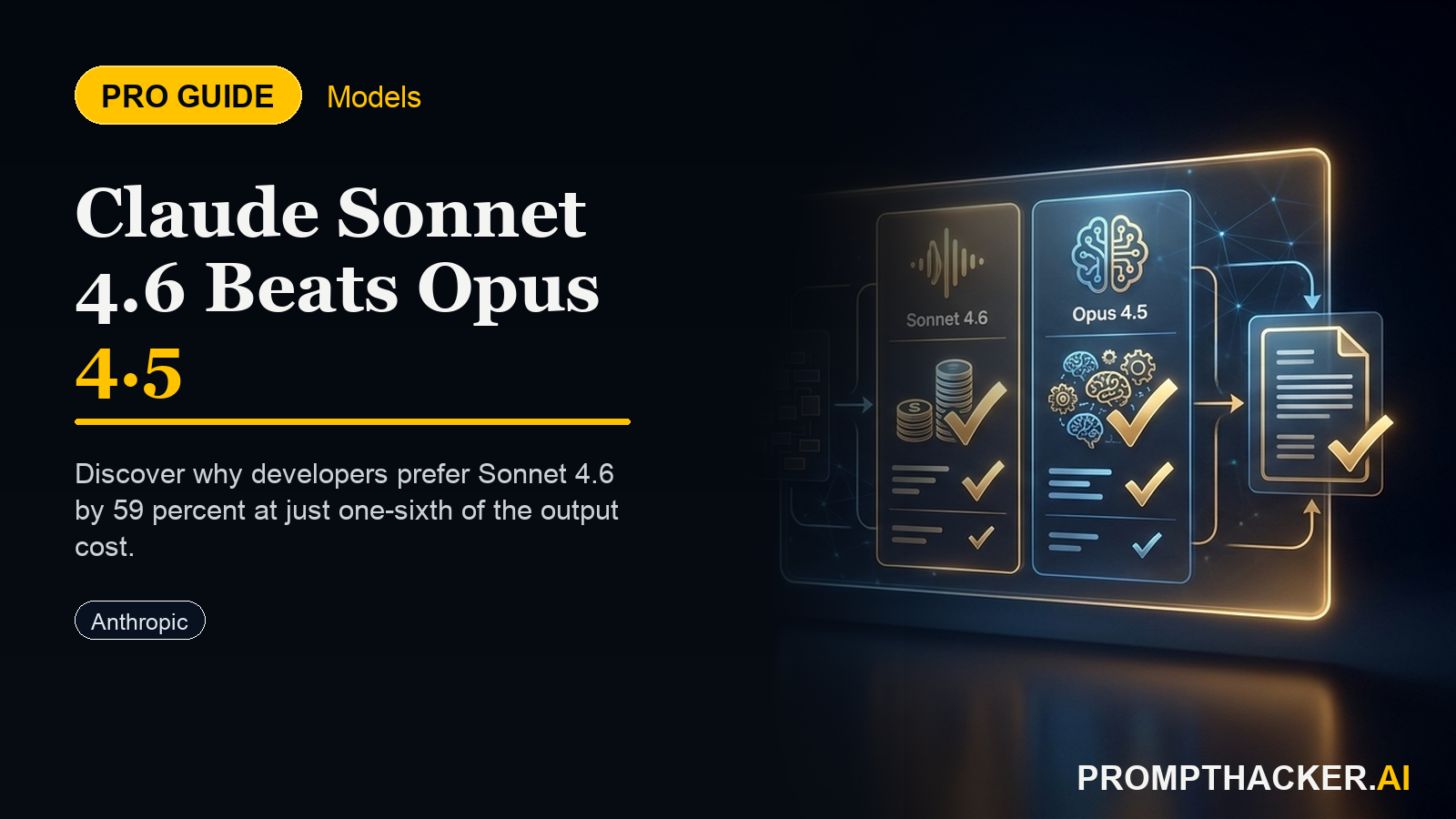
The finding that changes model selection for most executive workflows: 59% of developers in head-to-head testing now prefer Sonnet 4.6 over Claude Opus 4.5. The mid-tier model now outperforms the flagship on the majority of developer tasks - at one-sixth the output cost. Claude Opus 4.5 output pricing is $75 per million tokens. Sonnet 4.6 is $15.
This is a PromptHacker Premium article.
The full cost table, task-type comparison, and migration decision framework are available to Premium subscribers.
What Changed in Sonnet 4.6
Computer-use accuracy. Sonnet 4.6 has lower error rates across multi-step GUI automation sequences - fewer failed clicks, better state tracking when switching between applications, and improved handling of dynamic page elements. For any workflow involving automated desktop or browser control, Sonnet 4.6 is now the recommended tier.
Code generation and instruction-following. Sonnet 4.6 produces more complete, better-structured code outputs from complex specifications. On tasks requiring precise adherence to multi-part instructions, Sonnet 4.6 shows measurable improvement over Sonnet 4.5 and produces results comparable to Opus 4.5 on standard coding benchmarks.
Extended context handling. With 1 million tokens now in beta on Sonnet 4.6, the practical difference between Sonnet and Opus for document analysis workflows has narrowed significantly. Loading full contracts, audit trails, or quarterly filings was previously an Opus-tier differentiator. It is no longer exclusive.
When Opus 4.5 Is Still the Right Choice
Sonnet 4.6 does not make Opus 4.5 obsolete. Three task categories still favor the larger model: multi-step reasoning chains requiring sustained coherence across 8 or more sequential reasoning steps; novel problem framing where the task requires the model to invent its own framework; and high-stakes single outputs destined for a board, a regulator, or a major client - where the revision cost is high enough to justify the cost premium.
For everything else, Sonnet 4.6 is now the default. The combination of comparable output quality at one-sixth the cost makes the default-to-Opus pattern an expensive habit rather than a sound decision.
The Cost Calculation
At $75 per million output tokens, Opus 4.5 costs 5x more than Sonnet 4.6. For a 20-person team generating 2 million output tokens per month across drafting, analysis, and summarization: Opus 4.5 runs $150,000 per year in output token costs. Sonnet 4.6 runs $30,000. The difference is $120,000 - for a team where Sonnet 4.6 now handles the majority of tasks at comparable or better quality.
Action Steps Summary
- Identify which workflows currently run on Opus 4.5. Pull API logs or ask whoever manages the integration. List each workflow, its monthly output token volume, and the task category.
- Classify each workflow against the three Opus-appropriate categories: sustained multi-step reasoning chains, novel problem framing, high-stakes single outputs. Everything else is a migration candidate.
- Run a parallel test this week. For two workflows, run both Sonnet 4.6 and Opus 4.5 on identical inputs and compare outputs side-by-side. Evaluate on your actual use cases, not general benchmarks.
- Calculate the annual cost difference based on actual output token volume per migrated workflow. The number will be more motivating than a per-token comparison on a spreadsheet.
- Set a decision date before your next API invoice. A parallel test without a decision deadline produces no cost savings. Give yourself 30 days to test and commit.
Three deep dives. Four useful moves. One email worth opening.
PromptHacker turns the AI firehose into practical next steps for work, health, family, and everything time keeps trying to steal.