Copilot Wave 3: what Work IQ actually does inside Word, Excel, and Outlook
The exact Excel setup that lets Copilot read across named tables and generate reports
What matters today
The exact Excel setup that lets Copilot read across named tables and generate reports
Article roadmap
What you will learn
-
The exact Excel setup that lets Copilot read across named tables and generate reports
-
How Copilot's Word restructuring feature works (and when to use it)
-
Outlook inbox triage: what Copilot does automatically and what still needs human judgment
-
The Microsoft 365 E7 licensing math and whether it makes sense for your team
-
Why Agent 365 matters and what it does starting May 1
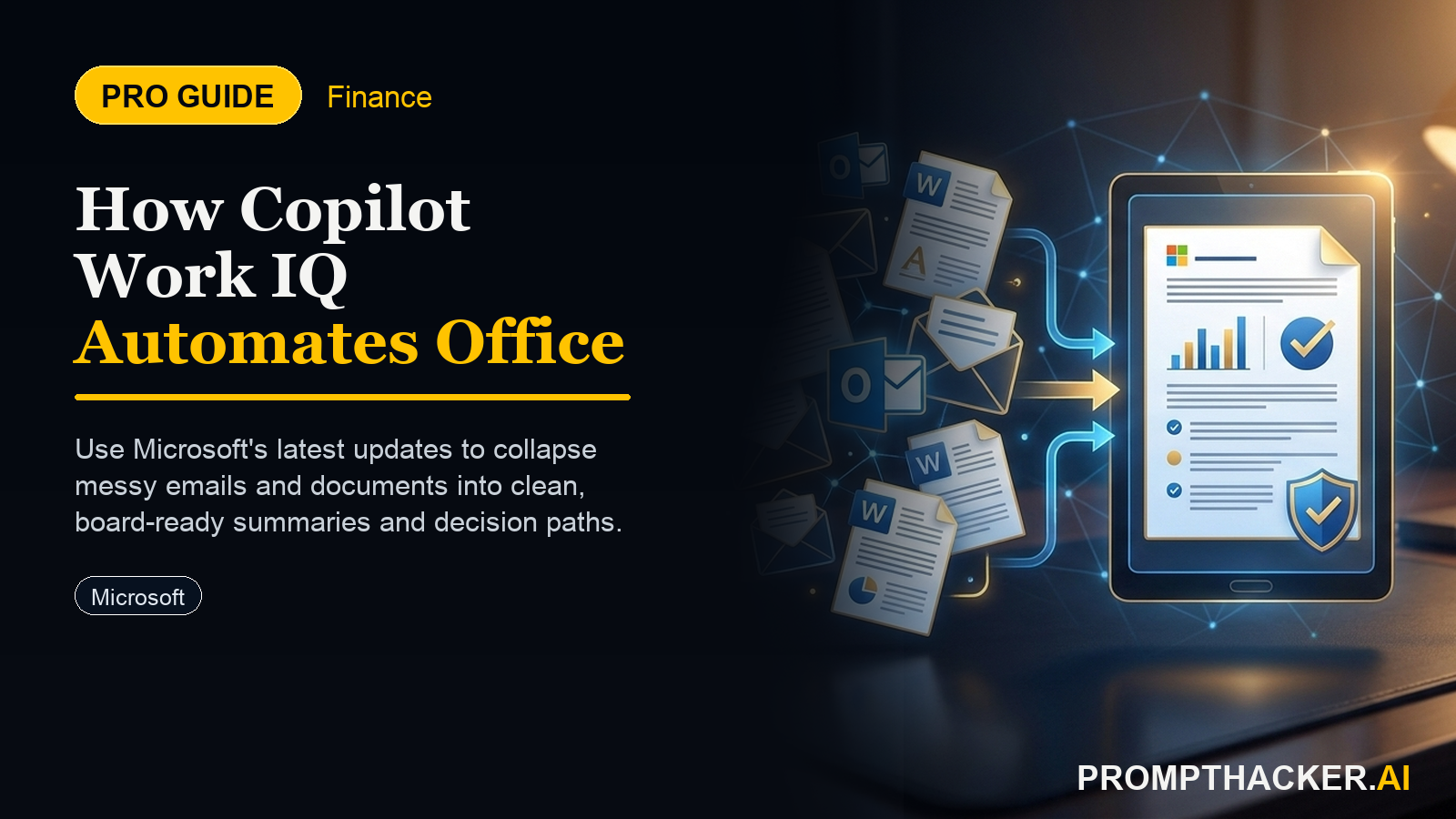
Most Microsoft 365 Copilot updates over the past year were incremental: better suggested replies, a slightly smarter Outlook summary, marginally improved Excel formula suggestions. Wave 3 is different. Work IQ is a set of agentic behaviors. Copilot taking multi-step actions across a whole app, not just assisting with one thing at a time.
The Excel feature alone is worth the setup time for any team that still builds weekly status reports manually. Word's audience-rewriting capability is legitimately useful for anyone who writes the same content for multiple audiences. And Outlook triage, used correctly, can reduce inbox-processing time by 30-40 minutes a week for busy managers. Here's what each one actually does and how to turn it on.
Excel (n)amed table reports with week-over-week comparisons
Work IQ in Excel reads across named tables within a single workbook. Before this, Copilot could only analyze the currently selected range or table. Now it can synthesize data from multiple tables in one prompt. The prerequisite: your tables need to be named.
To name a table: click any cell inside your data, go to Insert > Table, check "My table has headers," click OK. Then click anywhere in the table, go to the Table Design tab in the ribbon, and type a name in the "Table Name" box on the left. Use descriptive names without spaces: Sales_Pipeline, Tasks_Open, Budget_Actuals, Client_Activity.
Once named, open Copilot in Excel (Home tab > Copilot) and run:
The output includes a formatted table and a narrative summary. See the Productivity Gem article this week for the full prompt template.
Word (a)udience-targeted restructuring
Copilot in Word can now rewrite sections of a document for a specified audience without changing the underlying facts. Open any Word document, highlight the section to rewrite, click Copilot, and type:
Copilot returns a revised version in a side panel. Accept, reject, or ask for another pass. Practical use cases: taking an engineering specification and generating an executive summary from it, adapting a client proposal for different stakeholder levels, converting internal reports to external-facing language.
Outlook (i)nbox triage and reply drafting
The Outlook triage feature (Copilot > Priority Inbox in Settings) does three things: (1) flags emails that require a response within 24 hours, (2) surfaces emails where you're directly named and action is expected, (3) drafts replies for low-priority emails and queues them for your review. Copilot does not send replies autonomously (e)verything queued goes through your approval.
What it does not do well: accurately prioritize emails from senders it doesn't recognize, handle nuanced relationship dynamics (a low-priority sender who is actually important), or process emails with non-standard subject lines. Use it as a first pass, not a replacement for reading.
Microsoft 365 E7 (t)he licensing math
Microsoft 365 E7 (the Frontier Suite) launches May 1 at $99/user/month via Cloud Solution Provider partners. It bundles: Microsoft 365 E5, Microsoft 365 Copilot, Agent 365, Microsoft Entra Suite, and advanced Defender, Intune, and Purview security.
If your organization currently pays for E5 ($57/user/month) plus Copilot ($30/user/month) plus Entra Suite (varies, typically $7-12/user/month) separately, E7 likely consolidates without adding cost. Run the math with your current Microsoft licensing bill before May 1. The add: Agent 365 comes along for free if you're already in the bundle range.
Agent 365 (w)hat it does and why it matters
Agent 365 goes generally available on May 1 alongside E7. It's the governance control plane for all AI agents running inside Microsoft 365: one dashboard to observe, authorize, restrict, and audit every agent action across the organization. IT admins use it the same way they use Intune to manage devices (a)gent lifecycle management, permission auditing, usage reporting.
For executives, this matters because it's how Microsoft enables enterprise compliance for Copilot agents. If your industry has data governance requirements, Agent 365 is how you demonstrate that AI actions in your tenant are controlled and auditable.
The Copilot TOS situation (a brief note)
In early April, a viral post surfaced Microsoft Copilot's terms of service, which contained the phrase "Use Copilot at your own risk." Microsoft attributed this to legacy language from Copilot's early Bing Chat days and said it would be updated.
My take: treat every AI output in high-stakes documents (legal filings, financial models, client-facing reports) as a draft requiring human review. This applies to Copilot, ChatGPT, and Claude equally. The TOS story is a useful reminder to formalize your team's review checkpoints, not a reason to stop using the tool.
Action Steps Summary
- Name your Excel tables this week. Go through your most-used spreadsheets and name 3-5 tables with descriptive names (no spaces). This is the prerequisite for Copilot to read across them.
- Test Word restructuring on one document. Pick an existing report or proposal that you've written for multiple audiences. Highlight a section and use Copilot to rewrite it for a different audience. Note how tone and terminology change.
- Enable Outlook triage in Settings. Go to Settings > Mail > Copilot and turn on Priority Inbox. Review the first week of auto-flagged emails to calibrate your comfort level with automated prioritization.
- Check Wave 3 rollout status with your IT admin. Wave 3 rolls out gradually. Contact your admin to confirm which features are live in your tenant and when the remainder will arrive.
- Run E7 licensing math before May 1. Pull your current Microsoft licensing bill. Calculate total current spend on E5, Copilot, and Entra. Compare to E7 pricing ($99/user/month) before the rollout.
Three deep dives. Four useful moves. One email worth opening.
PromptHacker turns the AI firehose into practical next steps for work, health, family, and everything time keeps trying to steal.