AI Astronomy: Discover Tonight's Stars and Planets with AI
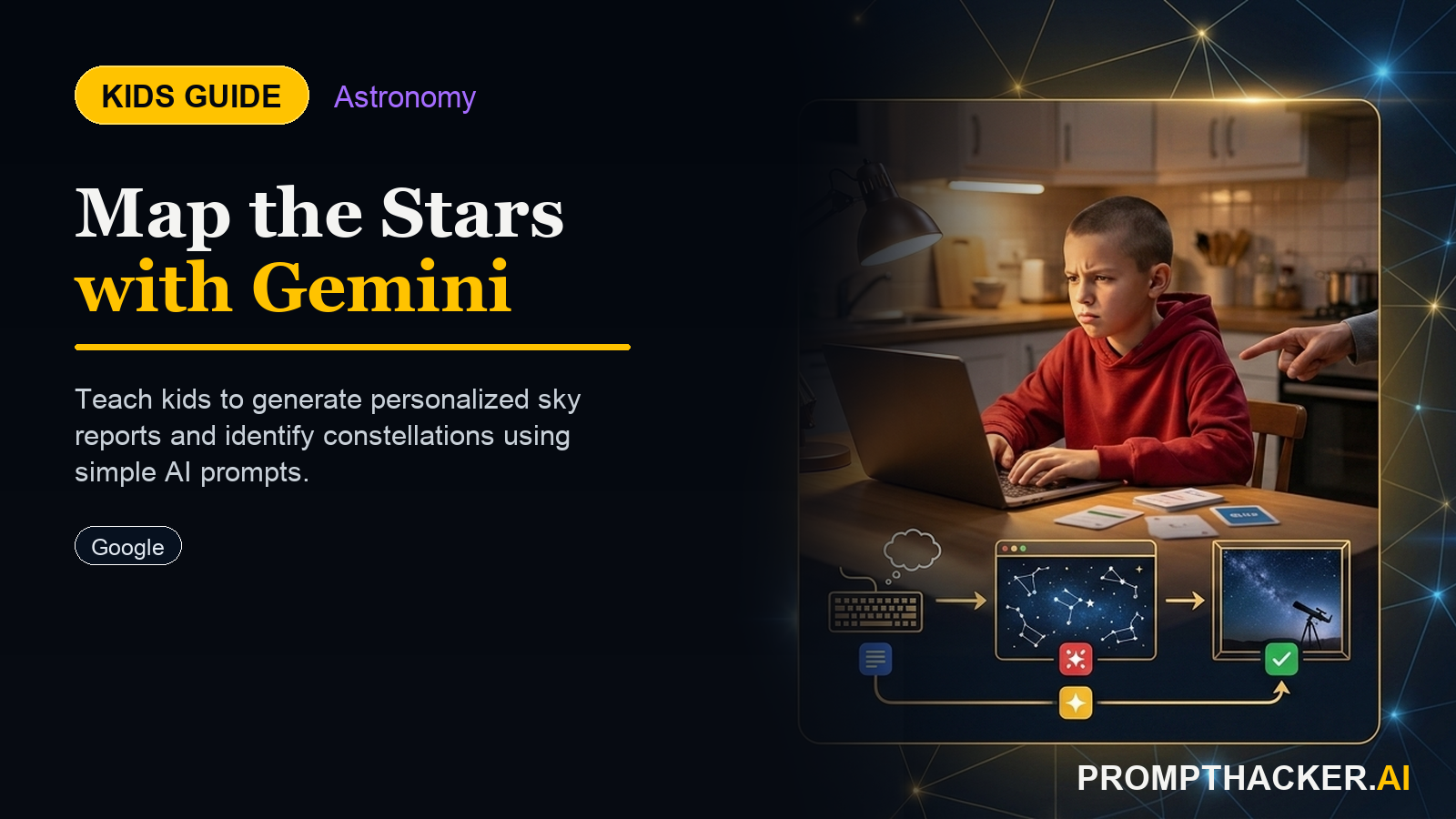
Kids create a hands-on AI project: AI Astronomy: Discover Tonight's Stars and Planets with AI. A parent or educator helps them build, test, and explain what the AI tool gets right and wrong.
What matters today
Kids create a hands-on AI project: AI Astronomy: Discover Tonight's Stars and Planets with AI. A parent or educator helps them build, test, and explain what the AI tool gets right and wrong.
Article roadmap
What you will learn
-
Using AI tools for real-world information gathering and problem-solving.
-
Developing scientific observation and verification habits through practical application.
-
Creating personalized checklists and informative reports based on AI-generated data.
-
Understanding basic astronomical concepts and how they relate to local viewing conditions.
-
Practicing clear communication through structured writing and oral sharing.
Many executives understand AI as a powerful tool for data analysis and strategic planning. But how does this translate for the next generation, for a curious 8-year-old who has never thought about how AI actually works, or a 14-year-old who uses AI for homework but has never built anything tangible with it? This activity bridges that gap, transforming abstract AI concepts into concrete, hands-on experiences. It introduces children to AI as a practical assistant for exploring the natural world around them.
Children who do not develop these skills early may miss a crucial connection: that digital tools are not just for screens, but can enhance their engagement with the physical world. Without early exposure to AI as a research and verification tool, they might perceive it solely as a source of instant answers, rather than a partner in discovery. This can hinder the development of critical thinking and the habit of questioning and verifying information, skills vital in a rapidly evolving technological landscape.
This activity delivers a unique blend of digital literacy and scientific exploration. Children will use AI to pinpoint exactly what celestial wonders are visible from their backyard, then step outside to verify the information with their own eyes. From finding a single planet to drafting a full family sky report, they will actively produce something concrete, connecting AI-powered insights to real-world observation.
AI Astronomy Discover executive action plan
This activity empowers children to become junior astronomers, using readily available AI tools to explore the night sky. The core idea is to use AI to gather specific, local information about celestial objects, then encourage outdoor observation to verify these insights. This builds a foundational understanding of how AI can assist in scientific inquiry and introduces the joy of stargazing.
You will need a standard household device: a phone, tablet, or laptop with internet access. The activity works with either Perplexity or ChatGPT with browsing enabled. No specialized hardware or paid subscriptions are required.
Activity for Age 8: Find a Star or Planet Tonight
This activity introduces the simplest form of AI-assisted observation. Your child will ask an AI tool what's visible in the sky tonight, then go outside to try and spot it. This is about sparking initial curiosity and making AI a fun, immediate helper.
- What platform or tool is used: Perplexity or ChatGPT with browsing.
- What device is needed: Phone, tablet, or laptop.
Step-by-step instructions:
- Open the AI Tool: Help your child open Perplexity or ChatGPT on your chosen device.
- Craft the Prompt: Guide your child to type a clear question. For example, they can say, "What planets and bright stars can I see from [Your City, State] tonight, [Date] at [Time]?". Be specific with your location and the current time for the most accurate results.
- Review the AI's Answer: Read the AI's response together. It will list a few prominent objects, often with general directions (e.g., "look to the southwest") or times they become visible.
- Prepare for Observation: Before going outside, discuss what the AI said. "So, the AI says we might see Jupiter. Do you know where the southwest is?"
- Go Stargazing: When it's dark enough, go outside together. Encourage your child to look in the general direction the AI suggested. Help them scan the sky.
- Identify and Discuss: When a bright object is spotted, ask, "Do you think that's what the AI told us about?" Even if it is not the exact object, the act of searching and identifying is the key learning. Talk about what they see.
"Act as an astronomy expert. List 3 planets or bright stars visible from [City] tonight at [Time]. Provide the direction to look and a fun fact about each object."
Unlock Full Access
Get exclusive prompts, deep-dive guides, and premium AI strategies.
Three deep dives. Four useful moves. One email worth opening.
PromptHacker turns the AI firehose into practical next steps for work, health, family, and everything time keeps trying to steal.