Google Project Astra: Real-time Multimodal AI for Operational Efficiency
How to pilot real-time multimodal AI in operational areas to gain immediate situational awareness.
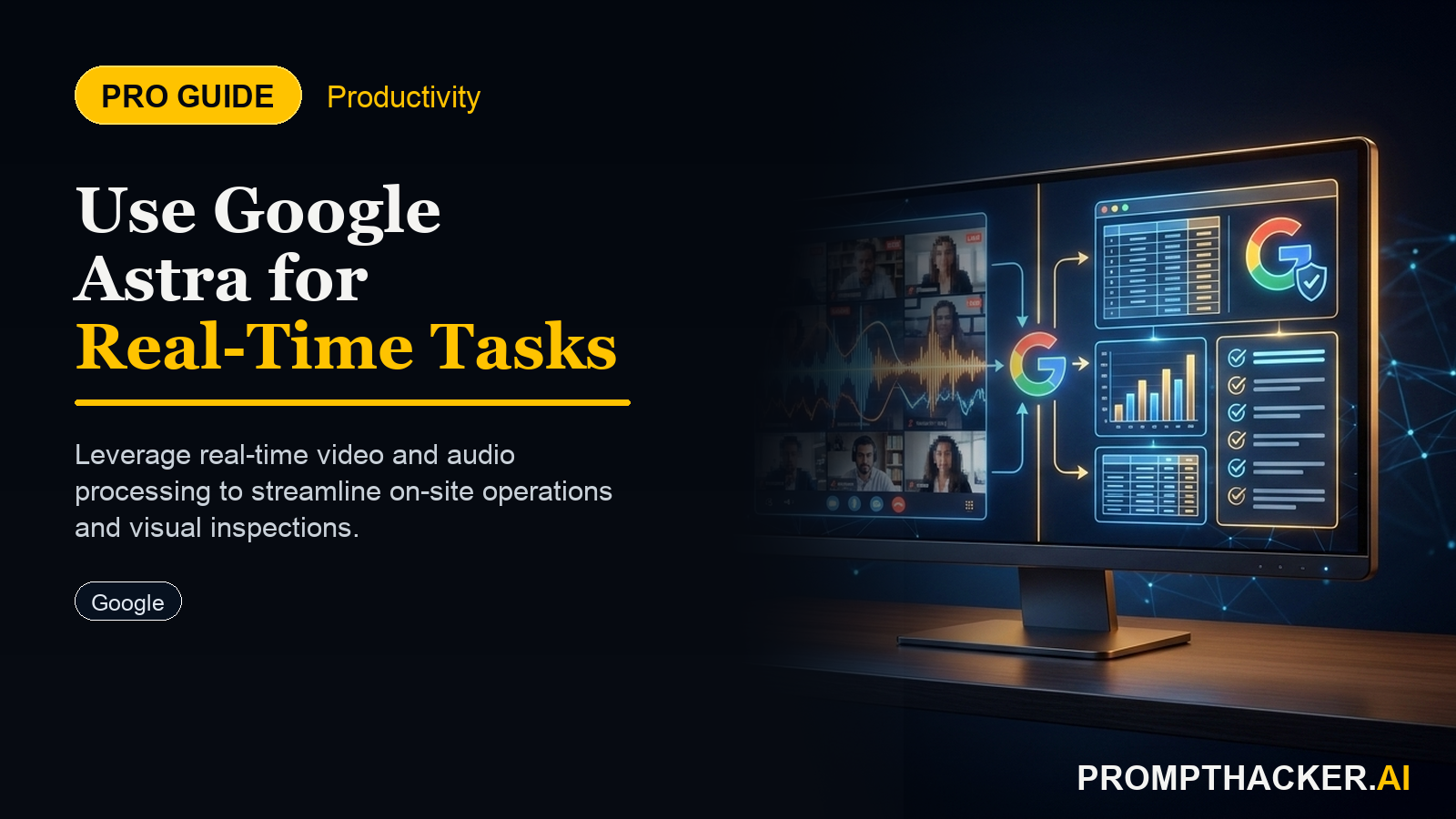
What matters today
How to pilot real-time multimodal AI in operational areas to gain immediate situational awareness.
Article roadmap
What you will learn
-
How to pilot real-time multimodal AI in operational areas to gain immediate situational awareness.
-
How to reduce human error and improve response times in field service and quality control using context-aware AI.
-
How to integrate advanced AI with existing IoT devices for a unified operational view.
-
How to train teams to utilize multimodal AI for enhanced decision-making and problem-solving in dynamic environments.
-
How to develop a strategic roadmap for scaling multimodal AI across diverse business units to achieve significant time savings.
A quality assurance director at a large manufacturing plant faces a persistent challenge: identifying subtle defects on a fast-moving assembly line. Manual inspections are prone to human fatigue, leading to missed errors that result in costly recalls and reputational damage. Existing vision systems can flag major anomalies, but they often lack the contextual understanding to differentiate between benign variations and critical flaws, requiring human intervention and slowing down production. This creates a bottleneck, increasing operational costs and delaying product delivery.
Without a solution, the plant risks escalating defect rates, declining customer satisfaction, and increased regulatory scrutiny. The traditional approach of adding more human inspectors or complex, custom-coded machine vision systems offers diminishing returns, often failing to keep pace with production demands or the nuances of real-world operational environments. The cost of inaction includes not only direct financial losses but also a loss of competitive edge as rivals adopt more agile, AI-driven quality processes.
This article details how Google's new Project Astra, a multimodal AI assistant capable of real-time understanding and interaction with its environment through vision and voice, addresses these challenges. It outlines how executives can deploy this advanced AI to eliminate manual data interpretation, reduce decision-making delays, and achieve significant time savings in critical areas like field operations and quality control.
Google's Project Astra, unveiled on March 18, 2025, represents a significant advancement in artificial intelligence, moving beyond text and static image analysis to genuine real-time interaction with the physical world. This multimodal AI assistant integrates vision and voice capabilities to process complex visual and audio cues, providing immediate, context-aware assistance. For business executives, this development signals a fundamental shift in how AI can be deployed to enhance operational efficiency, reduce errors, and accelerate decision-making across various departments.
The core capability of Project Astra lies in its ability to perceive and interpret its environment much like a human does, but with AI's speed and analytical power. Imagine an AI that can "see" a damaged component, "hear" the unusual hum of a machine, and then "speak" to provide diagnostic information or suggest immediate corrective actions, all in real-time. This eliminates the delays and inaccuracies inherent in manual data interpretation from visual or audio inputs, which often lead to delayed decision-making due to a lack of immediate context.
This capability is poised to deliver substantial time savings, estimated at up to 30%, in critical areas such as field operations, quality control, and interactive customer support. For field service managers, it means technicians can receive instant, AI-driven guidance while on-site. For quality assurance leads, it translates to more precise and rapid identification of defects. For customer experience directors, it offers highly personalized and efficient AI assistance that understands both what a customer says and what they are looking at or interacting with.
Understanding Multimodal AI in an Executive Context
Multimodal AI, as exemplified by Project Astra, signifies AI that processes and synthesizes information from multiple input modalities (like vision, audio, text) simultaneously. The "real-time" aspect means this processing happens instantaneously, enabling immediate responses and actions. This differs from previous AI systems that might analyze images after they are captured or process audio recordings retrospectively.
Consider a scenario in a logistics company where a warehouse manager observes a misplaced shipment. With Project Astra, the manager could simply point a device at the item and ask, "Where should this go?" The AI would process the visual information (identifying the item, its current location) and potentially integrate with inventory systems to provide an immediate, accurate directive.
Ready to scale AI in your operations?
Get full access to our implementation playbooks and executive strategy guides.
Three deep dives. Four useful moves. One email worth opening.
PromptHacker turns the AI firehose into practical next steps for work, health, family, and everything time keeps trying to steal.