GPT-5.4 Mini and Nano: Small Model Economics and the Subagent Architecture Shift
The full Mini and Nano spec: context windows, pricing tiers, and deployment constraints
What matters today
The full Mini and Nano spec: context windows, pricing tiers, and deployment constraints
Article roadmap
What you will learn
-
The full Mini and Nano spec: context windows, pricing tiers, and deployment constraints
-
Why $0.20 per million tokens changes the architecture of subagent workflows
-
The free tier strategic decision: what it means to put GPT-5.4 Mini in ChatGPT Free
-
How to route tasks across Nano, Mini, and Standard for cost-efficient multi-model systems
-
Four enterprise implications including the classification tier opportunity and free tier onboarding strategy
The Launch
OpenAI released GPT-5.4 Mini and Nano on March 17, 2026. The launch completes the three-tier GPT-5.4 architecture: Nano for high-volume inference, Mini for mid-complexity tasks with generous context, Standard (and Thinking and Pro) for full-capability work.
The pricing signals are the most important part. Nano at $0.20 per million input tokens places bulk AI inference - classification, routing, tagging, summarization - in the same cost category as existing database queries. Mini at $0.75 per million input tokens with a 400K context window sits in a tier that did not previously exist: long-context capable at sub-dollar per-million pricing.
This is a PromptHacker Premium article.
The full breakdown, verbatim prompts, and action steps are available to Premium subscribers.
The Nano Tier
GPT-5.4 Nano is API-only. No ChatGPT interface access. Priced at $0.20 per million input tokens, $1.25 per million output tokens. Context window: 128K tokens.
The intended use is high-frequency, low-complexity inference: routing queries to the right model, classifying documents before sending to a higher-cost analyzer, generating metadata tags at scale, running sentiment analysis on customer data, screening support tickets for escalation. Tasks that currently run on GPT-5.3 Mini or Claude Haiku equivalents cost 3 to 5x more per token at current pricing.
Latency is the other specification. Nano is optimized for sub-100ms response times on classification and routing tasks - a target that Standard and Thinking variants cannot consistently hit.
The Mini Tier
GPT-5.4 Mini is available in ChatGPT (including the free tier) and via API. Priced at $0.75 per million input tokens, $4.50 per million output tokens. Context window: 400K tokens.
The 400K context window is the differentiating specification. At $0.75 per million input tokens, loading a 400K context costs $0.30. That is the full content of a long-form regulatory document, a complete email thread history, or a project management history - synthesized in a single call for under fifty cents.
Mini replaces the cost inflection point where Standard becomes the only viable option for long-context work. The prior boundary was approximately 128K tokens, the common extended context ceiling for smaller models. Mini pushes that boundary to 400K.
The Free Tier Decision
ChatGPT's free tier previously accessed GPT-4o Mini. Free users now access GPT-5.4 Mini by default. This is not a capability announcement - it is a distribution decision.
OpenAI is expanding the installed base of users who consider GPT-5.4 Mini their baseline AI tool. The upgrade path from ChatGPT Free to ChatGPT Plus delivers GPT-5.4 Standard. The capability gap between Mini and Standard is real - particularly on complex multi-step reasoning - which makes the free tier a structured path into paid conversion rather than a ceiling.
For enterprise deployment, the free tier creates a workforce of users already familiar with the Mini interaction model. Training cost and adoption friction both decrease when employees already know the tool from personal use.
The Subagent Cost Architecture
The three-tier pricing structure enables a cost-aware subagent architecture that was not viable before:
- Nano ($0.20/M): Intake routing, classification, metadata generation, duplicate detection
- Mini ($0.75/M + 400K context): Document analysis, draft generation, research synthesis, ticket resolution
- Standard ($2.50/M + 1M context): Complex multi-step reasoning, M&A-scale synthesis, compliance analysis, client-facing output generation
A properly designed subagent system routes each task to the cheapest capable model. The Nano layer handles all work that does not require deep reasoning. Mini handles mid-tier analysis. Standard handles only the tasks that genuinely require it.
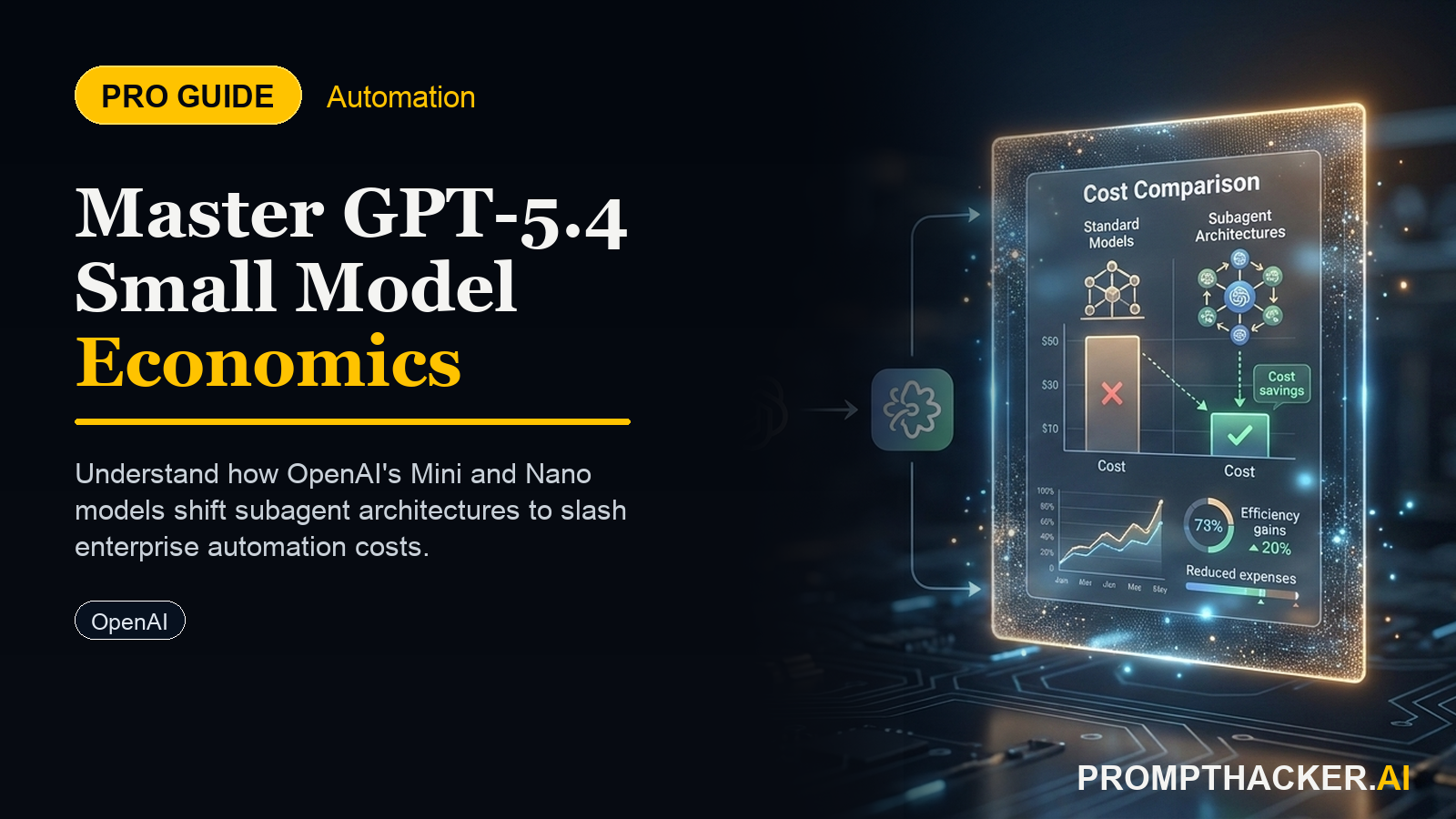
At current pricing, a workflow that routes 70% of tasks to Nano, 20% to Mini, and 10% to Standard costs approximately 74% less than running the same workflow exclusively on Standard.
Four Enterprise Implications
1. Rebuild the cost model for existing AI workflows. Any workflow currently running on GPT-5.3 Mini or equivalent should be re-evaluated against Nano. The latency and cost profile has shifted enough that it warrants a new architecture review.
2. The free tier creates an onboarding asset. Organizations that want employees using AI productively should account for the free tier's role in driving personal familiarity with the Mini interaction model before it becomes a corporate deployment decision.
3. Classification tasks are now a first-class design element. At $0.20/M, adding a Nano classification layer in front of any downstream AI workflow costs less than the prompt engineering overhead to eliminate it. Design the routing layer explicitly.
4. The 400K context boundary is the new decision threshold. When selecting between Mini and Standard for a new workflow, the first question is whether the task's context requirements exceed 400K tokens. Below that threshold, Mini is the correct default at 70% lower cost.
Action Steps
- Audit your current AI API spend against the new tier structure. Identify all workflows running at Standard pricing where task complexity does not require it.
- Test Nano for your three highest-volume classification or routing tasks. The target benchmark: Nano produces equivalent accuracy at over 80% of your current task volume. If it does, rebuild those tasks on Nano.
- For long-document analysis workflows that currently chunk documents into shorter segments: test Mini with full document load and benchmark synthesis quality against the chunked approach.
- Map your subagent architecture to the three tiers. Every agentic workflow has intake, analysis, and output steps. Assign tiers intentionally rather than defaulting everything to Standard.
- Update your AI usage guides to reflect GPT-5.4 Mini as the free tier capability baseline. Training materials based on GPT-4o Mini are out of date.
Three deep dives. Four useful moves. One email worth opening.
PromptHacker turns the AI firehose into practical next steps for work, health, family, and everything time keeps trying to steal.