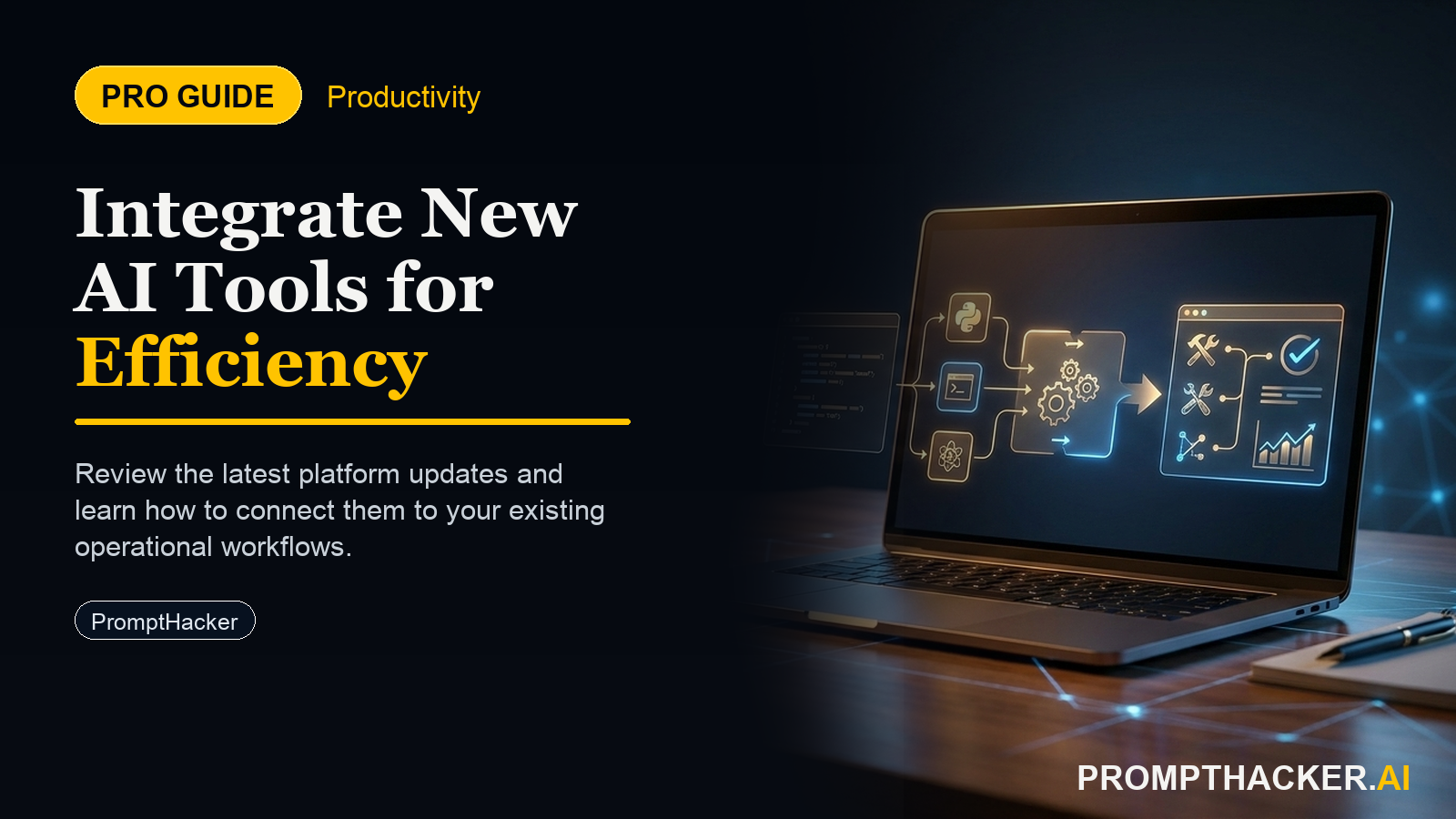
Critical AI Updates: Integrate Tools for Operational Efficiency
How to develop pilot programs for new AI tool integration to validate business impact.
What matters today
How to develop pilot programs for new AI tool integration to validate business impact.
Article roadmap
What you will learn
-
How to categorize AI advancements to identify relevant business applications.
-
How to establish a structured approach for monitoring emerging AI technologies.
-
How to develop pilot programs for new AI tool integration to validate business impact.
-
How to prepare organizational data infrastructure for seamless AI adoption.
-
How to measure the return on investment from AI integration initiatives.
A Chief Operations Officer at a 200-person logistics firm reviews quarterly performance metrics. The data shows a persistent 12% increase in operational costs over the past year, primarily due to inefficient route planning, manual inventory tracking, and delayed dispatching. Customer satisfaction scores have dipped by 5 points, reflecting slower delivery times and increased errors. Meanwhile, news circulates that a direct competitor recently secured a multi-million dollar investment to scale its AI-driven supply chain optimization.
Failing to actively engage with the rapidly evolving AI landscape means more than just missing out on new opportunities. It translates directly into higher operational expenditures, diminished service quality, and a gradual erosion of market share. Businesses that do not systematically identify and integrate relevant AI advancements risk becoming obsolete, unable to compete with more agile, data-driven rivals. The cost of inaction is not merely stagnation, but decline.
This article provides a comprehensive framework for executives to navigate the continuous stream of AI updates. Discover how to strategically monitor critical advancements, identify their direct business implications, and implement structured integration strategies. Learn to move beyond reactive responses to proactive AI adoption, establishing a clear path from understanding new capabilities to realizing measurable improvements in productivity and revenue.
The Executive Imperative: Beyond the Hype of AI Updates
The pace of AI development continues to accelerate, with new models, capabilities, and applications emerging weekly. For executives, the challenge is not simply to be aware of these advancements, but to understand their specific impact on business operations and competitive positioning. An AI update is not just a technical announcement; it represents a potential shift in how work gets done, how customers are served, and how value is created.
Ignoring this continuous evolution can lead to significant strategic disadvantages. Businesses might overlook tools that could reduce processing time by 30%, identify new revenue streams, or mitigate critical operational risks. A systematic approach to understanding and integrating AI updates ensures that an organization remains agile and innovative. This proactive stance protects market share and positions the company for future growth.
Decoding the AI Landscape: Categorizing Relevant Advancements
To effectively integrate AI, executives must first categorize the types of advancements and understand their direct business relevance. The broad spectrum of AI can be segmented into several key areas, each offering distinct opportunities.
- Generative AI: These models create new content, including text, images, audio, and code. For business, this translates to automated content creation for marketing, personalized customer service responses, rapid prototyping in product development, and accelerated code generation for software teams.
- Predictive AI: Focused on forecasting future outcomes based on historical data, predictive AI is crucial for strategic decision-making. Applications include sales forecasting, predictive maintenance for machinery, supply chain demand planning, and identifying potential customer churn.
- Automation AI: This category encompasses tools that automate repetitive, rule-based tasks. Robotic Process Automation (RPA) and intelligent process automation streamline workflows, reduce manual errors, and free up human resources for more complex activities.
- Specialized AI: These are AI systems designed for specific domains or complex problem-solving. Examples include AI for cybersecurity threat detection, medical diagnostics, or advanced materials science.
EXECUTIVE ACTION: Audit your current operational bottlenecks. Map each bottleneck to one of the four AI categories above to identify the most immediate integration opportunities.
Ready to scale your AI operations?
Get full access to our premium toolkits, templates, and strategic frameworks.
Three deep dives. Four useful moves. One email worth opening.
PromptHacker turns the AI firehose into practical next steps for work, health, family, and everything time keeps trying to steal.