MLK Day Activity: Ask AI to Explain the Dream, Then Help Your Child Write Their Own
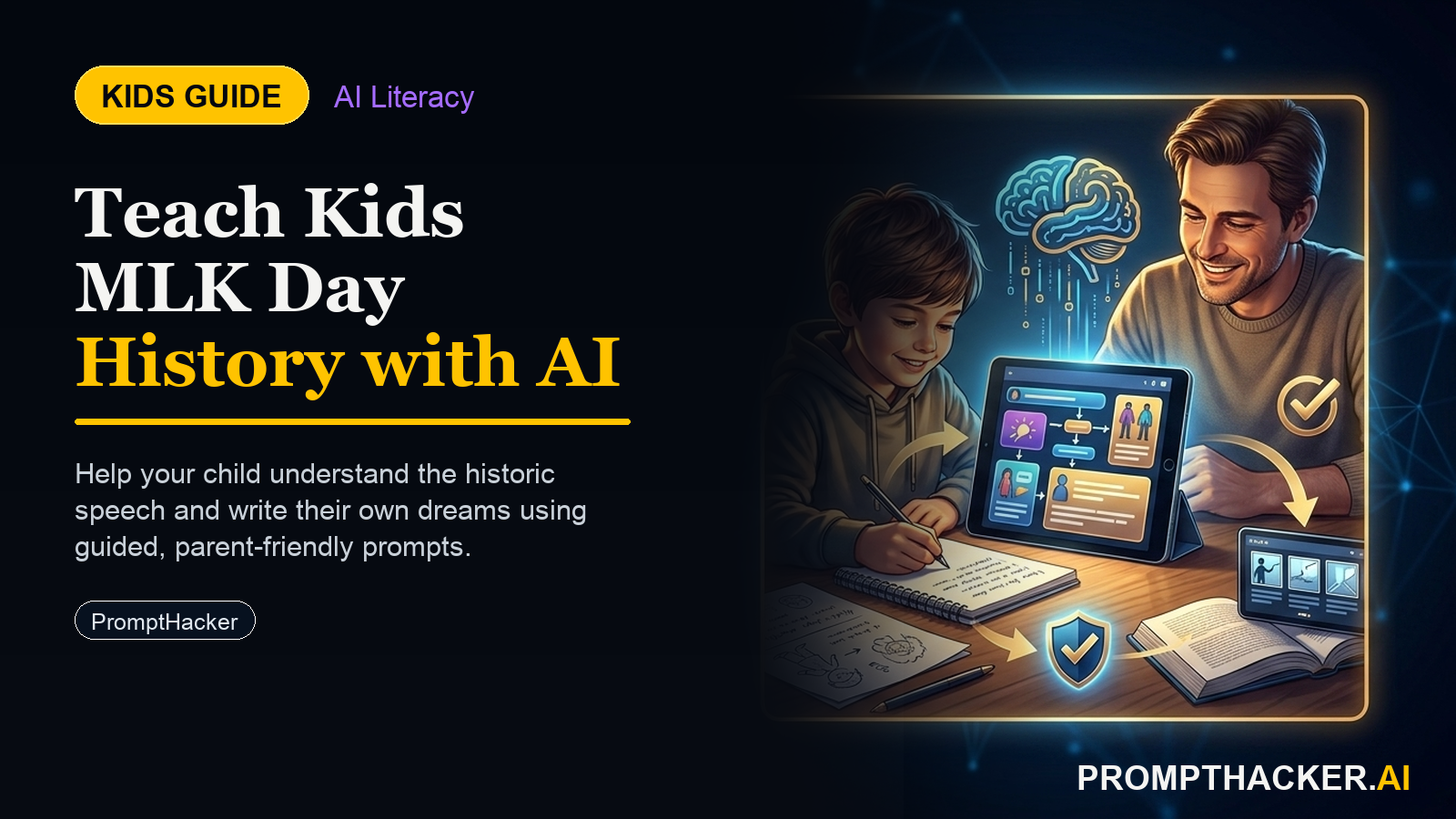
Kids create a hands-on AI project: MLK Day Activity: Ask AI to Explain the Dream, Then Help Your Child Write Their Own. A parent or educator helps them build, test, and explain what the AI tool gets right and wrong.
What matters today
Kids create a hands-on AI project: MLK Day Activity: Ask AI to Explain the Dream, Then Help Your Child Write Their Own. A parent or educator helps them build, test, and explain what the AI tool gets right and wrong.
Article roadmap
What you will learn
-
A simple MLK Day activity that builds historical literacy and personal expression
-
Three age-scaled versions for children 8, 11, and 14
-
The exact ChatGPT prompt that makes the AI a study partner rather than a ghostwriter
-
How to keep the activity safe and supervised
-
The core AI concept the child learns by doing it
Martin Luther King Jr. Day falls on Monday, January 19 this year, and most kids will hear the phrase "I Have a Dream" without ever really engaging with what it meant. The speech gets reduced to a quote on a poster. The deeper idea, that a person can name a better future and call others toward it, gets lost.
There is a 15-minute activity that fixes that, and it doubles as a first lesson in how to use AI well. The child asks ChatGPT to explain Dr. King's dream in plain language, reads it, picks the part that matters most to them, and then writes their own short "I Have a Dream" piece about something they care about. The AI explains and prompts; the child does the writing.
The reason this works is the framing. Used one way, ChatGPT writes the child's speech for them and they learn nothing. Used the way described here, ChatGPT is a study partner that helps the child understand and then asks them a question to draw out their own thinking. That distinction, AI as a partner rather than a substitute, is the most important thing a child can learn about these tools, and this activity teaches it through MLK Day rather than as an abstract lecture.
What the Child Builds
The output is the child's own short "I Have a Dream" piece, scaled to their age. The point is that the words are theirs. ChatGPT helps them understand the original and asks a question to spark their thinking, but the child writes the piece.
Age 8: After hearing the dream explained simply, the child names one thing they would add to it, in a sentence or two. ("I have a dream that no kid eats lunch alone.")
Age 11: The child writes a full paragraph in the "I Have a Dream" style about something important to them: kindness at school, the environment, fairness on their team.
Age 14: The child writes a 2026 version of the speech addressing a current issue they care about, and cites one real event from 2025 to ground it. This adds a research-and-relevance step appropriate for the age.
In every version the child ends up with something they wrote and can read aloud, which is what makes it stick.
The Activity, Step by Step
This takes about 15 minutes once an adult has set it up.
- An adult opens ChatGPT (free, at chatgpt.com) and sits with the child. The adult handles the typing for younger children.
- Ask AI to explain the dream. Have the child ask ChatGPT to explain Dr. King's "I Have a Dream" speech in simple words for their age. Read the explanation together.
- Pick the part that matters. The child names which idea from the dream stands out to them and why. This is the bridge from understanding to their own writing.
- Write their own piece. Using the age-appropriate version above, the child writes. For the youngest, this can be spoken aloud and typed by the adult. For older children, they write it themselves.
- Read it aloud and talk about it. The child reads their piece out loud. The adult asks what they would want others to do after hearing it.
Here is the prompt that makes ChatGPT a study partner instead of a ghostwriter. This is the age-11 version; adjust the age and topic for your child.
The Prompt
Explain Dr. King's "I Have a Dream" speech to an 11-year-old in simple words. Then help me write my own short "I Have a Dream" paragraph about something important to me: [topic]. Ask me one question to help me make it personal before you help, and do not write the paragraph for me.
The two key instructions are "ask me one question first" and "do not write it for me." Those turn the AI from a vending machine into a partner that draws the child's own ideas out.
Keeping It Safe
A few specifics about doing this safely with ChatGPT.
Account. ChatGPT's free tier is accessible without an account for basic use, but the safest setup is an adult-owned account that the adult sits with the child to use. ChatGPT is intended for users 13 and up, so for children under 13 an adult should drive the session, not hand the child an independent login.
Supervision. This is a sit-together activity, not a hand-the-tablet-over activity. The adult reads the AI's explanation alongside the child, which is also where the best conversation happens. Optional parent discussion is the whole point, not an add-on.
Content. Because the topic is a historical speech and the child's own positive ideas, the conversation stays in safe territory. If a child's chosen topic touches something heavy, the adult is right there to guide it.
For Parents and Educators
Conversation starters:
- "Dr. King described a future that did not exist yet and asked people to help build it. What is one thing about the future you would describe that way?"
- "When you asked the AI to help instead of to write it for you, what was different about your paragraph? Whose ideas are in it?"
- "If a friend used AI to write their whole assignment, and you used AI to help you understand and then wrote it yourself, what did each of you actually learn?"
Core AI concept:
AI as a study partner, not a homework cheater. The child learns that the same tool can either do their thinking for them or help them think for themselves, and that the difference comes down to how you ask. By instructing the AI to explain and to ask a question rather than to write the piece, the child experiences directing AI toward learning instead of shortcutting it. This is the single most useful AI habit a young person can build.
Action Steps Summary
- Set up the session: An adult opens free ChatGPT and sits with the child. Pick the age-appropriate version.
- Have the child ask AI to explain the dream: Read the simple explanation together and let the child pick the idea that matters most.
- Use the partner prompt: Paste the prompt above so the AI explains and asks a question rather than writing the piece.
- The child writes and reads aloud: A sentence at age 8, a paragraph at 11, a 2026 version with a cited 2025 event at 14.
- Have the conversation: Use the starters above to connect the activity to the bigger idea of using AI to think, not to skip thinking.
Three deep dives. Four useful moves. One email worth opening.
PromptHacker turns the AI firehose into practical next steps for work, health, family, and everything time keeps trying to steal.