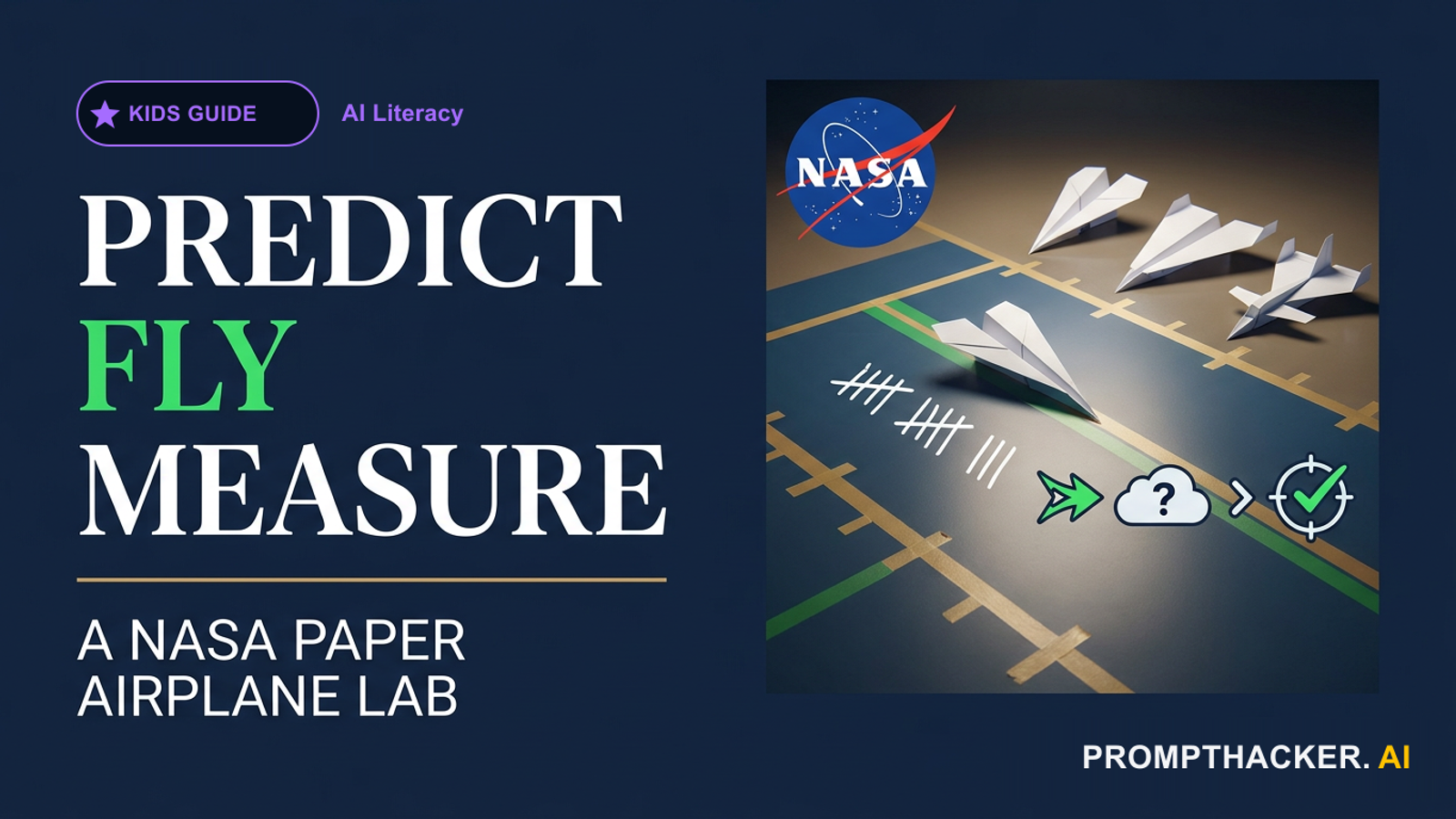
Run a NASA paper airplane AI prediction lab
Build six paper airplanes, test three hypotheses one variable at a time, and let five flights per design decide whether Gemini's prediction survives contact with the floor.
What matters today
Use NASA's paper-airplane activity and free Gemini chat to test three one-variable predictions with five real flights per design.
Key points
- The lab compares three matched pairs of paper airplanes while changing only wingtip position, added weight, or weight location.
- Gemini writes hypotheses before testing, but five measured flights per design decide whether each prediction survives.
- Using the middle result reduces the influence of one lucky throw without requiring advanced statistics.
- Results are labeled supported, not supported, or unclear; an unsupported prediction is a useful outcome, not a failed project.
- Only anonymous totals return to Gemini; names, photos, voices, school details, and location remain offline.
The executive summary remains public for search engines and AI answer systems. Subscriber-only sections are marked separately on the page.
Article roadmap
What you will learn
-
How a child can turn NASA's paper airplane activity into three controlled tests
-
How to change one design variable at a time
-
How to ask free Gemini consumer chat for hypotheses without treating them as facts
-
Why five flights per design beat one lucky throw
-
How an adult can supervise a safe, private, unpublished build
One great flight proves very little. A lucky release, a bent wing, or a small shift in launch angle can make one airplane look brilliant for ten seconds. That is exactly why this project is fun.
NASA's Wingin' It activity supplies the build. NASA asks students to explore how aircraft design changes flight distance, then test added weight and weight distribution. This version gives Gemini a limited role. Gemini predicts. Repeated flights settle what happened in the room.
The child needs ordinary paper, small pieces of tape, a measuring tool, and a phone, tablet, or laptop. Each design flies five times from the same line. The free Gemini chat handles the prediction. The family needs no API, paid plan, or special hardware. Keep every result private. Keep personal data out of the chat.
Pro subscriber access
This briefing is reserved for Pro subscribers.
Enter the email tied to your Beehiiv Pro subscription to continue.
Three deep dives. Four useful moves. One email worth opening.
PromptHacker turns the AI firehose into practical next steps for work, health, family, and everything time keeps trying to steal.