NVIDIA Just Put an Autonomous AI Agent on Your Desktop
How the NVIDIA RTX 50-series agentic layer automates complex administrative tasks without sending data to the cloud.
What matters today
How the NVIDIA RTX 50-series agentic layer automates complex administrative tasks without sending data to the cloud.
Article roadmap
What you will learn
-
How the NVIDIA RTX 50-series agentic layer automates complex administrative tasks without sending data to the cloud.
-
The technical requirements for deploying hardware-native AI agents within an executive workflow.
-
Strategic criteria for determining when to use local agentic processing versus cloud-based large language models.
-
Immediate implementation steps to integrate autonomous agents into financial and operational reporting.
The Director of Operations at a regional logistics firm manages a fleet of 150 vehicles and a staff of 200 drivers. Every month, this director faces a recurring administrative bottleneck: the reconciliation of over 200 physical and digital expense receipts. These documents arrive in various formats, including crumpled paper scans, PDF invoices, and mobile snapshots. The process requires a human to open each file, identify the vendor, extract the total amount, verify the date, and manually input the data into a master spreadsheet for the accounting department. This task consumes three full business days every month, distracting the director from high-level fleet optimization and strategic planning.
Current software solutions often fail this director because they require manual uploads to a cloud provider, which introduces data privacy concerns and subscription costs. The alternative is hiring a junior analyst to perform data entry, an expensive and inefficient use of human capital. The director needs a solution that operates within the local network, handles messy data with high accuracy, and completes the entire multi-step workflow without constant supervision.
The Shift from Chatbots to Autonomous Agents
NVIDIA changed the trajectory of desktop computing at CES 2025 by introducing a dedicated agentic software layer for the RTX 50-series GPUs. This technology moves beyond the standard "prompt and response" model of traditional AI. While a standard chatbot requires a user to provide a prompt for every single step of a task, an agentic system accepts a high-level goal and then plans, executes, and verifies its own sequence of actions.
The RTX 50-series hardware, specifically the RTX 5090 and RTX 5080, provides the computational power necessary to run these agents locally. The RTX 5090 features 32GB of VRAM and 92 billion transistors, providing the memory capacity to hold complex reasoning models entirely in hardware. This shift is significant because it removes the step-by-step human requirement for repetitive digital tasks. The software layer sits between the operating system and the GPU, allowing the AI to interact with files, folders, and applications as if it were a human Executive.
How the Agentic Layer Functions
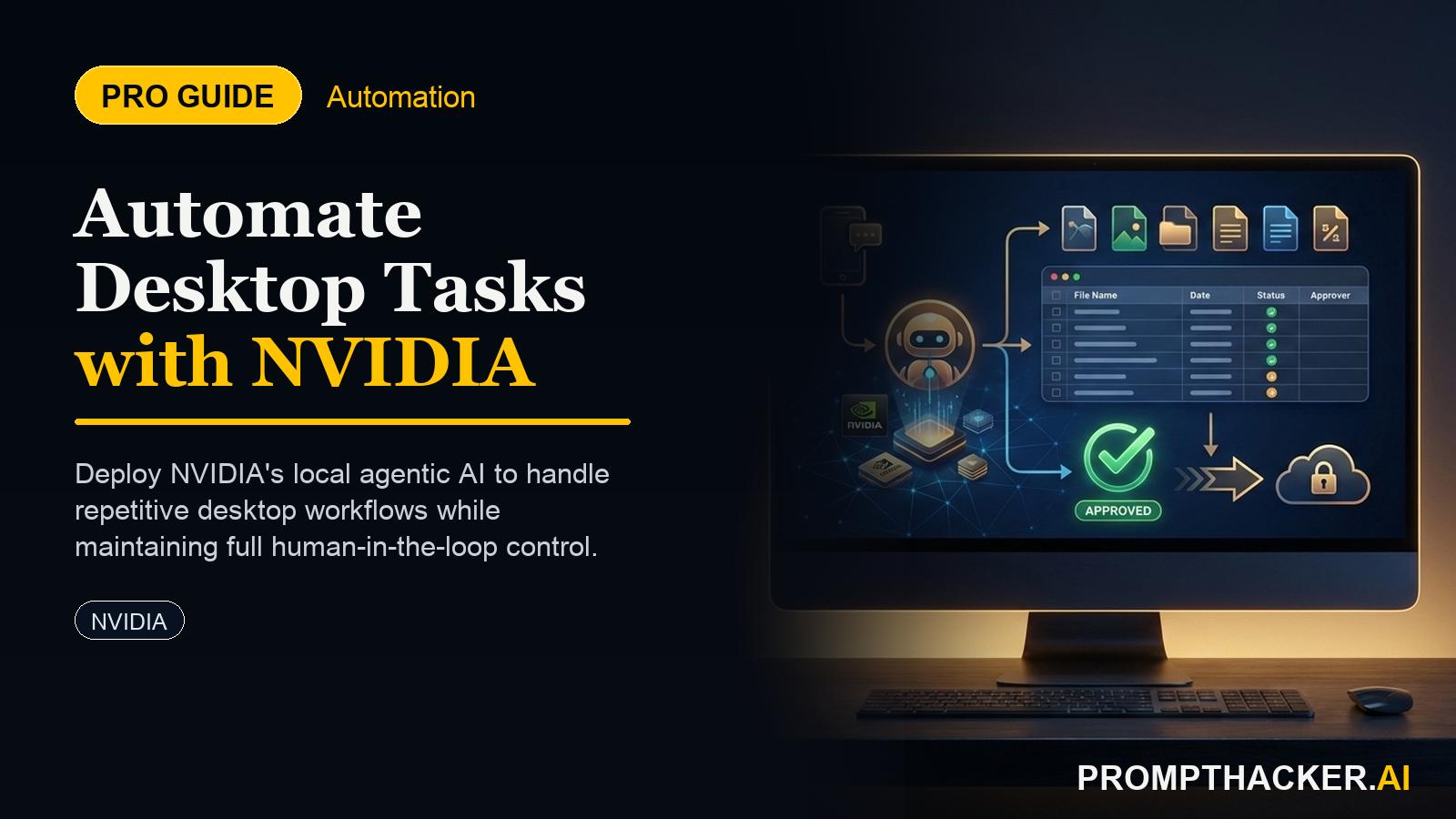
The NVIDIA agentic layer utilizes a "Reasoning-Action" (ReAct) loop. When an executive provides a goal, such as "Reconcile these receipts," the software performs four distinct phases:
- Perception: The agent scans the designated local directories to identify the relevant files.
- Planning: The agent breaks the goal into sub-tasks (e.g., Step 1: Extract text from PDF 1. Step 2: Identify date and total. Step 3: Check for duplicates.).
- Execution: The agent utilizes the GPU to run a local large language model (LLM) that processes the data.
- Verification: The agent checks its own output against the original files to ensure accuracy before finalizing the report.
This entire process occurs on the device. No data leaves the machine, and no third-party cloud provider receives a copy of the sensitive financial documents. This local execution provides a level of security that cloud-based agents cannot match.
Strategic Use Cases for the Executive Desktop
The utility of a hardware-native agent extends across various departments. These scenarios illustrate how the RTX 50-series software layer handles complex, multi-step workflows.
1. Financial Reconciliation and Auditing
The scenario involving the logistics firm director is the primary use case. The agent can monitor a folder for new invoices. Once a file appears, the agent extracts the line items, compares them against a purchase order database, and flags any discrepancies. It then generates a formatted Excel spreadsheet and drafts an email summary for the CFO. The executive only intervenes to approve the final draft.
2. Legal Document Analysis and Redlining
Legal departments often review hundreds of standard contracts. An executive can point the NVIDIA agent to a folder containing 50 new non-disclosure agreements. The agent reads every document, identifies clauses that deviate from the company's standard template, and creates a summary report highlighting the risks. This reduces the initial review time from hours to minutes.
3. Market Research Synthesis
Executives tracking competitors can direct the agent to monitor local downloads of industry reports and news filings. The agent can synthesize 500 pages of technical documentation into a three-slide executive summary, focusing specifically on market share shifts and new product announcements.
PROMPT CALLOUT: Multi-Step Expense Agent
"Analyze all files in the C:/Users/Executive/Desktop/Receipts folder. Extract the vendor name, date, and total amount including tax from every image and PDF. Create a new CSV file named 'Monthly_Expense_Report' and populate it with this data. If any receipt is dated older than 30 days, highlight that row in the final file. Notify me when the summary is ready for review."
Hardware and Software Requirements
To utilize this agentic layer, organizations must invest in the latest Blackwell-architecture hardware.
- RTX 5090: This is the flagship card, priced at $1,999. It features 32GB of VRAM, which is essential for running high-parameter models that require large context windows. It is the recommended choice for executives handling massive document sets or complex data analysis.
- RTX 5080: Priced at $999, this card offers a more accessible entry point for standard office automation.
- Software Integration: The agentic layer is included in the NVIDIA driver package. There are no additional monthly subscription fees, which simplifies the total cost of ownership compared to enterprise cloud AI licenses.
Shipping for these units begins January 30, 2025. Organizations should ensure their desktop workstations have adequate power supplies (at least 1000W for the 5090) and cooling systems to handle the sustained thermal load of local AI inference.
Local vs. Cloud: Making the Strategic Choice
The decision to move to local agentic AI depends on three factors: security, latency, and cost.
Cloud AI tools (like OpenAI's o1 or Anthropic's Claude) are superior for tasks requiring vast external knowledge or massive web-scraping operations. If a task requires the AI to know the current political climate in a foreign market, the cloud is the better option.
Local AI agents are superior for tasks involving sensitive internal data. Financial records, employee files, and proprietary product designs should stay on local hardware. Furthermore, local agents do not suffer from "token limits" or "rate limits" imposed by cloud providers. Once you own the hardware, you can run the agent 24 hours a day without incurring additional costs.
Failure Modes and Risk Mitigation
While the RTX 50-series software layer is advanced, it is not infallible. Executives must be aware of potential failure modes:
- Math Hallucinations: Even with the Blackwell architecture, LLMs can occasionally struggle with complex arithmetic. The agentic layer mitigates this by using Python scripts to perform calculations, but the executive should still perform spot checks on critical financial totals.
- Context Window Limitations: If a folder contains thousands of long documents, the agent may lose track of information from the first document by the time it reaches the last one. It is more effective to process data in batches.
- Hardware Throttling: Local inference generates significant heat. If a workstation is not properly ventilated, the GPU will slow down, increasing the time required to complete a task.
To mitigate these risks, implement a "Human-in-the-loop" approval process. The agent should never be allowed to move funds or sign contracts without a final manual click from an authorized executive.
Implementation Roadmap
- Audit Administrative Bottlenecks (Days 1-15): Identify the top three recurring tasks that involve moving data between files and folders. These are the primary candidates for agentic automation.
- Hardware Procurement (Days 16-30): Order RTX 5090 or 5080 workstations. Ensure the IT department verifies that current desktop cases can accommodate the physical size of the 50-series cards, which are larger than previous generations.
- Driver and Layer Setup (Days 31-45): Install the latest NVIDIA drivers and activate the agentic software layer. Map the agent's access permissions to only the necessary local folders to maintain internal security protocols.
- Pilot Testing (Days 46-60): Run the agent on a non-critical workflow, such as organizing a personal research library or summarizing internal memos. Compare the agent's output against a manual audit to verify accuracy.
- Full Deployment (Day 90+): Transition the primary administrative bottlenecks to the agentic layer. Monitor the time saved and reallocate that human capital to higher-value strategic initiatives.
NVIDIA has effectively moved the "AI Employee" from a remote data center to the local desktop. For the executive, this means a reduction in mundane tasks and a significant increase in data privacy. The RTX 50-series is no longer just a component for graphics; it is a dedicated processor for professional autonomy.
Three deep dives. Four useful moves. One email worth opening.
PromptHacker turns the AI firehose into practical next steps for work, health, family, and everything time keeps trying to steal.