PH PROMPTHACKER.AI

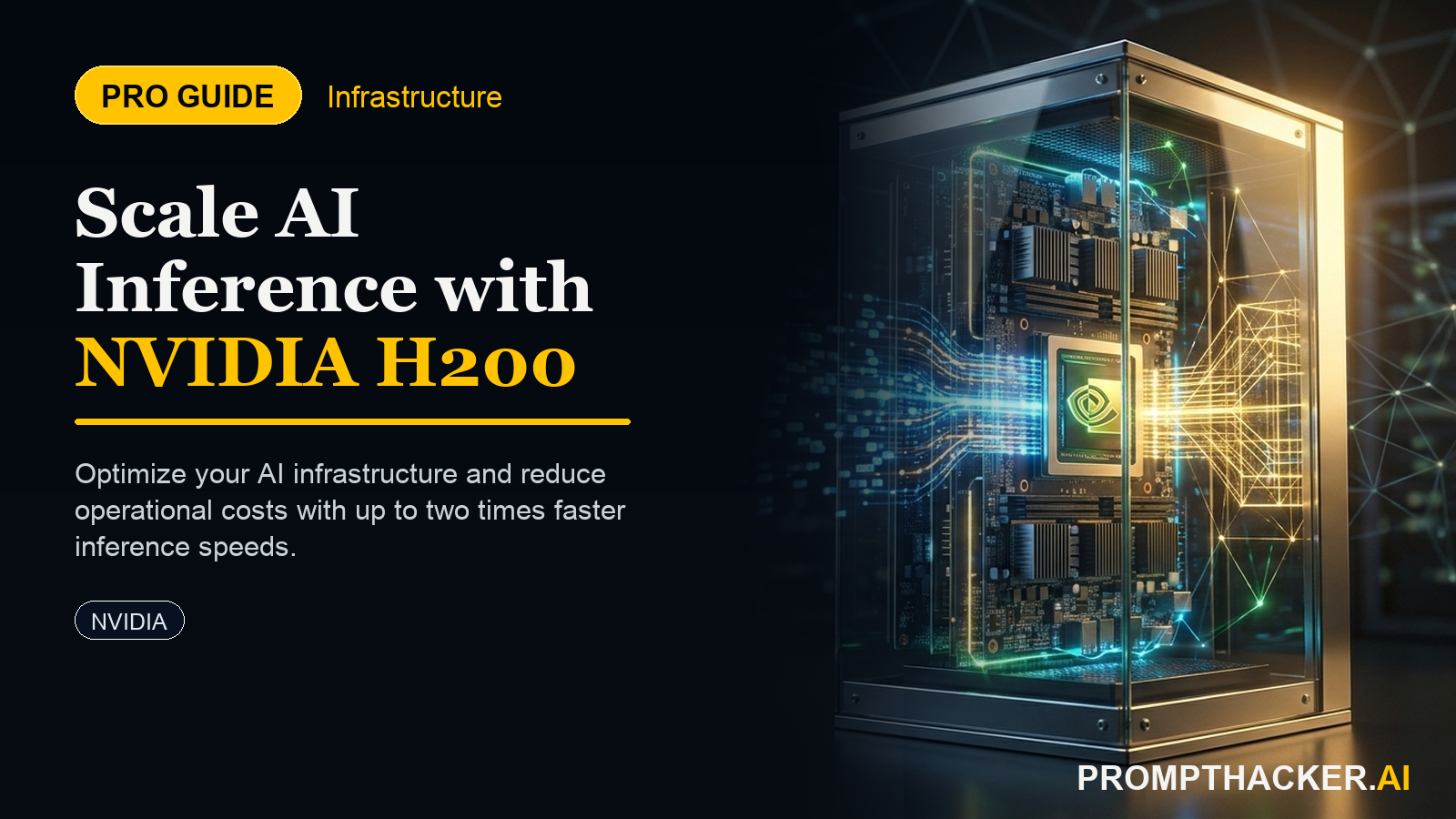
NVIDIA H200 GPU Accelerates AI Inference, Reduces Operational Costs

Optimize AI infrastructure with NVIDIA's H200 GPU, delivering up to 2x faster inference speeds and lower operational costs.

November 26, 2025 9 min read
nvidia h200 gpu faster ai inference scale
Quick Scan

What matters today

Optimize AI infrastructure with NVIDIA's H200 GPU, delivering up to 2x faster inference speeds and lower operational costs.

Format TOP UPDATE
Audience Executives using AI at work
Time 9 min read
Topic Top Update

Key points

  • The Engineering Behind Enhanced Inference Speed
  • Translating Speed into Operational Cost Savings
  • Strategic Deployment for Large-Scale AI
  • Planning Your H200 Integration Roadmap
  • Overcoming Implementation Challenges

What you will learn in this article:

  • How to evaluate the H200 GPU for optimizing existing AI infrastructure to reduce latency.
  • How to calculate potential cost savings from deploying H200 GPUs for large-scale AI models.
  • How to plan for integrating next-generation hardware to maintain a competitive AI edge.
  • How to mitigate risks associated with upgrading AI compute resources to ensure seamless operations.

A Chief Technology Officer at a rapidly growing e-commerce company is facing increasing compute demands. Their AI-powered recommendation engine, fraud detection systems, and customer service chatbots are experiencing latency spikes during peak traffic. The current GPU clusters are at capacity, leading to slow response times for critical AI applications and escalating cloud costs. The CTO needs a hardware solution that can not only handle current demand but also scale for future AI initiatives without incurring unsustainable expenses.

Without a strategic hardware upgrade, the company risks losing customers due to poor user experience, increasing operational expenditures, and falling behind competitors who can deploy more sophisticated, real-time AI models. The decision on infrastructure investment will directly impact the company's profitability and market position over the next 18 months. Delayed action could result in millions in lost revenue and a significant erosion of market share.

This article examines NVIDIA's H200 GPU, a hardware advancement promising to redefine AI inference performance. Discover how this technology can accelerate your AI models, reduce operational expenditures, and secure your competitive advantage in a data-driven economy. Executives will gain a clear understanding of the H200's capabilities and practical steps for integrating it into your AI strategy.

The landscape of artificial intelligence is constantly evolving, with the demand for faster, more efficient AI models growing exponentially. While training AI models often receives significant attention, the inference phase, where trained models are applied to new data to make predictions or generate outputs, is equally critical for business operations. Slow inference directly impacts user experience, real-time decision-making, and the overall cost of deploying AI at scale.

NVIDIA's H200 GPU directly addresses this inference bottleneck. Engineered for high-performance AI, the H200 promises up to 2x faster speeds compared to its predecessor, the H100 GPU. This advancement is not merely a technical specification; it translates directly into tangible business benefits, making advanced AI models more accessible and efficient for production use across various industries.

The Engineering Behind Enhanced Inference Speed

The H200's performance gains stem primarily from its advanced memory architecture. It features NVIDIA's HBM3e memory, which offers significantly higher bandwidth and capacity than previous generations. Specifically, the H200 includes 141 GB of HBM3e memory, providing 4.8 terabytes per second (TB/s) of memory bandwidth. This represents a substantial increase over the H100's 80 GB of HBM3 memory and 3.35 TB/s bandwidth.

This enhanced memory is crucial for large language models (LLMs) and other complex AI applications. Modern LLMs require vast amounts of memory to store their parameters and process large contexts during inference. Higher memory capacity allows the H200 to handle larger models or larger batch sizes, reducing the need for complex model partitioning or frequent data transfers, which are common sources of latency. The increased bandwidth ensures that the GPU can access this data faster, keeping its processing units fully utilized and minimizing idle time.

For an executive, this means AI applications can process more data simultaneously, respond quicker, and handle more complex queries without performance degradation. For instance, a customer support chatbot powered by an LLM can provide more nuanced and detailed responses faster, improving customer satisfaction and reducing agent workload.

Translating Speed into Operational Cost Savings

The "up to 2x faster inference speeds" provided by the H200 GPU directly translates into significant reductions in operational costs for large-scale AI deployments. This is not just about raw speed; it is about efficiency across the entire AI infrastructure.

First, fewer H200 GPUs are required to achieve the same or superior performance compared to previous-generation hardware. If one H200 can perform the work of two H100s for a given inference workload, the immediate hardware procurement costs for a new deployment can be halved. This direct reduction in the number of units needed leads to lower capital expenditure.

Second, fewer GPUs mean reduced power consumption. Each GPU consumes power, and faster, more efficient GPUs complete tasks quicker, or handle more tasks with less energy per inference. This leads to lower electricity bills for data centers. Consider an enterprise running a large AI model that processes millions of transactions daily. A 2x improvement in inference efficiency could cut the energy cost associated with that workload by nearly half, delivering substantial savings over a year.

Third, a smaller physical footprint is required. Fewer GPUs occupy less rack space in a data center. This also reduces associated costs like cooling and physical infrastructure. For companies operating their own data centers, this frees up valuable space for other critical systems or reduces the need for expansion. For those using cloud providers, requiring fewer GPU instances directly lowers monthly cloud computing expenses.

Finally, faster inference accelerates the time to insight and action. In scenarios like real-time fraud detection for a financial institution, quicker processing means fraudulent transactions can be identified and blocked almost instantaneously, preventing financial losses. This indirect cost saving, coupled with increased revenue potential from faster decision-making, significantly impacts the bottom line.

Strategic Deployment for Large-Scale AI

The H200 GPU's capabilities open new strategic opportunities for businesses deploying AI at scale, particularly in areas demanding high throughput and low latency.

Consider a pharmaceutical company utilizing AI for drug discovery. Running complex molecular simulations and analyzing vast datasets of chemical compounds requires immense computational power. With the H200, these simulations can run twice as fast, accelerating the research and development cycle. This means bringing new drugs to market faster, gaining a critical competitive edge, and potentially saving millions in R&D costs by shortening experimental iterations.

In the realm of generative AI, the H200 enables faster content creation. A marketing agency can generate high-quality ad copy, images, or even short video scripts in a fraction of the time, allowing for more rapid campaign iterations and personalized content at scale. This directly impacts marketing effectiveness and the ability to respond to market trends in real-time. Similarly, software development teams can leverage H200-powered AI to generate code suggestions, automate testing, and refine software designs more quickly, boosting developer productivity and accelerating product delivery.

Another real-world scenario involves a logistics company optimizing delivery routes in real time. As traffic conditions, weather patterns, and new orders continuously change, AI models must constantly re-calculate optimal routes for hundreds or thousands of vehicles. The H200's faster inference allows these complex optimizations to run with minimal latency, ensuring drivers always have the most efficient routes. This leads to significant savings in fuel consumption, reduced delivery times, and improved customer satisfaction.

Planning Your H200 Integration Roadmap

Integrating new, high-performance hardware like the NVIDIA H200 GPU requires careful planning and a strategic approach. Executives must ensure that the investment delivers maximum return and aligns with overall business objectives.

  • Assess Current AI Workloads and Bottlenecks: Begin by conducting a comprehensive audit of your existing AI workloads. Identify which specific models are currently compute-bound during their inference phase. Quantify current latency metrics (e.g., average response time for a chatbot query, processing time for a fraud detection model) and associated operational costs. This baseline data is crucial for measuring the impact of H200 integration and establishing clear target performance improvements. For example, determine if your LLM for internal knowledge management is struggling to provide sub-second responses to complex queries, or if your real-time analytics dashboard experiences delays during peak business hours.
  • Model Hardware Requirements and ROI: Based on your workload assessment, estimate the number of H200 GPUs needed to achieve your target performance, comparing it directly to your existing GPU infrastructure. Project the anticipated power savings and any potential reductions in data center space. Crucially, calculate the total cost of ownership (TCO) over a 3-5 year period, factoring in the initial hardware investment, power, cooling, and maintenance. This financial model should clearly demonstrate the long-term operational savings and the return on investment (ROI), justifying the capital expenditure. For instance, show how a 2x inference speed improvement allows you to reduce your GPU cluster by 40%, leading to a 30% reduction in power consumption and a 25% decrease in cloud instance costs annually.
  • Develop a Phased Migration Strategy: Avoid a "rip and replace" approach. Instead, plan a gradual, phased migration. Start by deploying H200s for non-critical workloads, new AI projects, or specific segments of your existing applications. Run parallel testing, where both your old and new infrastructure process the same data, allowing you to validate performance gains and identify any unforeseen issues without impacting core operations. This strategy minimizes risk and provides valuable insights before a full-scale transition. Ensure your software stack (e.g., CUDA drivers, AI frameworks like PyTorch or TensorFlow) is compatible with the H200 from the outset.
  • Optimize Software and Model Architecture: Simply installing new hardware is not enough. Your AI models and software pipelines must be optimized to fully leverage the H200's capabilities. Review existing inference pipelines for bottlenecks that might exist outside of GPU performance, such as data ingress/egress, pre-processing, or post-processing steps. Ensure your AI models are configured to take advantage of the H200's memory capacity and bandwidth, including considerations for mixed-precision inference if applicable. This optimization ensures you are not just running faster hardware, but running your entire AI workflow more efficiently.

Overcoming Implementation Challenges

While the benefits are clear, executives must also anticipate and plan for potential implementation challenges when adopting new GPU technology.

  • Compatibility and Integration: Ensuring seamless integration with existing software stacks is paramount. Older versions of CUDA, AI frameworks, or custom libraries may not be immediately compatible with new hardware. A detailed compatibility assessment and a plan for necessary upgrades or patching are essential. Allocate resources for testing and validation to prevent disruptions.
  • Data Transfer Bottlenecks: Even with the H200's ultra-fast HBM3e memory, data transfer speeds to and from the GPU can become a bottleneck if not managed correctly. Optimize your data pipelines, storage solutions, and network infrastructure to ensure data can be fed to the H200 at a rate that matches its processing capabilities.
  • Initial Investment: The H200 represents a significant capital expenditure. The business case must be robust, with clear ROI projections that account for both direct cost savings and indirect benefits like faster time-to-market or improved customer experience. Presenting a compelling financial argument to stakeholders is crucial.
  • Talent and Expertise: Managing and optimizing cutting-edge AI hardware requires specialized skills. Ensure your engineering and operations teams possess the necessary expertise, or invest in training and upskilling programs. Access to NVIDIA's developer ecosystem and support resources can also be invaluable during the transition.

By proactively addressing these challenges, organizations can successfully integrate the NVIDIA H200 GPU, achieving superior AI inference performance while simultaneously driving down operational costs and enhancing their competitive standing.

Action Steps Summary

  • Evaluate Workloads and Bottlenecks: Identify AI models constrained by inference speed and quantify current performance metrics to establish a baseline for improvement.
  • Model ROI and Resource Needs: Project hardware requirements, power savings, and TCO with H200 GPUs to build a clear business case for investment and optimize resource allocation.
  • Plan Phased Migration: Implement a gradual transition strategy, beginning with non-critical applications and incorporating parallel testing to ensure stability and minimize disruption.
  • Optimize Software and Models: Adjust existing AI models and software pipelines to fully leverage the H200's advanced capabilities, maximizing performance gains and overall efficiency.
  • Address Integration Challenges: Prepare for software compatibility, data transfer optimizations, and upskilling teams to manage new hardware effectively, ensuring a smooth transition.

Bottom line

The useful move with NVIDIA H200 GPU Accelerates AI Inference, Reduces Operational Costs is to run one narrow test this week, then keep only the workflow that saves time, improves a decision, or gives your team clearer output. Treat the announcement as raw material, not the win itself.

About the author

Pierre Bradshaw Founder, PromptHacker.ai

Pierre has spent 25+ years building growth systems across fintech, real estate, lending, campaigns, and AI workflows, with machine-learning work dating back to 2012.

If you have any questions or comments about NVIDIA H200 GPU Accelerates AI Inference, Reduces Operational Costs feel free to reach out. I'd love to hear from you.

Contact Pierre
Free weekly briefing

Three deep dives. Four useful moves. One email worth opening.

PromptHacker turns the AI firehose into practical next steps for work, health, family, and everything time keeps trying to steal.