NVIDIA Vera Rubin and NemoClaw: The Open-Source Enterprise AI Agent Stack Every Operations Leader Needs to Know
What NVIDIA announced at GTC 2026 and why it matters for executives building internal AI workflows
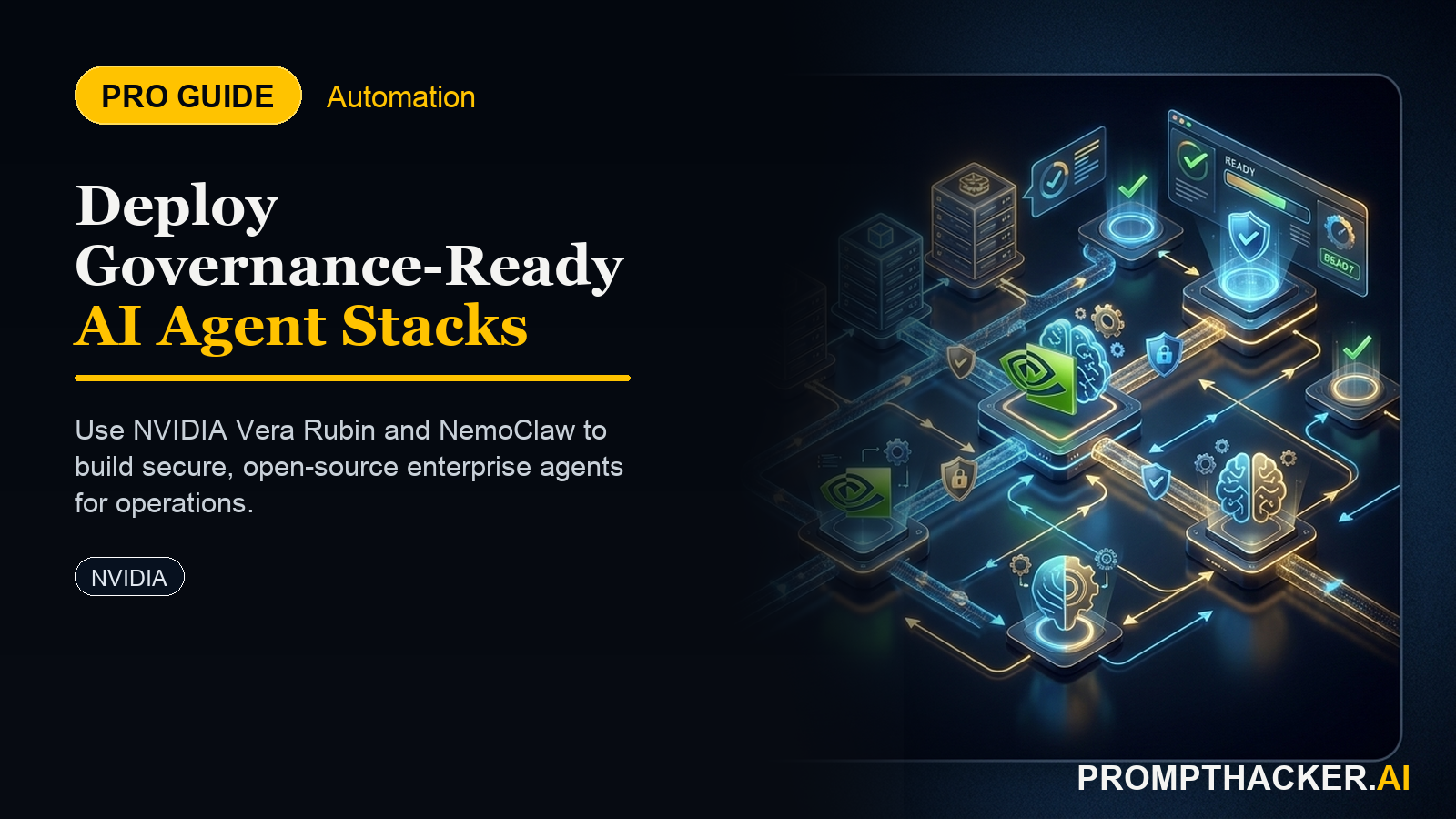
What matters today
What NVIDIA announced at GTC 2026 and why it matters for executives building internal AI workflows
Article roadmap
What you will learn
-
What NVIDIA announced at GTC 2026 and why it matters for executives building internal AI workflows
-
What NemoClaw is, how its three security layers work, and how it connects to the enterprise tools your organization already uses
-
A five-step action plan to evaluate and deploy NemoClaw in your environment in under a week
-
Why the Vera Rubin infrastructure build-out signals a multi-year shift in where AI compute is headed -- and what that means for vendor decisions today
-
The difference between MCP connectivity and agent governance, and why you need both
At GTC 2026 in San Jose, NVIDIA CEO Jensen Huang announced that the company sees at least $1 trillion in visible revenue from its Blackwell and Vera Rubin platforms through 2027. That number is striking, but it is not the most important thing executives took home from the three-day conference. The most immediately actionable story was quieter: NVIDIA released NemoClaw, an open-source enterprise reference stack for deploying AI agents inside organizations -- free, policy-governed, and designed to connect to the enterprise systems executives already run.
The challenge every organization faces when deploying internal AI agents is not capability -- the models are capable enough. The challenge is governance. Who can the agent access? What data can it read? What actions can it take without human approval? What audit trail does the compliance team see? These questions have been answered differently by every team building internal agents, which means the same governance work is being done from scratch dozens of times at each company. NemoClaw solves this by providing a reference stack with three enterprise-grade security layers built in, open-sourced, and pre-connected to the policy engines most large organizations already use.
If your company has started building AI agents for internal workflows -- or is about to -- NemoClaw is the first framework worth benchmarking against. The rest of this article explains exactly what it includes and how to evaluate it in your environment.
What Is NVIDIA NemoClaw
NemoClaw is NVIDIA's enterprise-grade reference design for deploying AI agents inside organizations. It is built on top of OpenClaw, an open-source agentic AI framework, and adds the enterprise readiness layer that IT and compliance teams require before any agent can touch production systems.
Three security layers ship with NemoClaw:
1. OpenShell Runtime Sandboxing Every agent action runs inside an isolated execution environment. This means an agent processing financial data cannot inadvertently read or write to HR systems, and an agent authorized for one department's SharePoint cannot crawl another's. The sandbox enforces the principle of least privilege at the runtime level -- not just at the prompt level, where it can be jailbroken or misconfigured.
2. Privacy Router All data flowing through an agent passes through a privacy routing layer that strips or masks personally identifiable information before it reaches the language model. This is particularly relevant for organizations under HIPAA, GDPR, or state-level privacy laws: the model never sees raw PII even when the agent is authorized to retrieve records that contain it.
3. Network Guardrails NemoClaw controls which external endpoints an agent can reach. An agent configured for internal research cannot exfiltrate data to external APIs. An agent connected to a customer database cannot initiate outbound web requests. The guardrails are configurable at the policy engine level, not hard-coded, so organizations can tune them without rebuilding the stack.
Key Insight
NemoClaw moves governance enforcement from the prompt level -- which is fragile and vulnerable to injection -- to the runtime and policy engine levels, which are deterministic and auditable. That architectural shift is what makes it worth evaluating against any custom agent stack your organization is building today.
Policy Engine Integrations Out of the Box
NemoClaw ships pre-built connectors for the policy and workflow engines that large organizations already maintain:
- Salesforce: Agent behavior can be governed by Salesforce's existing access control and data permission rules
- ServiceNow: Agents can trigger and respond to ServiceNow tickets with the same approval workflows already in place for IT requests
- Atlassian (Jira and Confluence): Agents read and write to Jira projects and Confluence spaces within the permissions already set for human users
- Adobe, Red Hat, Cisco: Enterprise content, infrastructure, and network policy integration
The implication: organizations do not need to build a new governance framework for AI agents. They extend the governance framework already in place for human employees into the agent layer.
Vera Rubin -- The Infrastructure Context
Understanding NemoClaw requires understanding why NVIDIA is building the enterprise software layer on top of Vera Rubin hardware.
Vera Rubin is NVIDIA's next-generation AI platform, succeeding Blackwell. It combines seven chips designed to work together: the NVIDIA Vera CPU, NVIDIA Rubin GPU, NVLink 6 Switch, ConnectX-9 SuperNIC, BlueField-4 DPU, Spectrum-6 Ethernet switch, and an integrated Groq 3 LPU. The platform covers every phase of AI -- pretraining, post-training, test-time scaling, and real-time agentic inference -- in a single factory-scale architecture.
For executives making vendor decisions, the signal is this: NVIDIA's hardware build-out and Jensen Huang's $1 trillion revenue projection indicate that AI infrastructure is heading toward a multi-year expansion cycle. Every cloud provider that runs on NVIDIA hardware (AWS, Azure, Google Cloud) will deploy Vera Rubin capacity through 2026 and 2027. The AI compute available per dollar is going to continue improving.
The practical implication for executives: the agent workflows built today on current compute will be meaningfully faster and cheaper to run by late 2026, with no changes to the workflow itself. Build the workflow now, benefit from the hardware ramp automatically.
How to Evaluate NemoClaw in Your Environment -- 5 Steps
Step 1: Download NemoClaw from GitHub Visit the NVIDIA AI Enterprise GitHub repository (github.com/NVIDIA/NemoClaw) and clone the repository. The framework is open-source with an Apache 2.0 license -- no licensing cost. Installation prerequisites are Python 3.10+ and Docker for the runtime sandbox. Estimated time: 30 minutes.
Step 2: Identify your policy engine NemoClaw's value is highest when it integrates with a policy engine your organization already operates. Review the list of pre-built connectors (Salesforce, ServiceNow, Atlassian, Adobe, Red Hat, Cisco) and identify the one that governs the most critical data your agent will need to access. Prioritizing a single integration for the first deployment reduces risk substantially.
Step 3: Configure a test agent with scoped permissions Start with the lowest-stakes internal use case -- for example, an agent that reads internal knowledge base articles and answers employee questions. Scope its permissions to read-only access on a single SharePoint library or Confluence space. Configure the three security layers as described in the NemoClaw documentation: OpenShell sandbox, privacy router (PII masking on), network guardrails (external requests blocked).
Step 4: Run a red-team test before production Before deploying to users, have a member of your IT or security team attempt to make the agent do something outside its defined scope: access a system it is not connected to, exfiltrate data, or take an action that requires human approval. Document every attempt and its outcome. This is not an adversarial exercise -- it is validation that the governance layer works as configured.
Step 5: Present the audit log to your compliance team NemoClaw generates structured logs of every agent action, data access, and policy decision. Export a sample audit log from the test deployment and review it with your compliance or legal team. If the log format meets their requirements, the deployment is cleared for production. Expected outcome: audit-ready agent deployment in 3-5 business days from starting the evaluation.
Why Agent Governance Is the Actual Bottleneck
The agents themselves are not the limiting factor. GPT-5.4 Thinking, Claude Sonnet 4.6, Gemini 3.1 Pro -- any of these models can handle the analytical and generative tasks that enterprise agents perform. The bottleneck is the governance layer: the ability to deploy an agent with the assurance that it will only do what it is authorized to do, only access what it is permitted to access, and leave an audit trail that satisfies your compliance requirements.
Most organizations building agents today are solving this problem manually -- writing custom access control logic, building ad hoc logging, and maintaining policy enforcement in the prompt itself. The prompt-level enforcement is the most fragile approach: it is vulnerable to prompt injection, model updates, and edge cases that were not anticipated when the prompt was written.
NemoClaw moves enforcement to the runtime and policy engine levels, which are deterministic and auditable in a way that prompt-level governance is not. That is the architectural shift that makes it worth evaluating.
The MCP Connection
The Model Context Protocol milestone confirmed this week (97 million installs, Linux Foundation governance) is directly related to why NemoClaw matters. MCP provides the connectivity layer: a standardized mechanism for AI agents to discover and connect to external tools, APIs, and data sources. NemoClaw provides the governance layer: the security and policy enforcement that makes those MCP connections enterprise-grade.
An agent using MCP connectors without a governance layer like NemoClaw can reach the right data, but IT and compliance cannot verify what it did with it. NemoClaw wraps MCP-connected agents with the sandboxing, privacy routing, and audit logging that enterprise deployment requires. The two frameworks are complementary, and organizations building agents will need both.
Action Steps
1. Download and install NemoClaw from GitHub. Clone the NVIDIA AI Enterprise repository, review the Apache 2.0 license, and confirm your environment meets the prerequisites (Python 3.10+, Docker). Target: under 30 minutes.
2. Identify your highest-priority policy engine integration. Choose from Salesforce, ServiceNow, Atlassian, Adobe, Red Hat, or Cisco based on which governs the most critical internal data your first agent will access.
3. Configure a scoped test agent with all three security layers enabled. Start with a read-only knowledge base or documentation assistant. Enable OpenShell sandboxing, privacy router with PII masking, and network guardrails blocking all outbound requests.
4. Run a structured red-team test. Have IT or security attempt to make the agent exceed its defined scope. Document every result. This validates the governance layer before any users touch it.
5. Export the audit log and clear it with compliance. Present the structured log output to your legal or compliance team. If the format meets their requirements, the deployment is cleared for production -- estimated 3-5 business days from start to sign-off.
THE PROMPT
"You are an enterprise IT advisor. I am evaluating NVIDIA NemoClaw for our organization. We use [policy engine -- e.g., ServiceNow / Salesforce / Atlassian]. Our first agent use case is [brief description]. Identify the top 3 risks we should test for in a red-team evaluation before production deployment, and draft a 1-page brief I can share with our compliance team explaining NemoClaw's three security layers."
Three deep dives. Four useful moves. One email worth opening.
PromptHacker turns the AI firehose into practical next steps for work, health, family, and everything time keeps trying to steal.