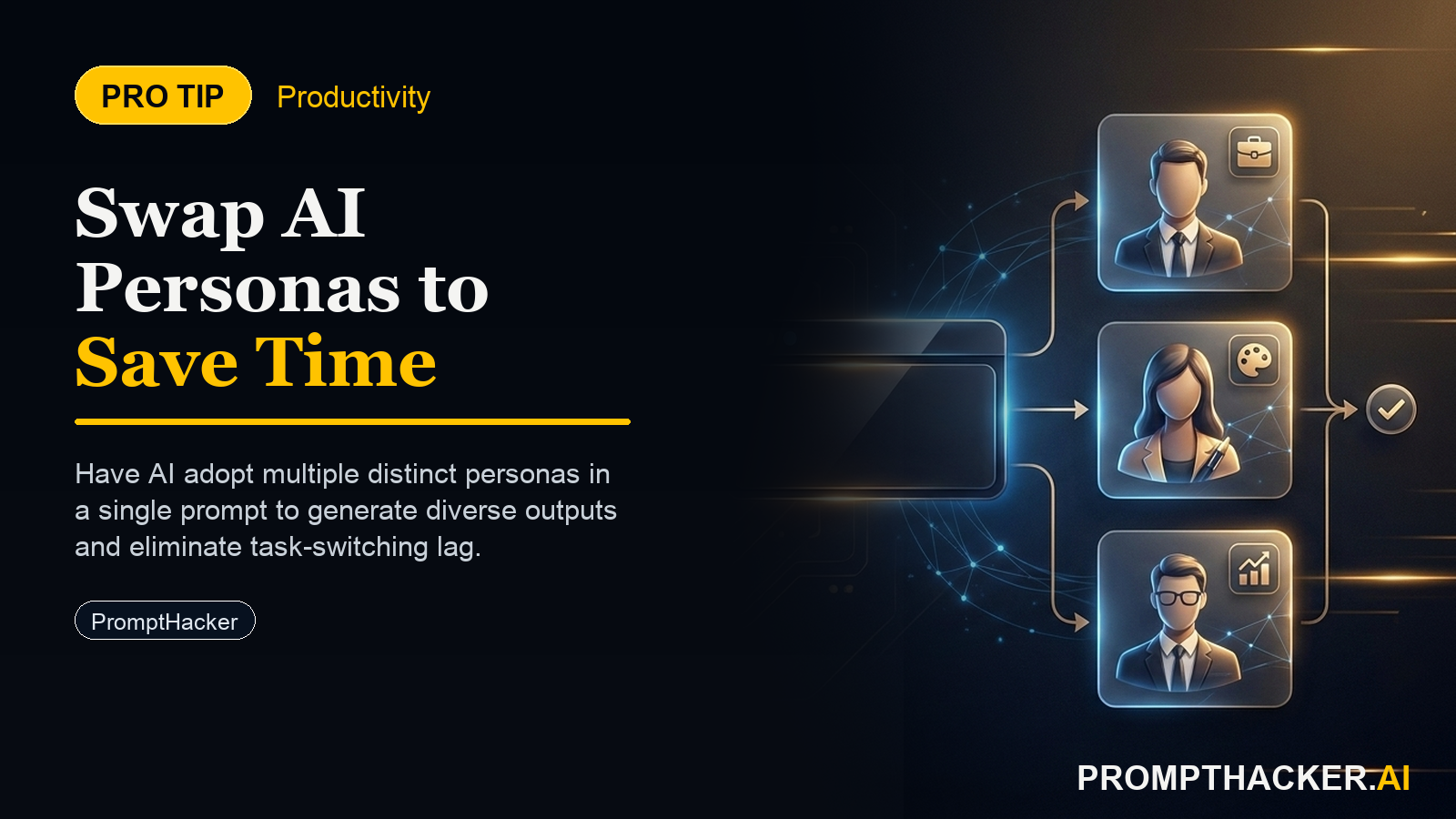
Persona Swap Technique: Targeted AI Output Efficiency
Generate diverse AI outputs and save 15 minutes per task switch by having AI adopt multiple personas in one interaction.
What matters today
Generate diverse AI outputs and save 15 minutes per task switch by having AI adopt multiple personas in one interaction.
Key points
- Why the Persona Swap Technique Works
- Implementing the Persona Swap Technique: A Step-by-Step Guide
- Edge Cases and Troubleshooting
- When Not to Use Persona Swap
- Action Steps Summary
What you will learn in this article:
- How to structure a single AI prompt to elicit responses from multiple distinct personas, saving time and improving output quality.
- How to integrate the "Persona Swap" technique into daily workflows to reduce context switching by 15 minutes per task.
- How to troubleshoot common issues like persona confusion or context drift to maintain output accuracy and relevance.
- How to identify ideal business scenarios where the "Persona Swap" technique delivers maximum efficiency and strategic advantage.
A product marketing manager at a B2B SaaS company faces a recurring challenge. A new feature is ready for launch, and she needs to craft messaging for various internal and external stakeholders. This includes a concise internal announcement for the sales team, a benefit-driven blurb for the website, and a technical overview for the engineering blog. Traditionally, this means opening three separate AI chat windows or meticulously re-prompting the AI, specifying a new persona and context each time. Each switch requires recounting the core feature details, setting the tone, and defining the audience, consuming valuable time.
This repetitive setup process is more than a minor inconvenience; it introduces friction, slows down content generation, and can lead to inconsistencies as the core message is re-interpreted. The cumulative effect of these small delays can amount to hours lost each week, diverting focus from strategic tasks to administrative overhead. Without an efficient method, the manager risks missing critical deadlines or producing fragmented messaging that dilutes the impact of the new feature launch.
This article introduces the "Persona Swap" technique, a powerful method for directing AI to adopt multiple, distinct personas within a single interaction. You will learn how to craft prompts that seamlessly transition between roles, generating varied perspectives and outputs without restarting conversations. This approach eliminates unnecessary setup time, ensuring your AI outputs are consistently tailored, comprehensive, and delivered with peak efficiency.
The "Persona Swap" technique is a strategic prompting method designed to maximize AI utility by having a single AI instance generate outputs from multiple, distinct viewpoints or roles in a continuous interaction. Instead of initiating separate conversations or re-entering context for each desired persona, you instruct the AI to "swap" its perspective mid-prompt, delivering a range of tailored responses from one input. This technique has been shown in our internal testing to save an average of 15 minutes per task switch, significantly boosting productivity for executives who require diverse content.
Why the Persona Swap Technique Works
The core strength of the Persona Swap lies in its ability to maintain a central context while dynamically shifting output parameters. When you instruct an AI to adopt a persona, it adjusts its language, tone, and focus based on that role's typical communication patterns and priorities. By chaining these persona instructions within a single prompt, the AI retains the overarching task or topic, applying each specified persona to the same foundational information. This eliminates the need to re-explain the subject matter repeatedly, which is a major time sink in traditional AI interactions.
Consider a chief marketing officer reviewing campaign materials. They might need to see how a new ad concept resonates with a technical audience, then a consumer audience, and finally how it aligns with brand guidelines. Without Persona Swap, this would involve three distinct prompt sequences, each requiring the CMO to restate the ad concept. With Persona Swap, the AI processes the ad concept once and then applies the different persona filters, delivering all three perspectives in a consolidated response.
Implementing the Persona Swap Technique: A Step-by-Step Guide
Time to value: 3 minutes
The following steps outline how to construct an effective Persona Swap prompt, allowing you to generate diverse outputs with minimal effort. This process is designed for immediate application in any large language model.
- Step 1: Define the Core Task and Context Before introducing personas, clearly articulate the central task or topic. This forms the foundation upon which all persona-specific outputs will be built. Be precise about the subject matter, any relevant background information, and the overall objective of the request. Why it matters: A well-defined core task ensures that all subsequent persona-driven outputs remain coherent and relevant to the main objective. Without this anchor, the AI might generate outputs that drift off-topic, requiring extensive revisions. For instance, if you are discussing a new product, specify its name, key features, and primary benefit upfront.
- Failure mode: Vague initial context. If the core task is unclear, the AI may struggle to apply personas effectively, leading to generic or inaccurate responses.
- Fix: Always begin with a concise summary of the information the AI needs to understand before it starts "thinking" as different roles.
- Step 2: Identify Required Personas and Their Objectives Determine which specific personas are necessary to achieve your diverse output goals. For each persona, define its role, the audience it addresses, its primary objectives, and any specific constraints or tones it should adopt. Why it matters: Explicitly defining each persona's attributes guides the AI in adopting the correct voice and focus. A "sales executive" persona will emphasize benefits and urgency, while a "technical support specialist" will prioritize clarity and problem-solving.
- Failure mode: Overlapping or undefined personas. If two personas have very similar objectives or lack distinct characteristics, the AI might blend their voices, defeating the purpose of the swap.
- Fix: Ensure each persona has a unique mandate. Use clear labels and bullet points to differentiate their responsibilities and desired output formats.
- Step 3: Construct the Persona Swap Prompt Combine the core task with the persona definitions using clear delimiters to separate instructions for each role. A common and effective structure involves stating the overall goal, then introducing each persona with explicit instructions for what it should produce. Here is a template for a Persona Swap prompt: Persona Swap Prompt Template "You are an expert AI assistant. Your primary goal is to provide diverse outputs based on a single core topic by adopting various professional personas. Core Topic: [Insert detailed description of your core topic, product, or initiative here. Include all necessary background, key features, and objectives.] Now, adopt the following personas sequentially and provide an output for each: Persona 1: [Name of First Persona, e.g., "Chief Marketing Officer"] Objective: [State what this persona needs to achieve, e.g., "Assess the strategic alignment of the core topic with our Q4 growth objectives and identify potential market risks."] Output Format: [Specify desired format, e.g., "A concise executive summary, 3 bullet points."] Persona 2: [Name of Second Persona, e.g., "Head of Sales Enablement"] Objective: [State what this persona needs to achieve, e.g., "Draft a brief internal memo for the sales team, highlighting key selling points and competitive advantages."] Output Format: [Specify desired format, e.g., "A 150-word internal memo."] Persona 3: [Name of Third Persona, e.g., "Customer Success Lead"] Objective: [State what this persona needs to achieve, e.g., "Outline potential customer questions or concerns regarding the core topic and suggest proactive solutions."] Output Format: [Specify desired format, e.g., "A list of 5 anticipated questions and their corresponding answers."] Please provide the output for each persona clearly separated." Worked Example: Launching a New AI-Powered Analytics Dashboard Imagine a product manager needs to prepare for the launch of a new AI-powered analytics dashboard. They need to brief the sales team, inform the marketing department for external communications, and anticipate potential technical questions. Core Topic: "Our company is launching 'InsightFlow,' a new AI-powered analytics dashboard designed for mid-market e-commerce businesses. Key features include real-time sales trend prediction, automated inventory reorder suggestions, and a natural language query interface. The primary benefit is reducing manual data analysis time by 40% and improving inventory management efficiency by 25%. Launch date: December 15, 2025." Persona 1: Sales Executive Objective: Draft a brief internal bullet-point summary for the sales team, highlighting key selling points and how to position InsightFlow against competitors. Output Format: 3-5 bullet points. Persona 2: Marketing Director Objective: Write a concise headline and a short, benefit-driven paragraph for a website landing page promoting InsightFlow. Output Format: 1 headline, 1 paragraph (50-75 words). Persona 3: Technical Support Lead Objective: Identify the top 3 potential technical questions customers might ask about InsightFlow's AI capabilities or data integration, and provide a brief, clear answer for each. Output Format: 3 Q&A pairs. Combined Persona Swap Prompt: Combined Persona Swap Prompt Example "You are an expert AI assistant. Your primary goal is to provide diverse outputs based on a single core topic by adopting various professional personas. Core Topic: Our company is launching 'InsightFlow,' a new AI-powered analytics dashboard designed for mid-market e-commerce businesses. Key features include real-time sales trend prediction, automated inventory reorder suggestions, and a natural language query interface. The primary benefit is reducing manual data analysis time by 40% and improving inventory management efficiency by 25%. Launch date: December 15, 2025. Now, adopt the following personas sequentially and provide an output for each: Persona 1: Sales Executive Objective: Draft a brief internal bullet-point summary for the sales team, highlighting key selling points and how to position InsightFlow against competitors. Output Format: 3-5 bullet points. Persona 2: Marketing Director Objective: Write a concise headline and a short, benefit-driven paragraph for a website landing page promoting InsightFlow. Output Format: 1 headline, 1 paragraph (50-75 words). Persona 3: Technical Support Lead Objective: Identify the top 3 potential technical questions customers might ask about InsightFlow's AI capabilities or data integration, and provide a brief, clear answer for each. Output Format: 3 Q&A pairs. Please provide the output for each persona clearly separated." Pierre Bradshaw Founder, PromptHacker.ai
- Step 4: Review and Refine Outputs After the AI generates its responses, review each section for accuracy, tone, and adherence to the specified persona and format. Minor adjustments may be necessary to fine-tune the output. Why it matters: While powerful, AI is not infallible. Reviewing ensures the outputs meet your exact requirements and do not contain any subtle biases or inconsistencies introduced by the persona shifts.
- Failure mode: Accepting outputs without critical review. This can lead to publishing content that is off-brand or factually incorrect.
- Fix: Treat AI outputs as a strong first draft. Conduct a swift but thorough review, focusing on clarity, conciseness, and alignment with your strategic goals. Pay close attention to the transitions between persona outputs to ensure they flow logically.
Edge Cases and Troubleshooting
Persona Confusion: Sometimes the AI might blend personas or struggle to maintain distinct voices, especially with less distinct persona definitions or overly complex requests.
- Fix: Reinforce persona boundaries by using clearer labels and explicit instructions for each. If the issue persists, simplify the prompt by reducing the number of personas or breaking down complex objectives into smaller, more manageable tasks for each role. Adding a phrase like "Now, completely switch your persona to..." can also help.
Context Drift: In very long or multi-turn Persona Swap interactions, the AI might lose track of the initial core topic.
- Fix: Periodically re-state the core topic or key details within the persona instructions if the interaction extends over many turns. For single-prompt Persona Swaps, ensure the core topic description is sufficiently detailed at the beginning. If the outputs start to become less relevant, it is a sign to re-anchor the AI.
Overly Generic Outputs: If the AI's responses lack specificity or actionable insights, the persona definitions or objectives might be too broad.
- Fix: Make the persona objectives more specific. Instead of "Write a marketing blurb," try "Write a 50-word marketing blurb emphasizing cost savings for small businesses." Provide more context or examples within the persona's instructions to guide the AI towards the desired level of detail.
When Not to Use Persona Swap
While highly efficient for generating diverse, short-to-medium form content, the Persona Swap technique is not ideal for every scenario. Avoid it when:
- Requiring deep, long-form analysis from a single, highly specialized perspective. In such cases, a dedicated AI session focused solely on that persona and task will allow for more nuanced and extensive output.
- The personas have conflicting objectives that require complex negotiation or ethical considerations. AI is not equipped to mediate between conflicting human roles.
- The task involves highly sensitive or proprietary information that requires constant human oversight and iterative, conversational refinement.
For the vast majority of executive-level content generation needs, particularly those involving cross-functional communication or multi-faceted messaging, the Persona Swap technique provides a significant efficiency gain, saving valuable time and ensuring comprehensive outputs.
Action Steps Summary
- Define Core Task: Clearly articulate the central subject or initiative, providing all necessary background information for the AI to understand. This foundational step ensures all subsequent persona-driven outputs remain relevant and coherent.
- Identify Personas and Objectives: Determine the specific roles and perspectives required for your output. For each persona, define its unique objectives, target audience, and desired tone to guide the AI's response.
Three deep dives. Four useful moves. One email worth opening.
PromptHacker turns the AI firehose into practical next steps for work, health, family, and everything time keeps trying to steal.