Accelerate Strategic Decision-Making with AI-Powered Document Synthesis
How to structure prompts for comprehensive document analysis to extract core insights.
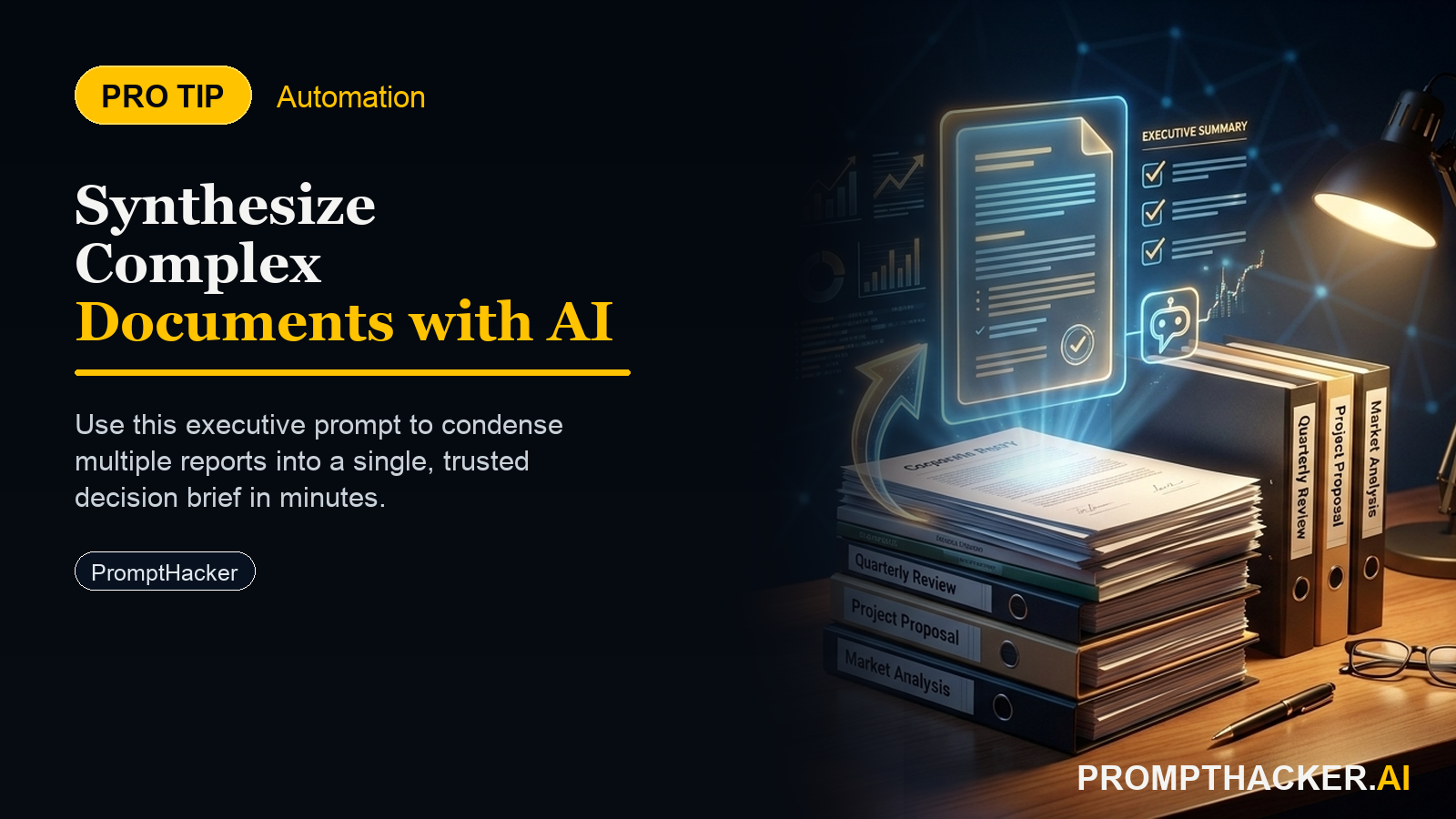
What matters today
How to structure prompts for comprehensive document analysis to extract core insights.
Article roadmap
What you will learn
-
How to structure prompts for comprehensive document analysis to extract core insights.
-
How to synthesize information from multiple sources into a concise executive brief for rapid understanding.
-
How to identify key trends, risks, and opportunities hidden within extensive reports to inform strategic choices.
-
How to validate AI-generated summaries and mitigate potential inaccuracies for reliable decision support.
A VP of Strategy at a rapidly scaling fintech company faces an onslaught of market research, competitor analyses, and internal performance reports. Each week, they need to synthesize this disparate information into a concise, actionable briefing for the executive committee, highlighting emerging trends, potential threats, and strategic opportunities. The sheer volume of reading and cross-referencing consumes significant time, often pushing critical strategic work to the weekend. Manually sifting through dozens of pages, identifying crucial data points, and then crafting a coherent narrative is a labor-intensive process that leaves little room for deeper strategic thought.
Without a streamlined approach, vital insights can be overlooked, strategic responses delayed, and the competitive edge dulled. Manual synthesis is prone to human bias and exhaustion, potentially leading to incomplete or skewed perspectives in high-stakes discussions. The cost is measured in missed opportunities and reactive decision-making, directly impacting market position and growth trajectory. The pressure to stay informed and agile in a dynamic market demands a more efficient method of information processing.
This article introduces a powerful AI-driven workflow that transforms how executives process and understand complex documents. Discover how to leverage advanced large language models to distill vast amounts of information into precise, decision-ready briefings, reclaiming hours and sharpening your strategic focus. This Pro Tip will provide a verbatim prompt, a detailed explanation of its components, and practical examples to integrate this capability into your weekly strategic review process, ensuring you always present the most critical insights.
The Strategic Document Synthesis Pattern
The ability to quickly extract the essence from lengthy, complex documents is a cornerstone of executive productivity. Whether it involves competitive intelligence, market trend analysis, or internal strategy reviews, the challenge remains consistent: too much information, too little time. This Pro Tip introduces a robust AI pattern for Strategic Document Synthesis, designed to turn overwhelming data into clear, actionable executive briefings.
This pattern leverages the AI's natural language understanding capabilities to act as your personal strategic analyst. It systematically identifies critical components within your provided text, filters out noise, and structures the output in a format immediately useful for high-level decision-making. The core of this efficiency lies in a carefully constructed prompt that guides the AI to perform specific analytical tasks, rather than just generic summarization.
Step 1: Prepare Your Documents for Analysis
Before interacting with the AI, gather the documents you need analyzed. These could be:
- Competitor earnings call transcripts.
- Market research reports from Gartner or Forrester.
- Internal strategic planning documents.
- Industry whitepapers or regulatory updates.
For optimal results, ensure the text is clean and directly copy-pasteable. If you are working with PDFs, use a reliable OCR tool to convert them to text first. Be mindful of the context window limits of your chosen LLM. For very long documents (e.g., over 100 pages), you may need to break them into logical sections and analyze them iteratively, then ask the AI to synthesize the summaries of those sections.
Why it works: Pre-processing ensures the AI receives the best possible input, minimizing errors and maximizing the quality of the output. It also helps manage token limits, preventing truncation of vital information during analysis.
Step 2: Utilize the Strategic Document Synthesis Prompt
This prompt is engineered to direct the AI toward a strategic analysis, not just a factual recall. It establishes the AI's persona, defines the output structure, and specifies the key analytical categories required for an executive.
Ready to scale your strategy?
Three deep dives. Four useful moves. One email worth opening.
PromptHacker turns the AI firehose into practical next steps for work, health, family, and everything time keeps trying to steal.