Generate Executive-Ready Briefings: Master the Role-Constraint-Format Prompt
A Head of Strategy at a global manufacturing firm faces a familiar challenge. A critical board meeting is scheduled for next week, and the agenda includes a deep dive into emerging market risks. Hundreds of pages of analyst reports, news articles, and internal data have accumulated.
What matters today
A Head of Strategy at a global manufacturing firm faces a familiar challenge. A critical board meeting is scheduled for next week, and the agenda includes a deep dive into emerging market risks.
Article roadmap
What you will learn
-
How to define a precise AI persona to generate authoritative content.
-
How to impose strict content and length constraints for concise outputs.
-
How to specify exact formatting requirements for immediate usability.
-
How to troubleshoot common AI output issues to maintain quality and relevance.
A Head of Strategy at a global manufacturing firm faces a familiar challenge. A critical board meeting is scheduled for next week, and the agenda includes a deep dive into emerging market risks. Hundreds of pages of analyst reports, news articles, and internal data have accumulated. The Head of Strategy needs a concise, actionable briefing that distills these complex inputs into a few critical takeaways and recommended actions,all while maintaining a formal, executive tone. Generic AI summaries often miss the mark, delivering verbose or unfocused content that requires hours of manual refinement.
The stakes are high. Presenting an undigested or poorly structured analysis can erode confidence, delay strategic decisions, and waste valuable board time. Relying on traditional methods to manually synthesize this volume of information within tight deadlines risks burnout and potential oversight of crucial details. The ability to quickly and accurately convert raw data into executive-ready intelligence is a significant competitive advantage.
This article introduces the "Role-Constraint-Format" (RCF) prompting method, a systematic approach designed to consistently deliver highly structured, actionable AI outputs. This technique enables executives to transform raw information into boardroom-quality briefings, analyses, and reports on the first attempt, significantly reducing the need for post-AI editing and freeing up time for critical strategic thought.
The core challenge for executives using large language models (LLMs) is often not the AI's ability to generate text, but its tendency to produce output that is too generic, unstructured, or verbose for immediate use in high-stakes environments. Board meetings, investor calls, and executive team discussions demand precision, conciseness, and a specific structure. The Role-Constraint-Format (RCF) prompting method directly addresses this by pre-defining the AI's parameters for content generation, ensuring the output aligns with executive expectations from the outset.
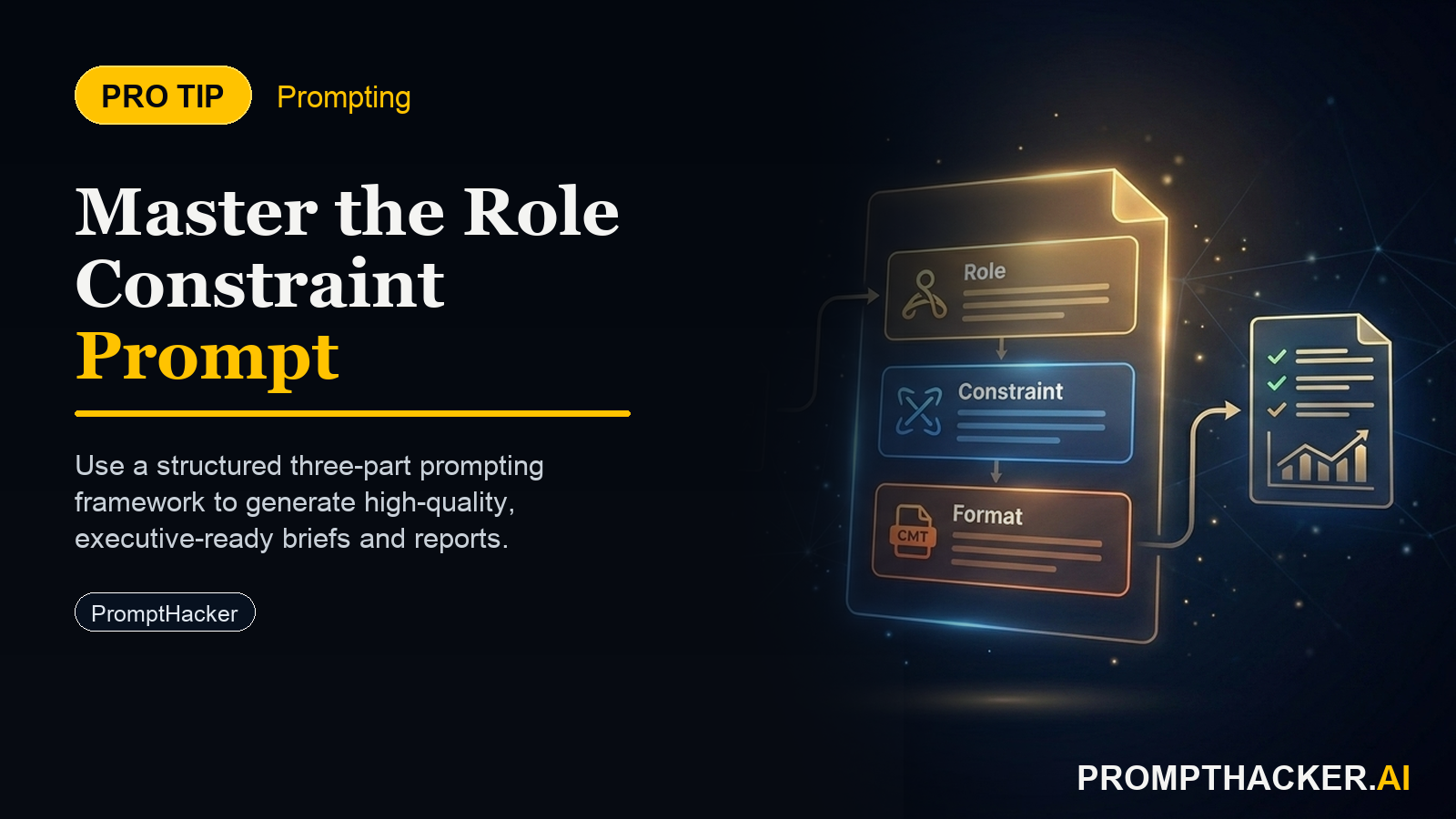
The RCF method breaks down prompt engineering into three critical components:
- Role Definition: Assigning the AI a specific persona and expertise.
- Constraint Establishment: Setting strict boundaries on content, scope, and tone.
- Format Specification: Dictating the exact structure of the desired output.
By systematically applying these three elements, executives can guide the AI to produce highly tailored, actionable, and ready-to-present materials. This approach minimizes the iterative back-and-forth often associated with AI interactions, saving significant time and improving the quality of strategic insights.
Time to value: 7 minutes (for prompt creation and initial AI output synthesis, assuming input data is ready).
Step 1: Define the AI's Role for Authoritative Content
The first step in crafting an effective RCF prompt is to clearly define the AI's role. This sets the context for the AI's response, influencing its perspective, depth of analysis, and even its language. Without a defined role, the AI defaults to a general, often academic or overly helpful, persona that lacks the specific authority or focus required for executive-level communication.
Why this matters: Assigning a role transforms the AI from a general information provider into a specialized expert. An AI instructed to act as a "seasoned M&A analyst" will approach a company valuation task differently than one acting as a "junior marketing associate." The former will focus on strategic implications, financial models, and risk assessment, while the latter might emphasize market positioning or brand perception. This specificity ensures the AI adopts the appropriate lens for the task, providing insights relevant to an executive's decision-making process.
"You are a strategic business analyst reporting directly to the CEO of a Fortune 500 company."
Ready to master AI strategy?
Get full access to our prompt library and executive templates.
Three deep dives. Four useful moves. One email worth opening.
PromptHacker turns the AI firehose into practical next steps for work, health, family, and everything time keeps trying to steal.