Science Week: Ask AI to Be a Scientist You Admire (Ages 8 - 16)
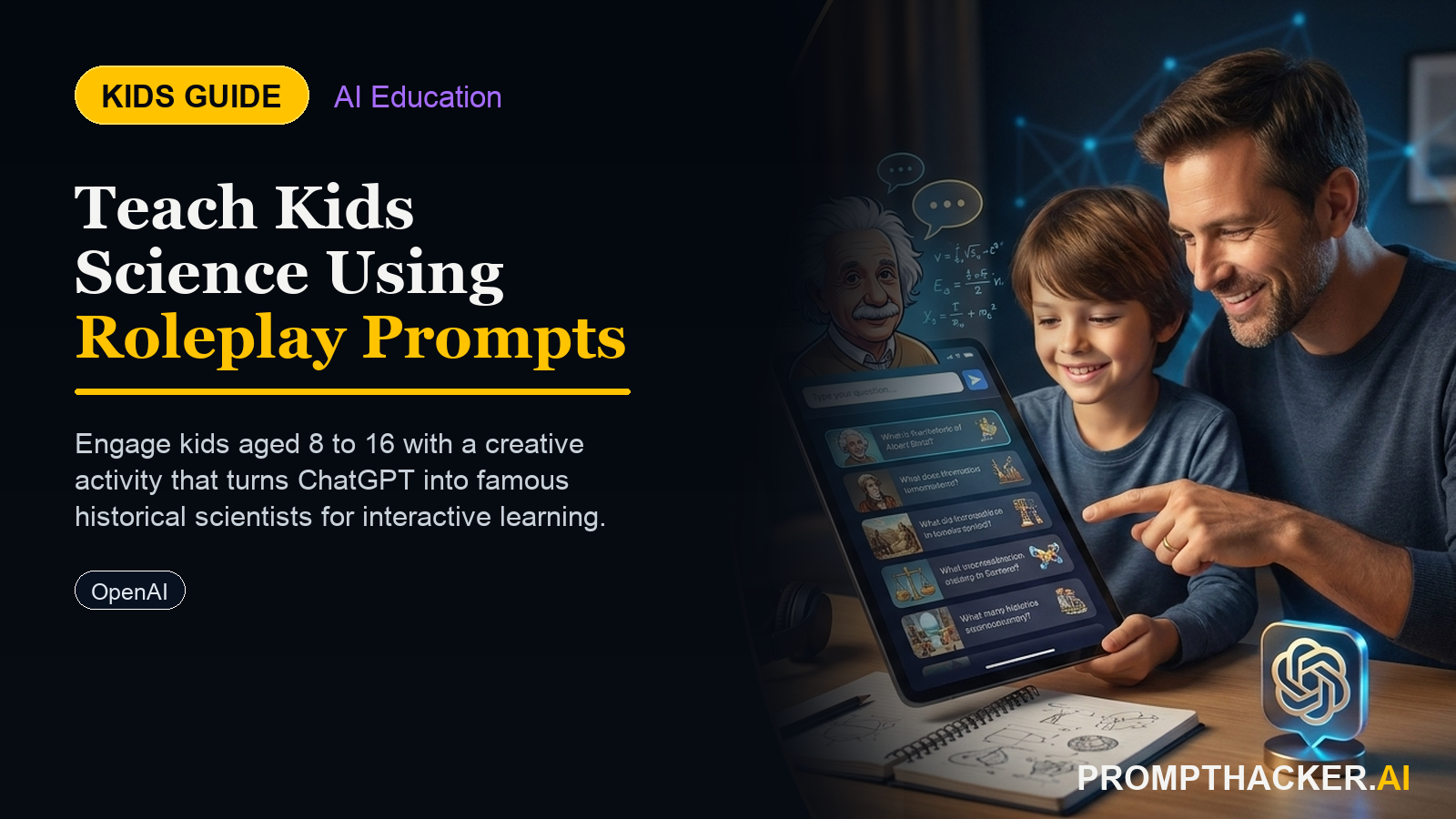
Kids create a hands-on AI project: Science Week: Ask AI to Be a Scientist You Admire (Ages 8 - 16). A parent or educator helps them build, test, and explain what the AI tool gets right and wrong.
What matters today
Kids create a hands-on AI project: Science Week: Ask AI to Be a Scientist You Admire (Ages 8 - 16). A parent or educator helps them build, test, and explain what the AI tool gets right and wrong.
Article roadmap
What you will learn
-
Why asking AI to embody a specific scientist produces better learning than asking it to explain a concept
-
Age-differentiated activities for 8 - 10, 11 - 13, and 14 - 16 with different complexity levels
-
The Pi Day (March 14) tie-in: mathematician profiles that make the date meaningful
-
Verbatim setup prompts for each age group
-
Parent and educator debrief questions that make the learning stick - and the skill transfer conversation worth having
Ask Claude to explain photosynthesis and you get an accurate, age-adjustable answer. Ask Claude to become Marie Curie and explain radioactivity as she discovered it - and the experience changes entirely. The model narrates in the first person, references the historical context, and can explain the emotional dimensions of scientific work in a way that a definition cannot.
Children who instruct AI to take on a specific persona are also practicing a transferable skill: specifying who an AI should be, what it should know, and how it should communicate. That skill transfers to every professional AI tool they will ever use. This week, Pi Day (March 14) gives the activity a natural date anchor - mathematician profiles that make the date a learning event, not just a number.
This is a PromptHacker Premium article.
The full age-by-age activity guides, verbatim setup prompts, and debrief framework are available to Premium subscribers.
Ages 8 - 10: Meet the Scientist
Paste this setup prompt before handing the device to the child. Let the child ask questions - no prep needed on their end:
You are now [scientist name]. You are talking to a [age]-year-old child who is curious about your discoveries. Speak in first person as [scientist name]. Use simple words. Be enthusiastic and encouraging. When you explain a scientific concept, use an analogy a child this age would understand. Start by introducing yourself and telling the child what you were most excited about discovering. Then ask: "What would you like to know about my work?"
Encourage the child to ask questions like "What was the hardest part of your discovery?" and "Did anyone believe you at first?" Pi Day version: set up as Ramanujan and ask the child to find out what Pi is and why Ramanujan spent so much time thinking about it.
Ages 11 - 13: Write the System Prompt
Explain the concept of a system prompt first: it is the set of instructions you give AI before the conversation starts, telling it who to be, what to know, and how to talk. The child writes this themselves - not fills in a blank.
The system prompt must include three parts: (1) who the scientist is - their role, time period, and what they are known for; (2) how they think - what they cared about, what excited them, how they approached problems; and (3) how they explain things - simple or technical, patient or fast-moving, examples-first or concepts-first.
Target length: 100 - 150 words. After writing, the child pastes it into a new chat and tests it with 3 questions. Debrief: "Does the AI respond differently than a generic 'explain this concept' query? What specifically changed?"
Ages 14 - 16: The Interview
The teenager conducts a structured four-phase interview: backstory (who shaped their thinking), discovery (the specific moment of their most important work), limitations (what they got wrong, what the field has corrected), and forward (what they would work on today).
The advanced system prompt for this age group explicitly gives the AI permission to acknowledge what the scientist was wrong about (AI responses often default to hero narrative) and to speculate about what the scientist would think today. Pi Day version: interview Euler on why he chose the symbol π, what he would make of modern computing's use of Pi, and whether he would agree with today's mathematical education approaches.
Parent and Educator Sidebar
Conversation starters after the activity:
- "The AI became whoever you told it to be. If you had written different instructions, would the conversation have gone differently? What would you change?"
- "When the AI explained something you already knew, how did it compare? Was there anything it said that seemed off or different from what you learned before?"
- "The AI followed your instructions, but it only knew what you told it. What information did you have to give it to make the conversation work? What does that tell you about how AI actually works?"
Core AI literacy concept:
The scientist roleplay works because children understand the framing immediately - they know what it means to ask a scientist questions. What the activity teaches implicitly is that the quality of the AI's performance depends entirely on the quality of the instructions given to it.
A child who notices "the AI gave me a better answer when I told it what grade I was in" has discovered prompt specificity through experience. A child who catches the AI describing an experiment inaccurately has practiced critical evaluation - which is the foundational professional AI skill. The debrief makes the skill explicit so the child can transfer it.
Action Steps
- Choose your date. Pi Day (March 14) is the natural anchor for mathematics-focused activities. Science Week activities can run any day in the surrounding two weeks.
- Pick the age-appropriate activity path and read through the instructions before sitting down with your child. The three versions have meaningfully different complexity expectations.
- For the 8 - 10 activity: Prepare the setup prompt yourself and paste it into Claude or ChatGPT before handing the device to the child. The first message should come from the AI as the scientist.
- For 11 - 13 and 14 - 16 activities: Have the child write the system prompt on paper before typing it. Writing first - then translating to the AI interface - makes the thinking more deliberate.
- Do the debrief. Ask: "What would you change in your system prompt?" This question is more valuable than any fact the child learned from the scientist session, because it teaches them to treat AI instructions as something they author, not something they accept.
Three deep dives. Four useful moves. One email worth opening.
PromptHacker turns the AI firehose into practical next steps for work, health, family, and everything time keeps trying to steal.