OpenAI Structured Outputs for Customer Feedback Categorization
How to handle ambiguous inputs and route low-confidence classifications for human review
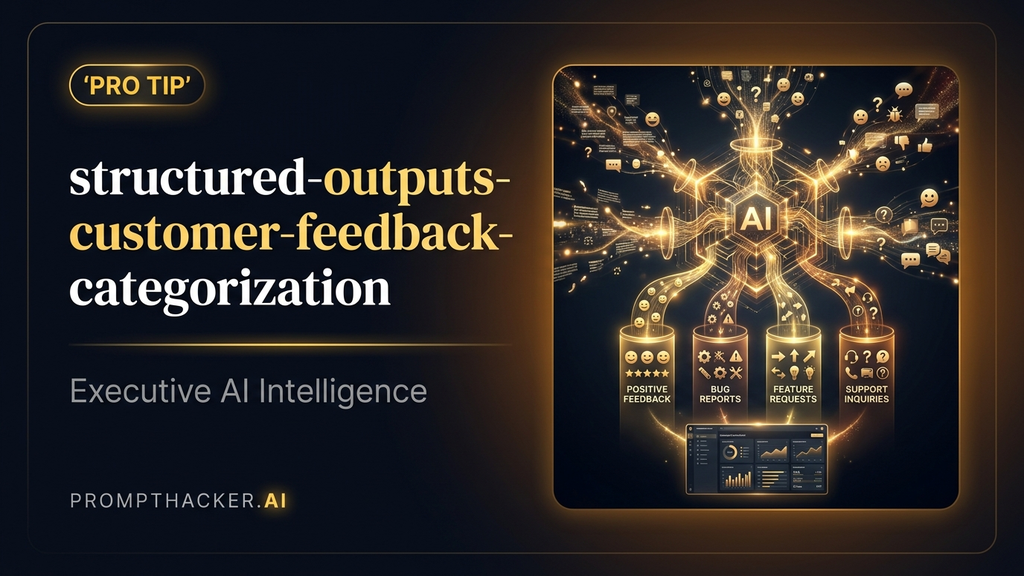
What matters today
How to handle ambiguous inputs and route low-confidence classifications for human review
Article roadmap
What you will learn
-
How to design a JSON schema for customer feedback that feeds downstream systems
-
The exact prompt configuration for Structured Outputs with a feedback use case
-
How to handle ambiguous inputs and route low-confidence classifications for human review
Customer feedback categorization is one of the highest-ROI AI automation opportunities for operations and customer success executives. Every survey response, support ticket, NPS comment, and product review contains actionable signal. Most organizations process a fraction of this feedback because manual categorization does not scale.
AI categorization at scale previously had a reliability problem: the model's output format was inconsistent enough that the downstream system (CRM, dashboard, Slack alert) would break on the unpredictable cases. Teams built retry loops and parsing fallbacks that added complexity without solving the root problem.
Structured Outputs with strict:true eliminates the root problem. The schema is enforced by the model. The downstream system always receives exactly the fields it expects.
SUBSCRIBER BREAK -- Premium Content Below
The Schema
Replace enum values with your actual category names, product areas, and team names. The values must exactly match what your CRM and downstream systems expect, including capitalization.
{ "type": "object", "properties": { "category": { "type": "string", "enum": ["feature_request","bug_defect","pricing_concern", "onboarding_difficulty","praise","support_quality","other"] }, "sentiment": { "type": "string", "enum": ["positive","neutral","negative"] }, "priority": { "type": "string", "enum": ["high","medium","low"] }, "product_area": { "type": "string", "enum": ["core_product","billing","integrations", "mobile_app","customer_support","documentation","unclear"] }, "summary": {"type": "string"}, "action_required": {"type": "boolean"}, "assignee_team": { "type": "string", "enum": ["product","engineering","customer_success", "billing","leadership","no_action_needed"] } }, "required": ["category","sentiment","priority","product_area", "summary","action_required","assignee_team"], "additionalProperties": false }
The Prompt
You are a customer success analyst classifying customer feedback. Respond only with the JSON object. Do not include any text before or after the JSON. Classification guidelines: - category: Choose the PRIMARY reason. If multiple issues present, choose the most prominent. - priority: High = urgent issue or significant frustration; Medium = improvement needed; Low = minor or cosmetic. - action_required: true if any team needs to take action; false if informational or pure praise. - summary: One sentence (max 20 words) summarizing the feedback in plain language. Customer feedback: [FEEDBACK TEXT]
Implementation Options
- Zapier or Make: Use the "Custom API Call" step rather than the native OpenAI integration. Specify the endpoint, Authorization header, and full request body including the response_format object with your schema and strict:true.
- Work with a developer: Use the OpenAI Python SDK's beta.chat.completions.parse method. The executive's role is schema design. Answer five questions: what fields, what type, what allowed values, what is required, what handles ambiguity.
Handling Low-Confidence Cases
Add a confidence field to the schema with enum values ["high","medium","low"]. Add to the prompt: "confidence: High = clear, unambiguous; Medium = reasonable inference; Low = ambiguous, may need human review." Route all Low items to a human review queue before processing. This creates a practical human-in-the-loop system without reviewing every item.
ROI Calculation
For a SaaS company receiving 200 customer feedback items per week: manual categorization and CRM entry takes approximately 800 minutes (13.3 hours) per week. Automated Structured Outputs reduces that to 40 minutes of reviewing low-confidence items. At a loaded staff cost of $60/hour, weekly savings: approximately $770. API cost at GPT-4o mini pricing for 200 items: approximately $0.05/week.
The Bottom Line
Start by defining your schema: list the fields your CRM or dashboard needs and the exact enum values for each category field. Everything else follows from there. The technical work is straightforward. The business value is in identifying the right feedback stream to apply it to.
Three deep dives. Four useful moves. One email worth opening.
PromptHacker turns the AI firehose into practical next steps for work, health, family, and everything time keeps trying to steal.