Teach AI About Your City, Then Watch It Write the Travel Guide
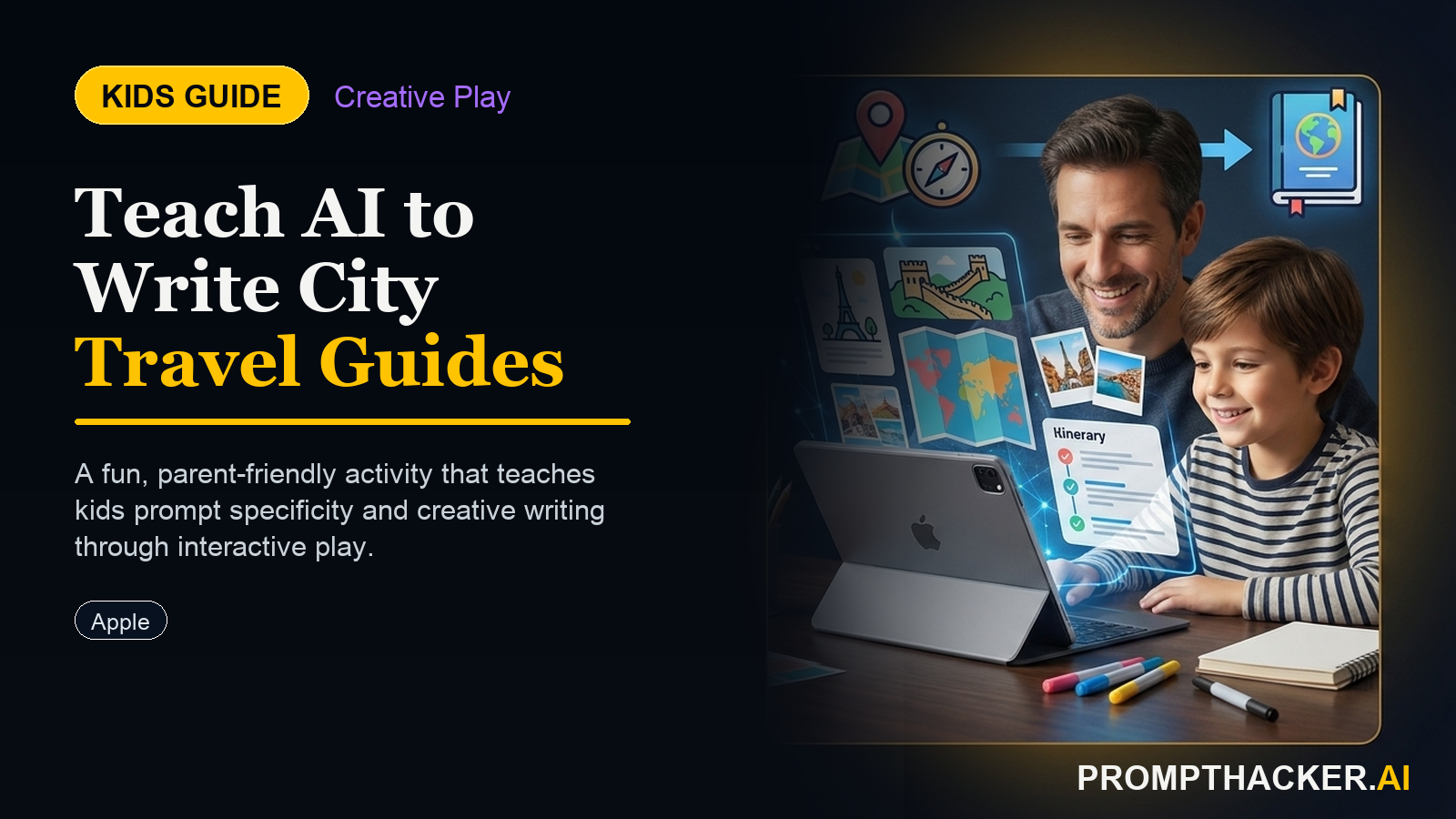
Kids create a hands-on AI project: Teach AI About Your City, Then Watch It Write the Travel Guide. A parent or educator helps them build, test, and explain what the AI tool gets right and wrong.
What matters today
Kids create a hands-on AI project: Teach AI About Your City, Then Watch It Write the Travel Guide. A parent or educator helps them build, test, and explain what the AI tool gets right and wrong.
Article roadmap
What you will learn
-
Why teaching AI something it does not know is a more powerful lesson than asking it something it does know
-
The three-session activity structure that turns local knowledge into a finished travel guide
-
Age-differentiated prompts for ages 8-10, 11-13, and 14-16 - each version teaches a different AI literacy concept
-
The fourth section trick for the 14-16 track that makes the limits of AI output visible
-
Parent and educator debrief questions that make the learning explicit and transferable
This is a PromptHacker Premium article.
The full analysis, verbatim prompts, and action framework are available to Premium subscribers.
Why This Activity Works Differently Most AI interactions place the child in the position of student - asking the AI what something is, how something works, what happened when. The AI knows more. The child receives. This activity reverses that dynamic. The child knows something the AI does not: what their neighborhood actually looks like, which coffee shop has the best hot chocolate, what the locals call a particular park, why a certain street is worth exploring and another is not. The child is the expert. The AI is the student and, eventually, the writer. That reversal is not just motivating. It teaches the foundational insight that makes AI literacy genuinely useful: AI output is shaped by what you put in. When a child tells an AI about their city and then reads the travel guide that comes back, they see the direct connection between input and output. The guide reflects what they said, not what is generically true. That connection - between instruction quality and output quality - is the core professional AI skill.
The Three-Session Structure
The activity runs in three phases that together take 40 to 60 minutes.
Session 1 - The Briefing (10 minutes)
The child teaches the AI about their city. The AI's only role is to ask follow-up questions and learn. It does not volunteer any information from its own training data.
Use this setup prompt:
I am going to teach you about my city. I will share facts, favorite places, and local knowledge. Your only job right now is to ask me follow-up questions and learn. Do not add anything from your own knowledge about this city. You only know what I tell you. Start by asking me: What city are you from, and what is one thing most tourists completely miss?
Let the conversation run naturally. The AI will ask follow-up questions. The child answers. The goal is 8 to 12 exchanges - enough to build a real picture of the city from the child's perspective.
Session 2 - The Writing (20 minutes)
Ask the AI to produce the travel guide using only what the child shared.
The age-differentiated output prompts are in the next section. Let the AI write uninterrupted. Do not intervene or correct it during this phase - the imperfections are part of what the child will evaluate.
Session 3 - The Evaluation (10 minutes)
The child reads the guide and marks:
- What the AI got right
- What it embellished or made more general
- What it missed entirely
- Anything it added that the child did not actually say
This evaluation session is where the learning becomes explicit. It is worth sitting through with the child rather than leaving it as independent reading.
Age-Differentiated Output Prompts
Ages 8-10 - Top 5 Picks
Using only what I told you about my city, write a "Top 5 Things to Do" list for kids my age visiting for the first time. Make it sound exciting, like a recommendation from a friend who lives there - not a tour guide. Keep each item to 3-4 sentences.
This version teaches: AI can organize and present information you give it. The child sees their own knowledge reflected back in a new format, which is both satisfying and illuminating.
Ages 11-13 - Two-Day Itinerary
Using only what I told you about my city, write a two-day travel itinerary for a family visiting for the first time. Day 1 should focus on exploring the main areas I mentioned. Day 2 should focus on the local experiences I described. Include timing suggestions and practical notes.
This version teaches: AI structures and sequences information according to implied logic - it infers what "morning" and "afternoon" mean without being told. The child can evaluate whether those inferences match what they actually intended.
Ages 14-16 - Full Travel Guide With the Reveal
Using only what I told you about my city, write a short travel guide with three sections: History, Food, and Practical Tips. Write as if for a travel magazine aimed at adults planning a first visit. Then add a fourth section titled "What AI Would Have Said Without Me." In this section, write what a generic AI travel guide would have included about this city using your own training data - things you knew before I told you anything.
The fourth section is the advanced lesson. When the child reads both versions side by side, they see the difference between AI working from their knowledge and AI working from its training data. The generic version will be more polished in some ways, more tourist-cliché in others, and entirely missing the specific local texture the child provided. That comparison makes abstract concepts like "AI hallucination" and "training data limits" concrete and visible.
Parent and Educator Sidebar
Conversation starters after the evaluation session:
- "Where did the AI add something you did not tell it? Why do you think it added that? Does it change how you feel about the rest of the guide?"
- "For the parts it got right - does that make you more or less confident in the parts of AI output you cannot personally verify? Why?"
- "If you were going to use AI to write something about your organization or your team's work in the future, what would you need to give it first? What would it get wrong if you did not?"
Core AI literacy concept:
The city travel guide activity makes the input-output relationship visible in a way that abstract explanation cannot. When the child reads a paragraph in the travel guide and knows exactly which thing they said produced it, they understand prompt engineering from the inside - not as a technique, but as an experience.
The fourth section of the 14-16 track is particularly powerful. Generic AI travel guides exist by the thousands. What the child produced is different because it came from genuine local knowledge. The comparison teaches that AI output is always a function of training data plus instruction - and that the instruction layer is the one the human controls. That is the professional AI insight that takes most adults years to internalize.
Action Steps
- Run this activity before the end of the school year while local knowledge is fresh - spring travel context makes it natural. The activity works any time, but a recent school trip, family day out, or neighborhood walk gives the child fresher material to work with.
- For the 8-10 track: Run the briefing session yourself first to see how the AI asks follow-up questions. It will help you guide the child through what kinds of answers are most useful to share.
- For the 14-16 track: Give the teenager time to read both sections of the final guide before the debrief. The "What AI Would Have Said Without Me" comparison is most effective when they have a few minutes to absorb both versions before discussing.
- Save the output. The travel guide the AI produces is a document based on the child's knowledge and voice - it is worth keeping. Some children will want to share it with grandparents or use it as a school writing exercise reference.
- Follow up two weeks later with the question: "Have you noticed any other times when you gave AI information and it shaped what came back?" This question connects the activity to everyday AI use in a way that reinforces the transfer of the skill.
Three deep dives. Four useful moves. One email worth opening.
PromptHacker turns the AI firehose into practical next steps for work, health, family, and everything time keeps trying to steal.