Zoom AI: Boost Sales Efficiency with New Features
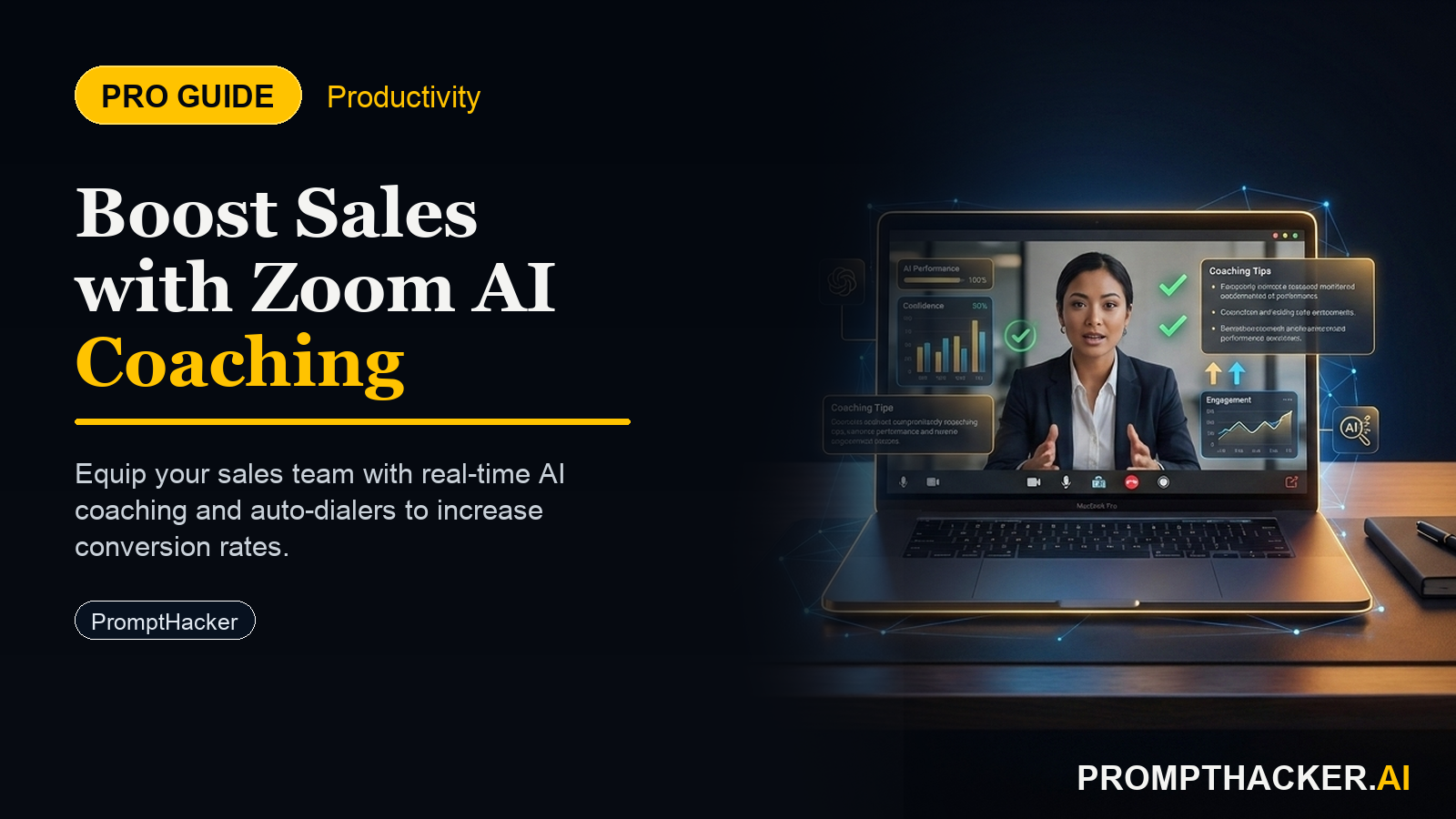
Equip your sales team with AI auto-dialers and real-time coaching to improve conversion rates and reduce new hire ramp-up time.
What matters today
Equip your sales team with AI auto-dialers and real-time coaching to improve conversion rates and reduce new hire ramp-up time.
Key points
- AI Auto-Dialers: Streamlining Outbound Sales Efforts
- Real-Time AI Coaching for Objection Handling
- Implementing Zoom's AI Sales Enablement Features
- Edge Cases and Potential Pitfalls
- Action Steps Summary
What you will learn in this article:
- How to integrate AI auto-dialers to increase outbound call efficiency and contact rates.
- How to deploy real-time AI coaching to improve sales team objection handling and script adherence.
- How to reduce the ramp-up time for new sales hires using AI-driven support.
- How to measure the impact of AI sales enablement features on conversion rates and revenue velocity.
- How to navigate implementation challenges and ensure ethical AI use in sales operations.
A Head of Sales at a mid-sized SaaS company faces a common challenge: scaling the sales team while maintaining high conversion rates and minimizing the ramp-up period for new hires. The market demands aggressive growth, but hiring and training new sales representatives is costly and time-consuming. Existing team members often struggle with consistent objection handling or keeping pace with evolving product narratives, leading to missed opportunities and inconsistent performance across the team.
The stakes are significant. Inefficient sales processes directly impact revenue targets, market share, and investor confidence. A prolonged ramp-up period for new hires means months of salary expense without proportional returns. Without effective coaching, sales teams may fall behind competitors who are adopting advanced tools to refine their outreach and engagement strategies. This gap can lead to a measurable slowdown in revenue velocity, impacting the company's ability to fund further innovation and expansion.
This article details how Zoom's new AI sales enablement features address these exact challenges. Discover how AI auto-dialers streamline outbound efforts and how real-time AI coaching refines sales interactions, leading to a projected 15% increase in revenue velocity. Learn the practical steps to implement these capabilities, reduce new hire onboarding time, and equip your sales force with intelligent support designed to improve conversion rates immediately.
Zoom has introduced a suite of AI-powered sales enablement features designed to enhance team productivity and improve key sales metrics. These updates focus on two critical areas: automating outbound calling processes with AI auto-dialers and providing instantaneous support to sales representatives through real-time AI coaching for objection handling. For executives leading sales organizations, these tools represent a strategic opportunity to optimize operational efficiency and drive measurable growth.
AI Auto-Dialers: Streamlining Outbound Sales Efforts
The first major enhancement is the integration of AI auto-dialers directly within the Zoom ecosystem. This feature automates the process of making outbound calls, allowing sales teams to connect with more prospects in less time. Traditional manual dialing is a bottleneck for many sales organizations, consuming valuable time that could be spent on actual conversations.
- How AI Auto-Dialers Function: These systems use AI to manage call queues, dial numbers sequentially, detect voicemails, and filter out non-connects. The AI can identify when a human answers the phone and then seamlessly connect the call to an available sales representative. This automation reduces dead air and maximizes the time representatives spend speaking with qualified leads.
- Impact on Efficiency: By eliminating manual dialing, sales teams can increase their daily call volume significantly. This directly translates to higher contact rates, as more attempts are made in the same timeframe. For a sales team making 100 calls per day manually, an AI auto-dialer could enable 200-300 calls, leading to a proportional increase in conversations.
- Data-Driven Prioritization: Advanced AI auto-dialers can also integrate with CRM data to prioritize calls based on lead score, previous engagement, or other relevant metrics. This ensures that sales representatives are always connecting with the most promising prospects first, optimizing their efforts for conversion.
- Compliance and Ethical Considerations: When implementing AI auto-dialers, executives must ensure strict adherence to telemarketing regulations, including Do Not Call lists and consent requirements. The AI system should be configured to respect these rules, and regular audits are necessary to maintain compliance. Training for sales representatives must cover the ethical use of automated dialing, emphasizing transparency and customer experience.
Real-Time AI Coaching for Objection Handling
The second, and arguably more impactful, feature is real-time AI coaching. This capability provides sales representatives with immediate, context-aware guidance during live sales calls, specifically targeting objection handling. New hires often struggle with unexpected objections, while even seasoned professionals can benefit from reinforcement on complex product features or competitive differentiators.
- Mechanism of Real-Time Coaching: During a live call, the AI listens to the conversation in real time. When a prospect raises an objection or asks a challenging question, the AI instantly analyzes the dialogue. Based on pre-programmed scripts, product knowledge bases, and best practices, the AI generates relevant responses, talking points, or data points directly on the sales representative's screen.
- Improving Conversion Rates: Sales calls often hinge on how effectively objections are handled. A poorly addressed objection can derail a potential sale. With real-time AI coaching, representatives receive immediate support, ensuring they deliver consistent, accurate, and persuasive responses. This consistency across the team directly contributes to higher conversion rates by reducing instances of fumbled answers or missed opportunities. The executive angle suggests a 15% increase in revenue velocity, which is a direct outcome of improved conversion rates.
- Reducing New Hire Ramp-Up Time: One of the most significant costs in sales is the time it takes for a new hire to become fully productive. Traditional training involves extensive role-playing and shadowing. AI coaching provides a safety net for new representatives, giving them the confidence and immediate knowledge needed to navigate live calls effectively from day one. This significantly shortens the learning curve, allowing new hires to contribute to revenue much faster. A typical ramp-up time of 3-6 months can be reduced by weeks or even months.
- Standardizing Best Practices: The AI coaching system can be continuously updated with the most effective objection handling techniques and product messaging. This ensures that every sales representative, regardless of experience level, has access to the organization's collective best practices. This standardization leads to more consistent messaging and a higher quality of customer interaction across the entire sales force.
- Beyond Objection Handling: While the primary focus is objection handling, real-time AI coaching can extend to other areas. It can prompt representatives to ask specific qualifying questions, remind them of key value propositions, or even flag sentiment shifts in the prospect's tone, suggesting a change in approach.
Implementing Zoom's AI Sales Enablement Features
Successful integration of these AI tools requires a structured approach, moving beyond simply activating the features. Executives must plan for training, data integration, and continuous optimization.
- Assess Current Sales Workflow: Before implementation, document the existing sales process. Identify specific bottlenecks in outbound calling and common challenges in handling objections. This baseline assessment helps quantify the potential impact of the new AI features and provides metrics for measuring success.
- Pilot Program with a Small Team: Do not deploy company-wide immediately. Select a small, representative sales team for a pilot program. This allows for testing the AI auto-dialers and real-time coaching in a controlled environment, gathering feedback, and identifying any unforeseen issues or necessary adjustments.
- Configure AI Coaching Content: The effectiveness of real-time coaching depends on the quality of the content it provides. Work with sales leadership, product marketing, and top-performing sales representatives to develop comprehensive scripts, FAQs, objection handling frameworks, and competitive differentiators. This content must be regularly updated to reflect new products, market changes, and evolving sales strategies.
- Integrate with CRM and Data Sources: For optimal performance, the AI features should integrate with your existing CRM system. Auto-dialers can pull lead lists and update call outcomes, while real-time coaching can access prospect history and product details to provide more personalized guidance. Ensure data flow is seamless and secure.
- Train Sales Representatives: Provide thorough training on how to use the AI tools effectively. For auto-dialers, focus on managing queues and understanding the hand-off process. For real-time coaching, train representatives on how to interpret the AI's suggestions, when to accept them, and when to rely on their own judgment. Emphasize that the AI is a co-pilot, not a replacement for human skill.
- Monitor Performance and Iterate: Establish clear KPIs such as call volume, contact rate, conversion rate, and new hire ramp-up time. Continuously monitor these metrics to assess the impact of the AI features. Gather feedback from sales representatives on the utility and accuracy of the AI coaching. Use this data to refine coaching content, adjust dialing strategies, and optimize the system for maximum effect.
Edge Cases and Potential Pitfalls
While these AI tools offer significant advantages, executives must be aware of potential challenges.
- AI Accuracy and Context: No AI is perfect. The real-time coaching might occasionally offer irrelevant suggestions or miss nuances in complex conversations. Sales representatives must be empowered to override AI suggestions when appropriate, relying on their human judgment and empathy.
- Data Privacy and Security: The use of AI to analyze live conversations raises concerns about data privacy. Ensure that all data processing complies with relevant regulations (e.g., CCPA, GDPR) and that robust security measures are in place to protect sensitive customer and company information.
- Over-reliance on AI: There is a risk that sales representatives might become overly reliant on AI, potentially dulling their critical thinking and problem-solving skills. Training should emphasize the AI as an assistant, not a crutch, encouraging active listening and independent thought alongside AI guidance.
- Resistance to Change: Some sales representatives may resist adopting new AI tools, perceiving them as micromanagement or a threat to their autonomy. Effective change management, clear communication of benefits, and involving the sales team in the implementation process are crucial for successful adoption.
By proactively addressing these considerations, organizations can maximize the benefits of Zoom's AI sales enablement features, driving efficiency, improving performance, and ultimately increasing revenue velocity by the projected 15%.
Action Steps Summary
- Evaluate Current Sales Operations: Analyze existing sales workflows, identifying inefficiencies in outbound calling and common challenges in objection handling. Establish baseline metrics for call volume, contact rates, conversion rates, and new hire ramp-up times to measure future improvements.
- Pilot AI Auto-Dialers: Implement AI auto-dialers with a small, focused sales team to automate outbound call management. Monitor initial results for increased contact rates and reduced manual dialing time, ensuring compliance with telemarketing regulations and refining processes based on feedback.
- Configure Real-Time AI Coaching: Develop and integrate comprehensive objection handling scripts and product knowledge into the AI coaching system. Begin with a pilot group, providing real-time, context-aware guidance to sales representatives during live calls to improve their responses and reduce new hire ramp-up time.
- Integrate and Train: Seamlessly integrate Zoom's AI features with your CRM to ensure data consistency and enhance contextual support. Conduct thorough training for all sales representatives, focusing on effective utilization of AI tools as a co-pilot and emphasizing the importance of human judgment and ethical AI use.
- Monitor and Optimize Performance: Continuously track key performance indicators (KPIs) such as conversion rates, revenue velocity, and sales cycle length. Collect ongoing feedback from the sales team and use these insights to refine AI coaching content, adjust dialing strategies, and optimize the overall system for sustained improvement and a 15% increase in revenue velocity.
Three deep dives. Four useful moves. One email worth opening.
PromptHacker turns the AI firehose into practical next steps for work, health, family, and everything time keeps trying to steal.